


Equipment Transport for Heavy Machinery
- Flat Out Services
- Jun 19
- 6 min read

A 90,000-pound excavator does not care what the schedule says. If the machine is too wide for a standard lane, too tall for a bad overpass choice, or too heavy for the wrong trailer setup, the move slows down fast. That is what separates routine trucking from real equipment transport. When the load is a dozer, wheel loader, crusher component, or crane section, the work starts long before the truck rolls.
For contractors, mining operations, and equipment managers, the cost of a bad move is usually bigger than freight. A delayed delivery can idle crews, miss a shutdown window, push paving work, or leave a machine sitting at the yard while the job burns time. Good equipment transport is not just about finding a truck. It is about matching the machine to the right trailer, building a legal route, and getting it loaded and delivered without creating new problems at either end.
What equipment transport actually involves
In heavy haul work, equipment transport means moving machines that often exceed standard legal dimensions or weights. That can be a 336 excavator moving between Phoenix and Kingman, a scraper headed to a highway project in Nevada, or a wheel loader coming out of a mine in Northern Arizona. Each move has different axle weight requirements, securement points, loading angles, and route restrictions.
The machine itself drives most of the plan. A tall excavator with the boom positioned wrong can create a height issue even if the weight is manageable. A long paving machine may fit on paper but still need a specific deck length and careful loading to balance axle groups. A crawler crane component might not look oversized until counterweights, boom sections, or attachments are added to the move.
That is why experienced carriers look at more than a model number. They want actual operating weight, transport dimensions, whether buckets or blades stay attached, the pickup surface, jobsite access, and whether loading requires ramps, a detach, or a tilt deck.
Matching the trailer to the machine
The trailer choice is where many equipment moves are won or lost. There is no single best setup for every machine.
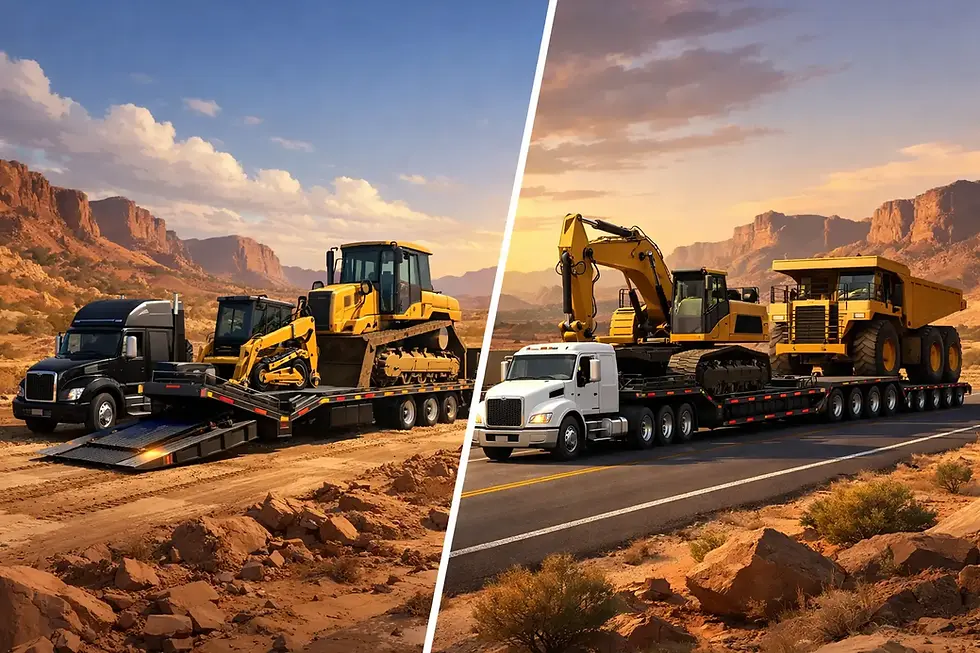
A standard lowboy works well for a lot of construction equipment because it keeps deck height down and handles substantial weight. For legal-height concerns on taller machines, that lower deck matters. If you are moving excavators, dozers, or loaders across Arizona corridors where overpass clearance and permit routing matter, a lowboy is often the practical starting point.
An RGN is usually the right answer when the machine needs to be driven on from the front or when loading angles make rear ramps a poor choice. Large excavators, scrapers, and certain tracked units load more safely on a detachable neck. It also helps when ground conditions are uneven and you need a controlled load-on process instead of forcing a machine up steep ramps.
A Landoll tilt deck has its own place. It is useful for certain machines, attachment combinations, or jobsite conditions where a tilt load makes more sense than a detach. Dealers and contractors often use this setup for equipment that is awkward to load but does not require a full multi-axle heavy haul configuration.
Then there are the loads that need real axle capacity. Bigger mining units, heavy crane components, or industrial equipment may require multi-axle configurations up to 9 axles to stay legal on bridge formulas and state weight rules. At that point, the trailer is only part of the answer. You are also planning permits, axle spacing, route restrictions, and often time-of-day movement limits.
Why permits and routing are part of the haul
A lot of equipment transport problems come from treating permits like paperwork instead of operations. In the Southwest, the route matters as much as the trailer.
Arizona, Nevada, and Southern California all bring different oversize and overweight rules. Width, height, gross weight, axle spacing, and commodity type can change what permits are needed and when the load can move. Some routes are simple on the map but not in reality. Tight interchanges, construction zones, older bridges, utility conflicts, and municipal restrictions can force a different plan.
A move from Las Vegas to Phoenix might sound straightforward because the corridor is common, but that does not mean every oversized machine can run the same way. Width can trigger escorts. Height can change the route entirely. Weight may require a different axle setup or state review. If the machine is leaving a mine site or an active project, the first ten miles can be harder than the interstate portion.
This is where direct asset-based carriers have an advantage. The people quoting the move understand what their trailers can actually do, how they load, and what the route will demand. There is less guessing and less back-and-forth when the same operation handling permits and planning is also putting the truck on the road.
Equipment-specific issues that affect the move
No two machines behave the same in transport, even when they weigh about the same.
Excavators are a good example. Boom placement, stick position, bucket removal, and track width all affect legal dimensions and securement. Some units are simple lowboy loads. Others need the bucket pulled, the arm tucked precisely, and the machine positioned by inches to control height and axle weights.
Dozers create a different set of issues. Blade width can push the load into escort territory, and track machines concentrate weight in ways that matter during loading and tie-down. Scrapers add length and weight distribution concerns. Wheel loaders are often easier to load but can become height-sensitive fast depending on tire size and cab configuration.
Paving equipment can be deceptively difficult. A machine may not be exceptionally heavy, but conveyor sections, screed components, or transport extensions can change how it fits and where it can be secured. Crane work is its own category altogether because the transport plan often involves multiple pieces, separate permit sets, and exact sequencing at pickup and delivery.
Industrial equipment adds another layer. It may not be self-propelled, lifting points may be limited, and weight can be uneven. In those cases, the haul is tied directly to crane scheduling, rigging plans, and delivery windows.
Jobsite reality matters more than the rate sheet
A clean yard pickup is one thing. A soft dirt jobsite after rain, a mine access road, or a paving spread on a live project is something else.
Good equipment transport planning includes the conditions around the machine, not just the machine itself. Can the truck get in and turn around. Is there enough room to detach an RGN safely. Will the machine have to be loaded from the shoulder. Is the pickup area level enough for a low-clearance trailer. These details affect whether the move goes quickly or turns into an expensive delay.
Timing matters too. Contractors often need equipment moved around crew schedules, lane closures, or pour sequences. A transporter that misses a narrow delivery window can cause more disruption than a transporter that costs slightly more but shows up prepared.
That is one reason many Southwest contractors prefer working with operations that understand the region and run their own equipment. On heavily used corridors like I-40, US-93, I-17, and I-10, experience helps. So does knowing which routes are realistic for oversize loads and which ones look fine until you factor in clearance, traffic control, or permit limitations.
What to have ready before you schedule equipment transport
If you want a fast quote and fewer surprises, accurate machine information matters. Transport dimensions should reflect the machine in haul configuration, not just the brochure. Operating weight should include attachments that are staying on. If parts are removed, say so. Photos help, especially when there are modifications, guarding, specialty tires, or unusual access points.
It also helps to be clear about site conditions. Mention if pickup is at a mine, auction yard, dealer lot, remote project, or active construction site. Note whether the machine runs, whether loading assistance is available, and whether there are deadline constraints tied to shutdowns, paving windows, or crane assembly.
The more precise the information, the better the transport plan. That is especially true for oversized loads where the difference between legal and permit-required can come down to inches or a small attachment left in place.
Where experience shows up
The best equipment transport work is usually quiet. The trailer is right, the permit is right, the route is right, and the machine shows up where it is supposed to be. That only looks simple from the outside.
In real heavy haul operations, experience shows up in small decisions - when to use a Landoll instead of forcing a lowboy, when to strip an attachment to save a permit complication, when a 9-axle setup is necessary, or when a route through a familiar corridor is still the wrong choice for that specific machine. Flat Out Services works in that kind of environment every day across Arizona, Nevada, and surrounding Southwest markets, where oversize loads, rough jobsites, and tight schedules are normal, not exceptions.
If you are planning a move, think past the truck. Start with the machine, the route, the site conditions, and the legal path to get it delivered without losing a day you cannot afford to lose.


Comments