


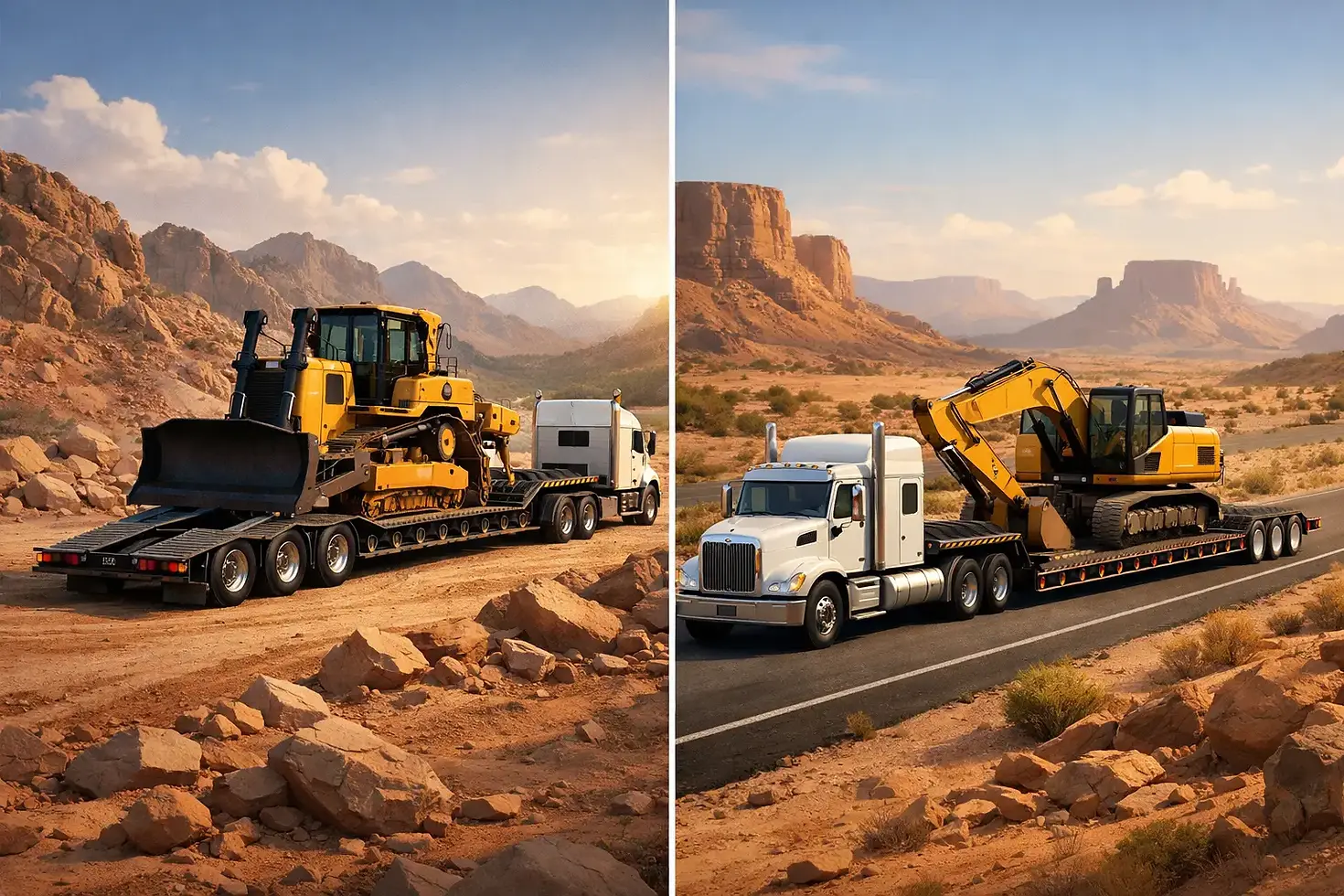
RGN Trailer vs Step Deck: Which Fits Your Load?

A Cat 336 excavator may look like a straightforward move until its boom height, operating weight, and loading location are put on paper. That is where the RGN trailer vs step deck decision stops being a pricing question and becomes an execution question. The wrong trailer can create a height problem, add avoidable permit restrictions, delay loading, or leave a machine sitting at a jobsite because it cannot safely get on the deck.
For contractors moving equipment across Arizona, Nevada, and Southern California, the best choice depends on the machine's transport dimensions, not its nameplate alone. Experienced heavy haul planning starts with the machine in its actual hauling configuration: attachments removed or installed, boom position, cab height, track width, fuel level, and any counterweight or components moving separately.
RGN Trailer vs Step Deck: The Practical Difference
A step deck has an upper deck over the tractor's fifth wheel and a lower main deck behind it. Its lower deck is substantially lower than a standard flatbed, commonly around 36 to 42 inches from the ground depending on the trailer. It is a useful platform for equipment and freight that need more height clearance than a flatbed allows but do not require a very low well.
An RGN, or removable gooseneck trailer, detaches at the front so equipment can be driven onto the trailer's well from ground level. Its deck is much lower, commonly in the 18- to 24-inch range. The well can also be configured with additional axles and specialized components for heavier machinery.
That difference in deck height is often the deciding factor. A step deck may work well for a smaller wheel loader, a compact excavator, or a long but relatively light machine. An RGN is usually the more practical choice for tracked excavators, dozers, scrapers, larger loaders, cranes, and equipment that is tall, heavy, or difficult to load over ramps.
Neither trailer is automatically "better." A step deck can be the more efficient and economical legal move when the machine fits it. An RGN earns its place when clearance, loading method, axle requirements, or stability make the step deck a poor operational fit.
Height Is Usually the First Filter
Customers often focus on trailer capacity first. Height should be checked first because it can change the entire permit and routing plan.
A machine sitting on a step deck starts roughly a foot and a half to two feet higher than it would on an RGN. That may not matter for a low-profile machine. It matters immediately for an excavator with a tall cab and boom, a dozer with a canopy or GPS mast, or a paving component that cannot be disassembled easily.
In much of the Southwest, the typical legal maximum height is 13 feet 6 inches. A legal-height load is generally easier to route, permit, schedule, and move through active construction corridors. Once a load exceeds that height, the carrier must assess overhead signs, utility crossings, traffic signals, bridge structures, and local restrictions. A few inches can turn a simple Phoenix-to-Kingman move into a route-specific oversize plan.
An RGN does not make every tall machine legal. It does, however, provide the lowest practical starting point. That can be the difference between hauling an excavator with the boom correctly positioned in the well and needing to remove components, use a different route, or obtain additional approvals.
Machine dimensions should be measured in transport position, not guessed from a sales brochure. An excavator's boom must be lowered and secured in the planned position. Removable buckets, stick extensions, antennae, exhaust stacks, and GPS equipment all deserve a look before a truck is dispatched.
Weight Is More Than the Trailer Rating
A common misconception is that a heavier trailer always solves a heavier load. Legal hauling capacity comes from the complete axle configuration, axle spacing, tire ratings, bridge law, state permit limits, and the route being used. It is not just the number printed on the trailer.
A standard step deck may be appropriate for lighter equipment within legal axle weights. A larger RGN can be paired with a jeep, booster, or additional axle groups when the machine requires a multi-axle configuration. This is where equipment weight, loaded axle weights, and state-specific permit rules have to be reviewed together.
For example, a 70,000-pound excavator may physically fit on more than one trailer type. But if the move needs additional axles to distribute the load legally, an RGN configuration is often the better platform. The trailer well places the machine low and helps manage center of gravity, while the axle setup addresses weight distribution.
That does not mean every heavy machine needs a 9-axle combination. Adding axles can mean a longer overall unit, more routing constraints, more time to set up, and more complex loading. The objective is to use enough trailer and enough axle capacity to move legally and safely without building an unnecessarily complicated configuration.
Loading Method Changes the Answer
The detachable neck is one of the RGN's biggest advantages for tracked equipment. Once the neck is removed, an excavator or dozer can drive directly onto the trailer well. There is no need to climb long ramps at a steep angle, and there is less risk of hanging up low ground clearance or damaging ramps.
This matters at rough jobsites. A clean, level yard with adequate room may support ramp loading on a step deck. A mining access road, uneven construction laydown area, or tight urban project may not. The truck needs enough firm, level space to detach the neck, load the machine, reconnect, and secure it without interfering with site traffic or creating a recovery problem.
Step decks can still be the right loading solution when equipment has suitable ramps, the site has room, and the machine is light enough and low enough for the deck. They can also be useful for items that are loaded by crane or forklift, such as long structural components, attachments, industrial skids, or equipment that cannot be driven.
The loading plan should include the machine's approach angle, the condition of the ground, ramp capacity, and the order of any attachments. One mistake contractors make is sending a machine with the bucket or blade attached, then finding it changes the loading angle or exceeds the planned transport height. In some cases, removing the attachment is faster and safer than forcing the entire machine onto the wrong trailer.
Route and Permit Strategy Cannot Be Added Later
Trailer selection and route planning happen together. A legal-height, legal-width step deck load may have a more direct route than an RGN load requiring oversize permits. But when the step deck makes the machine too tall, the RGN's lower deck may actually produce the simpler trip.
Width and length matter as well. A wide dozer, an excavator with a wide track stance, or a long machine with attachments can require permits, escorts, restricted travel periods, or route reviews regardless of trailer type. Interstate 10, Interstate 17, US-93, and Interstate 40 each have their own practical considerations once the load grows beyond standard dimensions. The final-mile route is often more limiting than the highway portion.
A good move plan checks bridge restrictions, overhead clearances, construction zones, city access, and the receiving site's unloading area before permits are submitted. Permits are not a formality that gets handled after a truck is assigned. They are tied to the actual dimensions and axle arrangement of the loaded configuration.
At Flat Out Services, that planning is why a trailer recommendation starts with complete machine information, pickup and delivery conditions, and the required delivery window. A photo helps, but accurate transport dimensions and machine weight are what allow the dispatch team to select equipment that will work on the road and at both ends of the move.
When a Step Deck Is the Better Choice
A step deck is often the practical option when the load is within its capacity, can be loaded safely by ramps or lifting equipment, and remains legal height on the lower deck. It can be particularly effective for compact and mid-sized equipment, lower-profile machinery, attachments, and long items that do not need an RGN well.
It may also reduce complexity when a move does not require a detachable neck, multi-axle setup, or special loading procedure. For a contractor with a machine that is ready to load at a paved yard and deliver to another accessible yard, that simplicity can matter.
The key is not to treat a step deck as a lower-cost substitute for an RGN without checking the numbers. If it creates a high load, a difficult ramp angle, or marginal axle weights, any apparent savings disappear quickly.
When an RGN Is Worth the Extra Planning
An RGN is generally the better answer for tall or heavy machinery, tracked equipment, low-clearance machines, and jobs where direct ground loading is safer than ramp loading. It is also the stronger choice when an axle configuration must be built around a high-weight machine.
For excavators, dozers, large wheel loaders, scrapers, crane components, and mining equipment, the low deck improves both transport height and loading control. The detachable neck adds setup time and requires more room, but that is usually a reasonable trade when it avoids a height issue or reduces loading risk.
Before requesting a quote, send the machine make and model, operating weight, overall transport height, width, length, attachments, pickup conditions, delivery conditions, and required date. Those details let a heavy haul carrier choose the trailer based on the move that actually has to happen, not the one that looks easiest from the equipment list.


Comments