


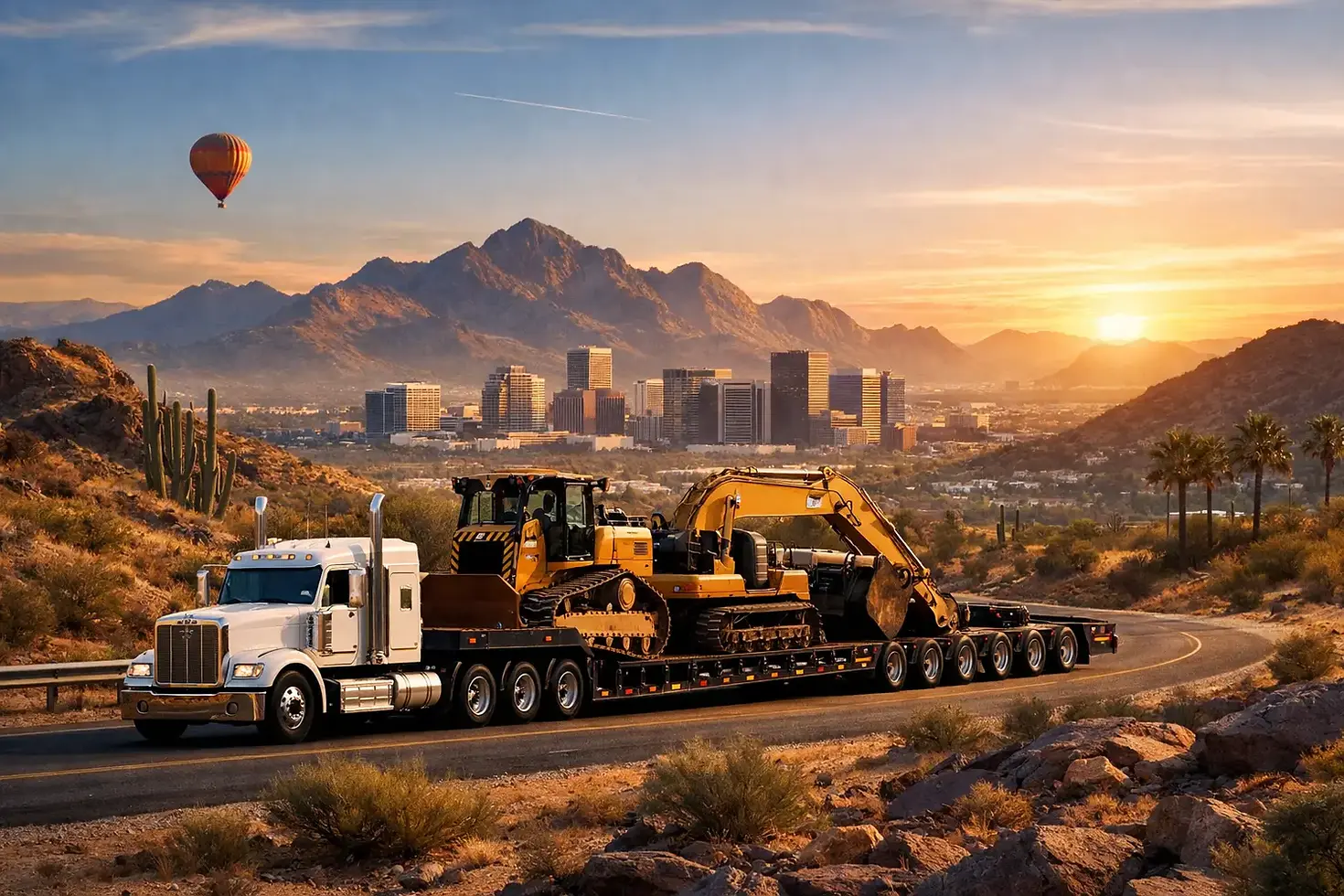
Ritchie Bros Equipment Hauling Phoenix Planning
- Flat Out Services
- 3 days ago
- 6 min read

A Ritchie Bros purchase can look straightforward until the machine has to leave the Phoenix yard. The winning bid is only one part of the cost and schedule. Ritchie Bros equipment hauling Phoenix moves often involve machines that have been sitting, attachments stored separately, unknown transport dimensions, and pickup windows that do not wait for a contractor to sort out the details.
For a wheel loader or a mid-size excavator, the question is not simply, “Can a truck haul it?” The useful question is, “What trailer, axle count, route, and loading plan will get it to the next job without creating a permit issue, equipment damage, or a missed delivery?” That is how an experienced heavy haul operation approaches auction equipment.
Start the haul plan before the auction closes
One mistake contractors make is treating transportation as an afterthought. They see a machine at auction, estimate a basic freight rate, and assume it can leave the next day. That assumption can become expensive when the unit is oversize, disabled, missing a key attachment, or needs to move during a restricted travel period.
Before bidding, confirm the machine’s make, model, serial-number configuration, operating weight, overall width, height, and length. Published specifications are a starting point, not a transport plan. A Caterpillar 336 excavator, for example, can have different transport dimensions based on boom position, stick, bucket, counterweight, track pads, and whether the boom must be removed or secured in a particular position. A machine listed at a manageable operating weight may still need a more capable trailer setup because of concentrated axle loads or deck height.
Ask whether the equipment runs, steers, and brakes. Auction listings may identify condition, but the transport crew needs practical loading information. A non-running dozer or loader changes the plan from a drive-on load to a winch, push, or recovery-assisted load. That affects trailer selection, loading time, yard coordination, and sometimes the pickup appointment itself.
Attachments deserve the same attention. A bucket may travel on the deck, in a separate position, or on another trailer depending on total length and legal weight distribution. A blade, ripper, grapple, or hydraulic hammer can change the load from a standard lowboy move into an oversize or multi-piece shipment.
Match the trailer to the machine, not the lowest quote
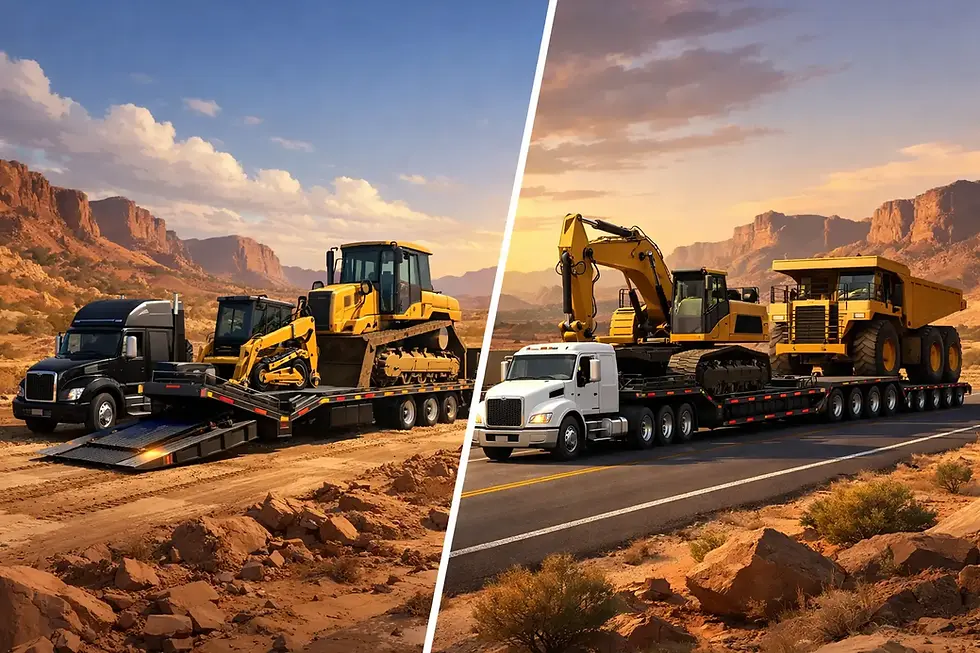
A basic lowboy is often the right answer for equipment that can drive onto the deck and fit within legal height and weight limits. It is efficient for many excavators, loaders, and smaller dozers. But “lowboy” is a broad term. Deck length, well depth, axle spacing, ramp capacity, and tractor-trailer configuration all affect what can be loaded legally.
An RGN is usually the better choice for larger tracked equipment, long paving machines, and machines where ground-level loading is safer than climbing ramps. The detachable front allows the equipment to drive directly onto the well. That reduces loading angle and gives more control with low-clearance equipment or heavier machines. The trade-off is that RGN equipment takes more time to detach, load, secure, and reassemble than a simple ramp load.
A Landoll tilt deck can be useful for a running machine, a smaller piece of specialized equipment, or a unit that needs a controlled winch load. It is not automatically the right tool for every auction purchase. The deck angle, capacity, and load placement must fit the machine. Trying to force a heavy, low-clearance machine onto the wrong tilt deck risks damage before the load ever reaches the highway.
For large scrapers, cranes, mining equipment, or heavy industrial components, multi-axle configurations may be required to distribute weight legally. A 9-axle combination is not used because it looks impressive. It is used when axle weights, bridge formulas, permit conditions, and route structures demand more carrying capacity and a different footprint on the road.
The lowest transportation quote can leave out the work that actually makes the move viable: permits, escorts, route research, detachable trailer requirements, separate attachment handling, or wait time at the pickup yard. A sound quote identifies the likely configuration and calls out the variables that still need confirmation.
Ritchie Bros equipment hauling in Phoenix depends on dimensions
Width gets most of the attention, but height can be the problem that changes the entire route. Phoenix-area road networks provide plenty of access, yet overpasses, overhead utility lines, construction zones, and local streets near the final jobsite still matter. A machine that clears the interstate route may not clear the entrance to a plant, mine, or active project.
Weight is equally important. A heavy excavator can be within a permitable gross weight while still requiring careful axle placement. Put the machine too far forward and tractor axles can overload. Place it too far back and trailer groups can exceed their limits or the combination can become difficult to steer through tight turns. Experienced drivers and dispatchers do not just chain down a machine where it fits. They load it where the axle weights work.
For oversized loads, the permit route should be reviewed before pickup. Arizona permits can set route conditions, travel windows, escort requirements, and restrictions that differ by dimensions and jurisdiction. A move from Phoenix to Kingman or Las Vegas may look simple on a map, but active roadwork, route-specific restrictions, and timing requirements can alter the plan. The same is true for moves from Phoenix toward Southern California, where the load may cross several agency jurisdictions.
Permit lead time also matters. Some routine oversize moves can be planned quickly. Others need more review, particularly when the load is unusually heavy, tall, wide, or routed through municipal areas. Waiting until the auction release deadline to start that process limits options.
Pickup day is a jobsite operation
Auction yards are controlled environments, not open equipment yards where a driver can arrive and improvise. Release paperwork, lot location, pickup appointments, safety rules, and staging space all affect how efficiently the load comes out.
The machine should be inspected before loading for loose panels, leaking hoses, damaged tracks or tires, low batteries, and anything that could make loading unsafe. If it is running, the operator needs to verify steering, brakes, and travel functions before the machine is committed to the trailer. If it is not running, the hauler needs enough notice to bring the proper winching capability and plan for the additional time.
Equipment preparation also protects the delivery schedule. Secure doors, remove or lower antennas where appropriate, pin articulated sections, lock swing mechanisms when applicable, and secure loose attachments. Excavator booms and sticks need to be positioned for both legal dimensions and stable securement. The goal is not just to make the load fit. It is to prevent movement, hydraulic drift, or contact damage over rough pavement and long Southwest corridors.
At Flat Out Services, this is why equipment details are requested before dispatch rather than after a truck is assigned. The trailer decision, permit request, and pickup sequence are connected. Missing information at any one stage usually costs time at another.
Plan delivery around the actual jobsite
The final mile often creates more trouble than the highway portion. Contractors should confirm gate width, turning room, ground conditions, overhead clearance, unloading area, and who will receive the machine. A lowboy can reach a site and still be unable to unload safely if the only available area is soft, sloped, or blocked by other equipment.
An RGN needs room to detach and a reasonably level surface for the machine to drive off. A ramp-equipped trailer needs adequate approach distance. If the jobsite is inside a congested urban project, delivery may need to happen before crews arrive or during a scheduled lane closure. On remote mining or solar sites, access roads may require a different route, daylight arrival, or a pilot vehicle even when the highway portion is uncomplicated.
Do not assume the auction machine can immediately go to work after delivery. A new purchase may need inspection, fluids, a service check, attachment installation, or owner decals before entering an active project. Scheduling transport a day before the machine is needed can be a false economy if there is no time to address a startup issue.
Treat transportation as part of the purchase decision
The right hauling plan protects the value of the equipment you bought and the schedule it was bought to support. Get dimensions and condition details early, identify attachments, confirm both yard and jobsite access, and allow enough time for permits when the load requires them.
A machine that is cheap at auction can become costly when the move is planned around assumptions. A machine that is properly evaluated before pickup is far more likely to arrive ready for the next phase of work.


Comments