


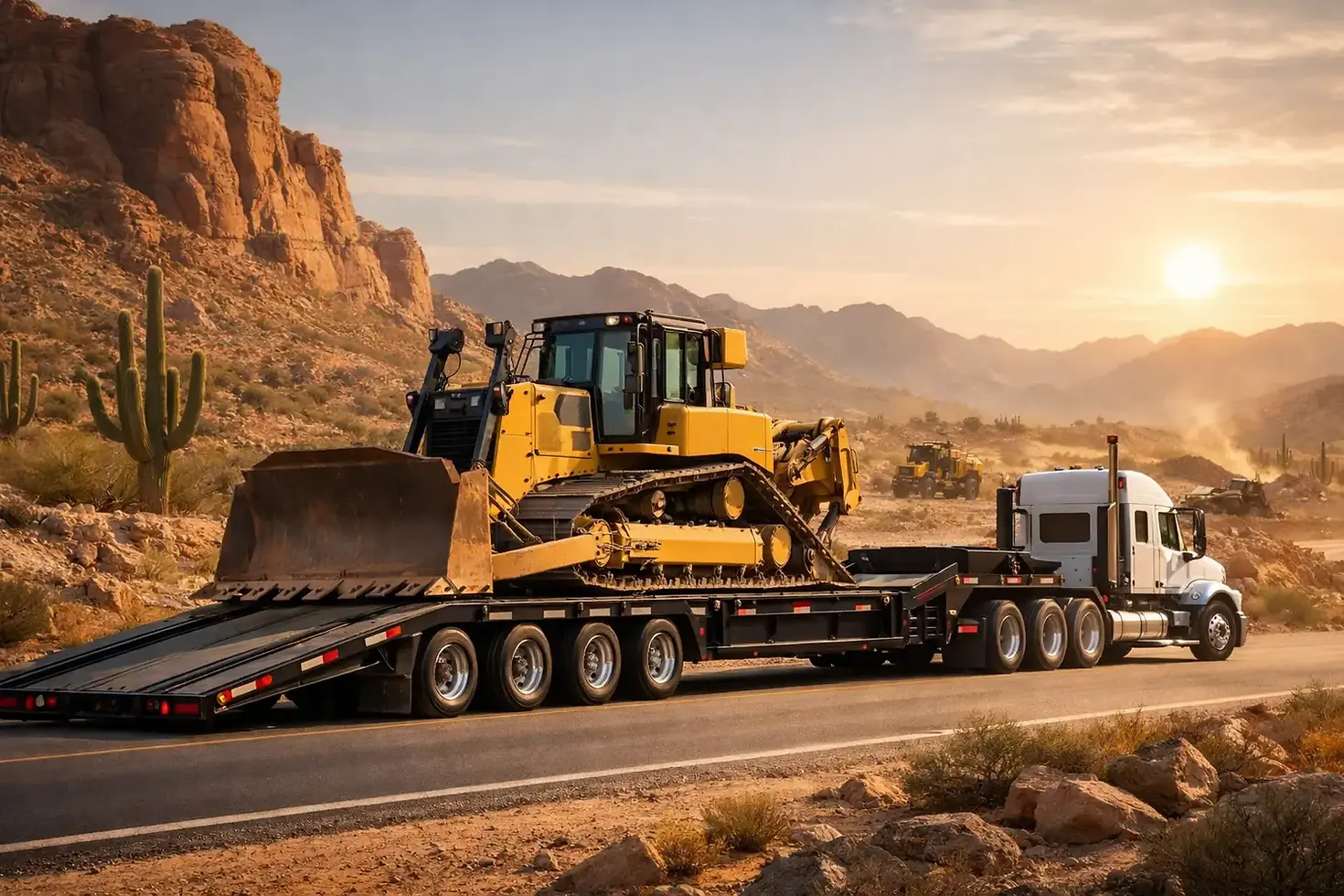
Landoll Trailer Services in Phoenix Arizona

A skid steer with dead hydraulics sitting sideways in a tight Phoenix yard is not a lowboy problem. A paver that needs to be loaded without steep deck angles is not an RGN problem. Those are exactly the kinds of moves where landoll trailer services in Phoenix Arizona make sense - especially when the machine has to be recovered, loaded fast, and delivered without turning a simple transfer into a half-day production loss.
A Landoll tilt deck fills the gap between standard equipment hauling and full heavy haul configurations. It is not the answer for every oversized move, and that matters. In Phoenix, where equipment often moves between active jobsites, rental yards, dealers, maintenance shops, and laydown yards, the right trailer choice affects load time, route options, and whether the machine gets where it needs to go without added handling.
When Landoll trailer services in Phoenix Arizona make sense
A Landoll is built for machines that can be difficult to load on fixed-deck trailers or equipment that benefits from a lower loading angle. That usually means smaller to mid-sized construction equipment, compact paving equipment, forklifts, scissor lifts, rollers, sweepers, telehandlers, and support equipment that needs easy roll-on capability. It is also useful when a unit is disabled but still recoverable by winch.
In Phoenix, that often comes up on city work, plant work, utility jobs, and contractor yard transfers where space is tight and time matters. If a machine is legal-width or only moderately oversized, a tilt deck can reduce loading complexity compared to a detached gooseneck or lowboy setup. That is especially true when the pickup point is uneven, congested, or not ideal for a long trailer and separate loading area.
The advantage is practical, not theoretical. Less loading angle means less risk of dragging attachments, belly pans, or low-clearance points. The trailer can also handle machines that are not in perfect running condition, which is common on breakdown recoveries, auction pickups, and shop transfers.
What a Landoll does better than a lowboy
A lowboy still carries the heavy side of equipment transport. If you are moving large excavators, dozers, scrapers, or cranes with significant weight and height concerns, a lowboy or RGN is usually the correct tool. But there are plenty of jobs in Phoenix where a Landoll is the more efficient choice.
The biggest difference is loading method. A Landoll tilts and creates a gradual load angle, which helps with rubber-tired equipment, lower-clearance machines, and equipment that should not be driven up aggressive ramps. For contractors moving rollers, compactors, aerial equipment, trenchers, small milling machines, or jobsite support machines, that can save time and reduce handling problems.
Another factor is access. Some Phoenix yards and urban jobsites do not give you much room to work. A Landoll can often load in places where setting up a larger lowboy combination is less practical. That does not mean it replaces specialized heavy haul equipment. It means the trailer should match the machine, the site, and the route.
Common equipment moved on Landoll trailers around Phoenix
Most calls for Landoll work are not for extreme heavy haul loads. They are for equipment that still matters to production but does not justify a larger multi-axle setup. Common examples include scissor lifts, reach lifts, forklifts, compact excavators, skid steers, sweepers, rollers, small loaders, welders, generators, compressors, and paving support equipment.
There are also situations where a contractor needs one machine moved immediately to keep a crew working. A roller going from one asphalt crew to another, a disabled telehandler leaving a site, or a forklift transfer between yards can all fit the profile. Dealers and rental providers also use tilt decks for local and regional deliveries where the load needs clean, controlled loading without overcomplicating the move.
That said, machine dimensions and actual operating weight still drive the decision. A Landoll is not a catch-all trailer. Attachment length, ground clearance, tire condition, and whether the machine is operational all affect whether the load can be handled safely and legally.
Phoenix routing, permits, and jobsite realities
Phoenix looks straightforward on a map, but equipment transport inside the metro is rarely just a mileage question. Bridge restrictions, municipal road limitations, traffic windows, overhead clearance concerns, and tight commercial access points all shape the move. Even for loads that are not extreme, planning matters.
For legal-size machines, timing and site coordination are often the bigger issue. Early deliveries, lane access, crane yard congestion, plant loading schedules, and active project staging areas can slow down what should be a simple move if nobody has the pickup and delivery conditions squared away. For oversize equipment on a Landoll, permits and route review come into play right away.
That is where local heavy haul experience matters more than generic dispatch. A trailer may be right for the machine, but the route still has to work. In the Phoenix market, that can mean avoiding problem intersections, planning around restricted delivery hours, or coordinating with escorts if dimensions require it. The same move can be simple one day and delayed the next if route conditions or site access are not checked in advance.
Landoll service is often about recovery as much as transport
A lot of people think of a Landoll as just a delivery trailer. In reality, one of its biggest strengths is recovery-style loading for disabled or partially functioning equipment. That is a common need on construction sites and industrial properties where a machine has to come out for repair but cannot be driven onto a standard trailer setup.
Winch capability and deck angle make a difference here. If a machine has axle damage, drivetrain trouble, or hydraulic failure, the loading method matters as much as the haul itself. The goal is to get it on safely without causing more damage or creating a long shutdown in the middle of the jobsite.
This is also where experience with equipment balance counts. A dead forklift, a small loader with a bucket issue, or a roller with limited mobility does not load like a normal running machine. Weight position, attachment placement, tie-down points, and deck distribution all have to be handled correctly from the start.
Choosing between a Landoll and a heavier haul configuration
If the machine is pushing higher weights, taller dimensions, or unusual axle loads, a Landoll may not be the right answer even if it can physically carry the equipment. Contractors sometimes look at the easiest loading method first, but legal transport and route compliance still decide the move.
That is why trailer selection should start with actual specs, not assumptions. Transport weight with attachments, overall width, total height, and pickup conditions all matter. A compact machine with an awkward attachment may need a different setup than expected. On the other hand, a machine that sounds like a lowboy load on paper may move more efficiently on a tilt deck if the dimensions are still within range and the site conditions favor that trailer.
For larger excavators, crawler dozers, cranes, and heavier mining or industrial equipment, the right answer usually shifts to lowboys, RGNs, or multi-axle combinations. In those cases, loading angle is not the only issue. Axle groupings, legal weight distribution, permit routing, and bridge law become the real constraints.
What commercial buyers should have ready before they call
If you need Landoll trailer services in Phoenix Arizona, the fastest way to get the move lined up correctly is to have the machine details ready. That means make and model, operating or non-operating condition, pickup and delivery locations, and whether there are attachments, forks, buckets, or other accessories changing the overall dimensions.
Pictures help, especially if the equipment is damaged, tight against other machines, or sitting in a place with limited trailer access. It also helps to know whether the site has room for loading, whether there are time restrictions, and whether someone on site can assist. Those details affect trailer choice and scheduling more than most people think.
For recurring contractors, consistency matters too. If equipment is regularly moving between Phoenix, Northern Arizona, Las Vegas, or Southern California corridors, working with an asset-based hauler that already understands regional routes and trailer fit can save a lot of back-and-forth. Flat Out Services handles that type of work directly, which matters when the move has to happen without broker layers slowing down decisions.
A Landoll is not the biggest trailer in the fleet, but on the right move it is the one that keeps the job on schedule. If the machine needs a controlled load angle, recovery-style loading, or fast transfer out of a tight Phoenix site, that trailer can solve a problem a heavier setup does not solve any better. The key is matching the equipment, the site, and the route before the truck ever rolls.


Comments