


Landoll Trailer vs Lowboy Trailer: Which Fits?
- Flat Out Services
- 11 minutes ago
- 6 min read

A Landoll trailer vs lowboy trailer decision usually gets made before the truck leaves the yard. The machine’s operating weight matters, but so do its loaded height, ground clearance, loading method, destination access, and permit route. A trailer that is easy to load can become the wrong choice if it adds height on an Arizona permit route. A lower trailer can solve the height problem but create a loading problem at a rough jobsite with no ramp space.
For contractors moving excavators, dozers, wheel loaders, paving equipment, or industrial machinery, the best trailer is not simply the biggest one available. It is the configuration that carries the machine legally, gets into both sites, and avoids unnecessary handling, permit revisions, or downtime.
Landoll Trailer vs Lowboy Trailer: The Operational Difference
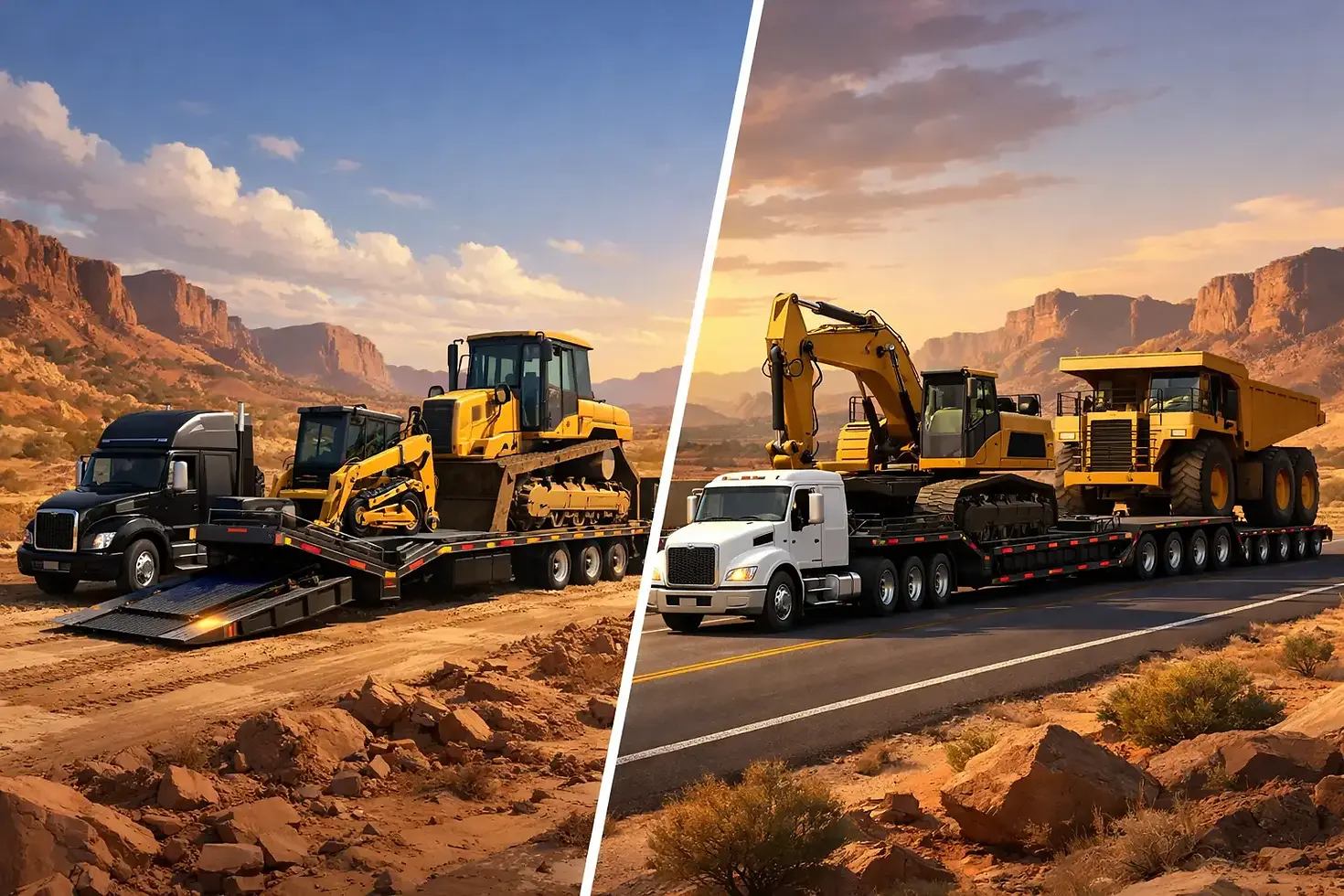
A Landoll is a hydraulic tilt-deck trailer. The deck tilts to the ground or close to it, allowing many machines to drive or winch onto the trailer without separate ramps. Its appeal is straightforward: fast loading, practical ground-level access, and fewer loading components to manage on jobsites that are tight, uneven, or constantly changing.
A lowboy uses a dropped deck between the tractor and trailer axles to place the load lower than it would sit on a flatbed or many tilt-deck trailers. That lower deck height is the reason lowboys remain the standard for taller, heavier construction equipment. A mechanical detachable gooseneck, hydraulic detachable gooseneck, or RGN configuration also lets equipment drive onto the deck from the front once the neck is detached.
The common misconception is that a Landoll is for lighter equipment and a lowboy is for heavy equipment. Weight is part of the decision, but it is not the whole decision. A properly configured Landoll can move substantial equipment. The question is whether its deck height, axle rating, and overall dimensions work for the specific machine and route. Likewise, a lowboy may be rated for the load but still be inefficient if the pickup location cannot accommodate neck removal or ramp loading.
When a Landoll Makes More Sense
A Landoll is often the practical answer for equipment that needs to be loaded quickly from grade. That includes smaller excavators, skid steers, compactors, forklifts, aerial equipment, certain wheel loaders, and attachments that are awkward to load over ramps. It can also work well for disabled equipment that must be winched rather than driven aboard.
The tilt deck matters when the origin or destination is a crowded equipment yard, a plant with limited maneuvering room, or an active site where the loading area changes by the hour. Rather than finding space to remove a detachable neck or position long ramps, the driver can set the deck and load from the rear. That can save real time, especially when a crew is waiting on a machine for the next shift.
Landolls also reduce one concern associated with ramps: breakover. A machine with low clearance can hang up at the transition between a ramp and deck. A tilt deck creates a more gradual approach, though it does not eliminate clearance concerns altogether. Long wheelbases, low-hanging counterweights, and paving equipment still need to be evaluated before loading.
The tradeoff is deck height. If a machine already stands near a route’s practical height limit, even a few additional inches can turn a straightforward move into a height-sensitive oversize load. Overpasses, utility crossings, traffic signal arms, and work-zone restrictions matter more along some Southwest corridors than the machine’s width alone suggests.
Why Lowboys Are the Better Choice for Many Heavy Moves
Lowboys earn their place when loaded height and weight distribution control the move. A 70,000-pound excavator, a large dozer, a scraper, or a crane component may need the lower deck and greater axle capacity of a multi-axle lowboy or RGN configuration. Getting the load down is not just about clearing bridges. It can determine whether the load can use a workable permit route at all.
A lower deck also improves stability by keeping the machine’s center of gravity lower. That matters on long grades, uneven access roads, and routes with frequent turns. It does not replace proper securement or sound driving, but it is a meaningful operational advantage for tall or top-heavy machinery.
With a detachable gooseneck lowboy, equipment can drive straight onto the deck from the front. For tracked excavators and dozers, that is often the cleanest loading method. The machine does not need to climb a steep rear ramp, and the operator has a more direct approach. On a prepared site, the process is efficient and controlled.
The limitation is setup space. Detaching a neck requires firm, reasonably level ground and enough room for the tractor and trailer to position safely. A jobsite entrance that looks wide enough for a truck may still be unsuitable for an RGN load-out if there is loose material, a sharp crown, overhead obstructions, parked equipment, or no room to stage the neck. Experienced dispatchers ask about those conditions before selecting the trailer, not after arriving.
Height, Weight, and Axles Must Be Planned Together
Trailer selection should start with accurate machine information: operating weight, transport width, overall height, length, axle or track dimensions, ground clearance, and attachments. Manufacturer brochure weight is not always transport weight. A bucket, blade, counterweight, ripper, hydraulic hammer, additional fuel, or material in the undercarriage can change the plan.
The trailer must then be matched to the required axle group. A machine may fit physically on a two-axle lowboy yet require additional axles to meet legal weight limits or permit conditions. This is where a heavier configuration, such as a three-axle lowboy, jeep-and-booster arrangement, or multi-axle combination, becomes necessary.
More axles are not automatically better. They add capacity, but they also add length, turning constraints, setup time, and route considerations. A nine-axle combination may be appropriate for a heavy industrial component or major mining machine, but it is not the efficient answer for every overweight excavator. The goal is legal axle loading with a configuration that can complete the route and access both sites.
Permit planning follows the actual loaded dimensions, not the trailer description. A lowboy does not guarantee an easy permit, and a Landoll does not automatically mean a standard legal move. Width, overall length, rear overhang, axle spacing, gross weight, and height all affect permits, escorts, travel windows, and approved routing.
Loading Method Can Decide the Job
The equipment’s condition changes the choice. A running excavator on firm ground may load easily onto an RGN. A dead wheel loader with brake issues or a machine missing a track may require a tilt deck, winch plan, additional recovery equipment, or a different loading location altogether.
One mistake contractors make is assuming the machine can be loaded the same way it was unloaded at the dealership or previous site. Conditions are rarely identical. A soft desert access road after monsoon weather, a steep paved entrance, or a congested urban project can change what is safe. The loading plan needs to account for machine traction, approach angle, ground bearing capacity, and space for the operator to maneuver.
Attachments deserve the same attention. An excavator may travel within height on a lowboy with the boom positioned correctly and bucket removed, but exceed height with the bucket left on or the boom carried incorrectly. A dozer blade may need to be angled, removed, or separately hauled. These are not minor details when a permit route has tight vertical clearance.
Route and Jobsite Conditions Matter in the Southwest
In Arizona, Nevada, and Southern California, route planning often involves more than interstate bridge clearance. Mining roads, remote construction access, desert shoulders, narrow city approaches, and mountain grades can all influence trailer selection. A trailer that works well from a paved Phoenix yard to a major highway may be a poor fit for a remote Northern Arizona site with limited turnarounds.
Travel restrictions can also affect scheduling. Oversize loads may face permitted travel hours, escort requirements, or restrictions through urban areas and construction zones. If the route requires a height-sensitive detour or an escort window, the loading schedule must leave enough time for inspection, securement, and equipment preparation. A rushed load-out is where preventable delays begin.
At Flat Out Services, planning typically starts with the machine and ends with the full move: pickup conditions, trailer configuration, axle weights, permit dimensions, route, delivery access, and unloading method. That sequence prevents the common mistake of quoting a trailer first and discovering the operational complications later.
The Better Question to Ask Before Booking
Instead of asking, “Do I need a Landoll or a lowboy?” ask how the machine will load, what it measures when prepared for transport, where it must travel, and what the receiving site can support. A Landoll may be the faster, cleaner answer for a grade-loaded machine with manageable height. A lowboy or RGN may be necessary when height, weight, stability, or axle capacity drives the permit plan.
The right trailer is the one that gets the equipment on site without creating a second problem at the gate, under an overpass, or on the permit route. Provide complete machine dimensions, current photos, attachment details, and honest site conditions early. That gives the hauler the information needed to make the trailer decision before it becomes an expensive field decision.


Comments