


Arizona Oversize Permit Requirements for Heavy Equipment

A machine can be ready to roll out of Phoenix at daylight and still sit all day if the permit, route, or axle configuration is wrong. That is why arizona oversize permit requirements for heavy equipment are not just paperwork - they directly affect schedule, trailer selection, escort needs, and whether the load can move legally without getting shut down.
For contractors, mining operations, and equipment managers, the main issue is not just getting a permit number. The real issue is matching the machine to the correct trailer, legal dimensions, gross weight, axle spacing, and approved route. Arizona is workable for heavy haul, but it is not forgiving if a load is misclassified or routed casually.
What Arizona oversize permit requirements for heavy equipment usually involve
In practical terms, Arizona oversize permitting starts with the actual loaded dimensions and weights, not the sales brochure dimensions of the machine. A Caterpillar excavator with the boom tucked, bucket removed, and stick repositioned may permit differently than the same machine loaded as-is from a jobsite. A wheel loader with the bucket detached can become a simpler move. A scraper, crane component, or paving spread may require a completely different axle setup than the customer first expects.
Arizona typically looks at overall width, height, length, and gross and axle weights. Once a load exceeds legal limits, it generally requires an oversize or overweight permit, and in many cases both. The details matter because a load that is only overwidth can be a straightforward move on a lowboy or RGN, while a load that is overweight on concentrated axle groups may push the job into a multi-axle configuration with route restrictions and a different permit path.
That is where real heavy haul experience matters. Anyone can say a machine is oversized. The harder part is determining whether it should move on a Landoll, a standard lowboy, an RGN, or a 9-axle combination based on how Arizona will treat the dimensions and weight distribution.
Legal dimensions are only the starting point
Many equipment owners assume width is the main issue because that is the easiest thing to see in the yard. In Arizona, width often is the first trigger, especially with excavators, dozers, and loaders. But height is just as critical on many routes. A machine that looks fine on a lowboy can become a route problem if the loaded height pushes bridge or utility clearance limits.
Weight is where jobs get complicated fast. An excavator that is manageable on a tri-axle lowboy in one configuration may need more axles once the counterweight, stick, and attachments stay on. A mining machine moving through northern Arizona is a very different permit exercise than a smaller dozer moving across town in the Valley.
Length also enters the picture with certain machines, especially crane components, paving trains, and equipment that cannot be easily broken down. Arizona may allow the move, but the route, time of travel, and escort conditions can change based on the final loaded length.
Route approval is where many heavy equipment moves are won or lost
A permit is not a blanket pass to go wherever you want. Arizona oversize permit requirements for heavy equipment are tied closely to the approved route. The state wants to know where the load is starting, where it is going, how it is configured, and whether that route can safely handle the dimensions and weights involved.
This is especially relevant on common Southwest corridors. A move from Phoenix to Kingman, or from a mine site in northern Arizona to a dealer yard, may look simple on a map. On the ground, it can involve grade changes, bridge limits, restricted structures, traffic constraints, and local access problems at either end. The state route may be legal while the last two miles into the project site are not.
For that reason, good route planning is not separate from permitting. It is part of permitting. If the machine height is close, route choice may determine whether the load runs at all. If the axle weights are heavy, a different highway segment can change whether the move stays on the permit or requires a more specialized configuration.
Escort vehicles and travel restrictions depend on the load
Not every oversize load needs escorts, and not every escort requirement is obvious from width alone. Arizona may require front or rear escort vehicles depending on the load dimensions, route, and travel conditions. Height can also trigger additional precautions if overhead clearances are tight.
Time-of-day and travel-day restrictions are another factor. Some loads can move with limited disruption, while others face restrictions around metro areas, weekends, holidays, or heavier traffic periods. Anyone planning a crane or large excavator move through the Phoenix area already knows that timing can matter as much as dimensions.
This is one reason experienced carriers ask detailed questions early. If the load needs pilot cars, restricted travel windows, or utility coordination, that should be built into the schedule from the start rather than discovered after the machine is loaded.
Trailer choice changes the permit strategy
Heavy equipment hauling is not just about finding a trailer with enough deck space. Trailer selection affects loaded height, weight distribution, turning radius, and the permit category itself.
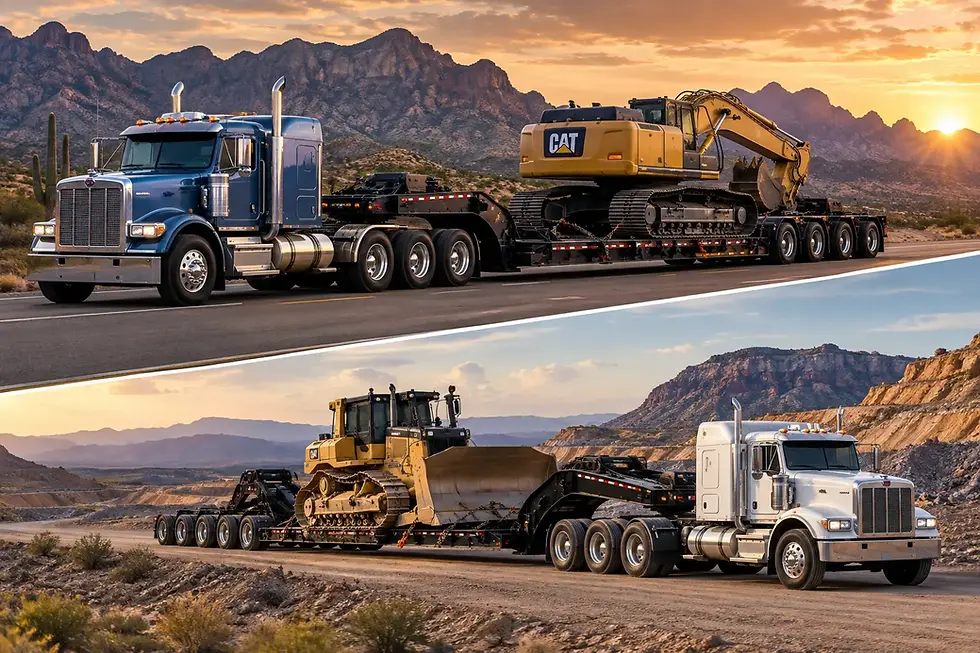
A Landoll can make sense for certain jobsite pickups, dead machines, or equipment that needs easier loading angles. A lowboy is common for many construction machines and can help control height. An RGN is often the right call for taller or heavier equipment that needs drive-on loading and better deck well positioning. Once gross weight and axle loading climb, multi-axle combinations become necessary, and that is where permit planning needs to be tied directly to the actual transport setup.
For example, a contractor may ask for a quick move on a standard lowboy because the machine fit that trailer on a previous job. But if the current route involves stricter bridge considerations or the machine is carrying additional attachments, the legal picture changes. The right answer is not whatever moved it last time. The right answer is whatever permits cleanly and runs safely this time.
Jobsite realities affect Arizona permits more than people expect
State permitting gets most of the attention, but jobsite access can be the part that causes the delay. Arizona heavy equipment moves often involve dirt sites, mine entrances, subdivision work, paving closures, or partially developed industrial areas. A legal highway route does not guarantee that the machine can be loaded or unloaded without issue.
Ground conditions, approach angle, gate width, overhead power, and available turnaround space all matter. So does whether the machine is running, partially disabled, or missing components. A dozer stuck on rough grade may call for a different loading plan than the permit office ever sees on paper.
That is why asset-based heavy haul operators tend to catch problems earlier. When the same company handling the transport also understands the trailer, the axle setup, and the field conditions, permit planning is more accurate from the start.
Common mistakes with Arizona oversize permit requirements for heavy equipment
The first mistake is using guessed weights or dimensions. Manufacturer specs are useful, but they are not always what is actually being hauled. Added guards, blades, buckets, counterweights, fuel level, and attachments can change the permit picture.
The second mistake is assuming the shortest route is the best route. In Arizona, the safer permit route may not be the shortest. It may avoid a restrictive structure, traffic issue, or local bottleneck that would create more delay than the extra miles.
The third mistake is trying to force a machine onto the wrong trailer to save time or cost. That can create height issues, axle concentration problems, or loading hazards that end up costing more in permit revisions, delays, or escort changes.
The fourth mistake is waiting too long to start the permit process. If the move is large, unusual, or headed into a constrained area, lead time matters. This is especially true for mine equipment, larger crane loads, and heavy construction iron moving on multi-axle combinations.
What experienced Arizona heavy haul planning looks like
A proper setup starts with exact dimensions, exact weight, pickup and delivery details, and a realistic understanding of whether the machine can be reduced. Sometimes removing a bucket, blade, or counterweight makes the move much simpler. Sometimes tear-down is not worth the downtime, and a heavier configuration is the better operational choice.
From there, the load should be matched to the right trailer and axle group, then routed based on actual permit conditions rather than assumptions. In the Southwest, that kind of planning matters because distances are long, weather can change route timing, and many projects are working against tight production schedules.
Flat Out Services handles these kinds of moves with that field-first approach because oversize hauling in Arizona is not theoretical. It is a matter of getting the machine moved legally, on time, and without creating avoidable problems at the scale house, on the route, or at the jobsite.
If you are planning a heavy equipment move in Arizona, the smartest first step is not asking how fast a truck can get there. It is confirming how the machine will permit in its actual loaded condition, because that answer usually determines everything that follows.


Comments