


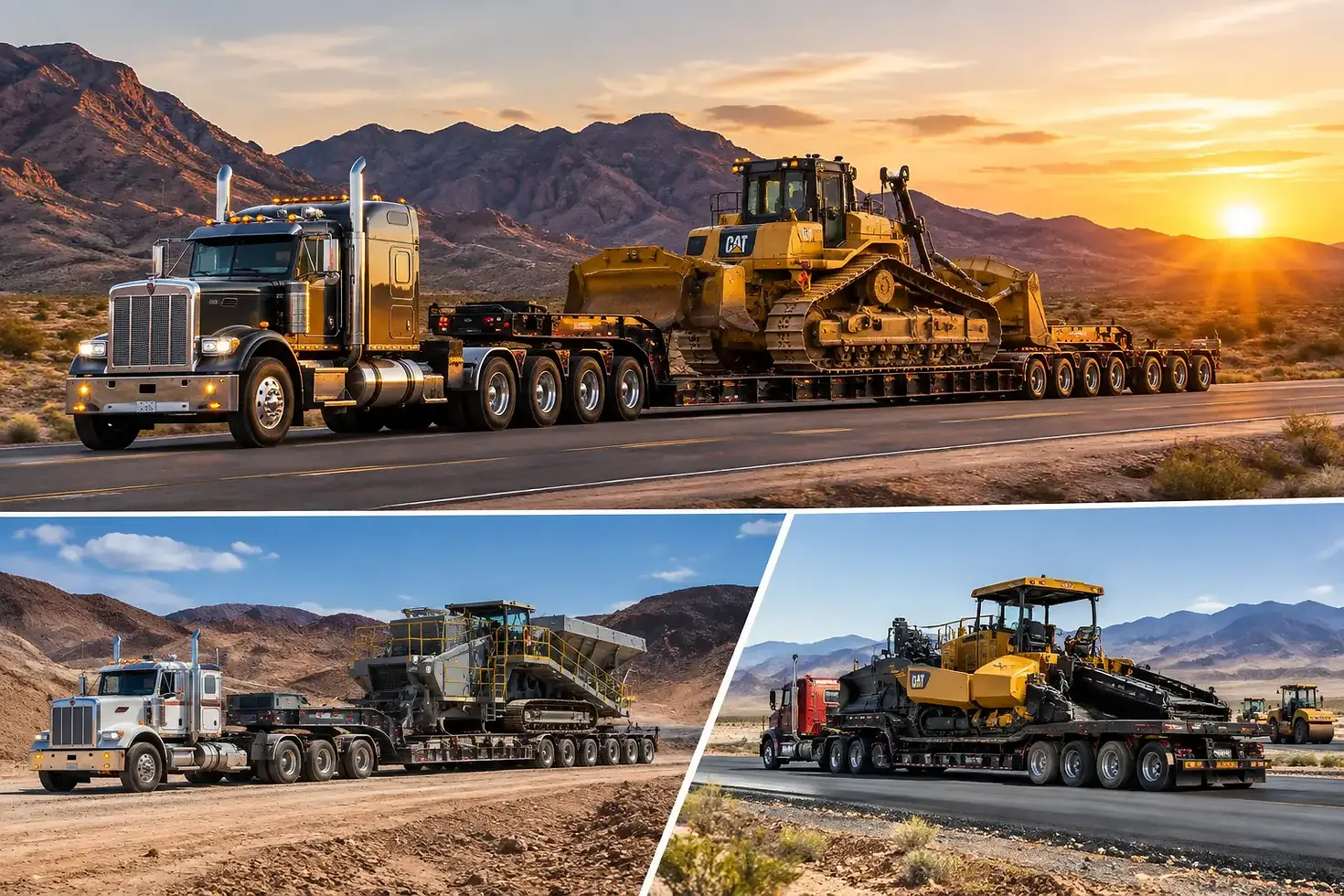
Top Oversize Haul Delay Causes to Avoid

A dozer can be loaded, tied down, and ready to move by daylight, yet still miss its delivery window by a full day. That is the reality behind the top oversize haul delay causes. Most delays are not caused by a truck breaking down on the highway. They start earlier, when a move is quoted from incomplete machine information, a permit route is treated like a normal driving route, or the receiving jobsite is not ready for a heavy haul trailer.
For contractors and equipment managers, the cost is rarely limited to the trucking invoice. A delayed excavator can hold up a crew, a crane move can affect an entire lift plan, and a paving spread that arrives after the work window may sit until the next shift. Avoiding those problems comes down to planning the move as an operation, not simply booking a truck.
Top Oversize Haul Delay Causes in the Southwest
Permit information that does not match the actual load
The most common preventable problem is inaccurate load data. A machine's brochure weight is not always its transport weight. Add a blade, counterweight, thumb, bucket, ripper, guarding, or attachment, and the dimensions and axle loading can change enough to require a different permit or trailer configuration.
A Caterpillar excavator may be legal on a standard lowboy in one setup but need a removable gooseneck (RGN), extra axles, or a wider permit envelope once the boom, stick, and counterweight configuration are confirmed. The same issue comes up with wheel loaders transported with buckets attached, cranes carrying removable components, and pavers loaded with extensions still installed.
Permits are issued for specific dimensions, weights, axle spacings, routes, and travel conditions. If the actual loaded height, width, or gross weight differs from what was permitted, the driver cannot simply proceed and sort it out later. The load may need to be remeasured, re-permitted, re-routed, or reconfigured. That can turn a planned same-day move into a multi-day delay.
The practical fix is to provide the complete machine model, serial number when available, operating weight, attachments, transport configuration, pickup and delivery addresses, and the exact dates needed. Photos from all four sides are often more useful than a broad statement such as "large excavator" or "oversize loader." They help confirm low points, tie-down locations, boom position, attachment removal needs, and clearance concerns before the truck arrives.
Route conflicts discovered after the permit is filed
A permitted route is not automatically a usable route. Arizona, Nevada, and Southern California moves can encounter low bridges, restricted interchanges, temporary construction zones, narrow ramp geometry, weight-restricted structures, utility work, and city restrictions that do not appear on a basic mapping application.
This is especially relevant on routes connecting Phoenix, Kingman, Las Vegas, and mining or construction sites outside the main corridors. The direct route may look efficient on a map, but a wide load may need a longer path to avoid a constrained bridge, tight roundabout, or overhead clearance issue. A 9-axle configuration may solve a weight-distribution problem while creating additional turning-radius and route-approval considerations.
One mistake contractors make is assuming the highway portion is the difficult part. Often, the last five miles cause the problem. A mine access road may have a narrow gate, a soft shoulder, a sharp turnout, or a bridge not rated for the proposed axle group. At an active project, new concrete barriers, stored material, parked equipment, or trenching can make an access route that worked last month unusable today.
Experienced heavy haul planners evaluate the full path: yard exit, local streets, highway route, fuel and inspection locations if needed, delivery entrance, internal haul road, and unloading area. That work should happen before permits are finalized, because the best legal route is not always the shortest one.
Trailer selection based on availability instead of the machine
A trailer that can physically carry the equipment is not necessarily the right trailer for the move. Using the wrong configuration can create loading delays, permit complications, clearance problems, or unsafe weight distribution.
A lowboy may be the efficient choice for a moderate-height excavator or dozer. An RGN can be the better answer when deck height, loading angle, weight, or drive-on access matters. A Landoll tilt deck is useful for certain equipment that needs a controlled loading approach, but it is not a substitute for a heavy multi-axle setup when the machine's weight and axle loading demand more capacity.
Customers sometimes focus only on overall weight. Height and geometry matter just as much. A tall cab, raised boom, high stack, or machine sitting on a taller deck can create a height issue even when the load is well within trailer capacity. Conversely, dropping a machine onto a lower deck may reduce the permit burden but require more careful loading and a better unloading surface.
The tradeoff is straightforward: a more specialized trailer and axle configuration may take more coordination upfront, but it can prevent a rework at the pickup point. Flat Out Services plans equipment moves around the actual machine, transport dimensions, route, and jobsite conditions rather than forcing every load onto the first available trailer.
Equipment that is not prepared for transport
Heavy equipment often arrives at pickup still configured for work. That creates delays when attachments must be removed, loose components must be secured, fluids are leaking, tracks are packed with mud, or the machine cannot be safely driven or winched onto the trailer.
A machine does not need to be showroom clean, but it does need to be transport-ready. Excess mud can affect weight and make securement inspection harder. A boom or blade that cannot be positioned properly can increase length or height. A dead battery, damaged travel motor, or non-functioning parking brake can turn a routine drive-on load into a recovery and loading problem.
Before the scheduled pickup, confirm these items with the field team:
The machine is in its agreed transport configuration, with attachments removed or identified.
Access is available to start, move, steer, and brake the equipment.
The loading area is firm, level enough for the selected trailer, and clear of obstructions.
Required keys, gate access, and a knowledgeable site contact are available at the scheduled time.
That short check prevents the familiar call where a truck is on site but cannot load because the key is locked in an office, the bucket has not been removed, or the equipment is trapped behind material stockpiles.
Escort, travel-hour, and weekend restrictions
Oversize moves are often governed by more than a permit. Depending on dimensions and route, the load may require pilot cars, restricted travel hours, daylight-only movement, or limitations on weekend and holiday travel. Some routes also require coordination with utilities or local agencies when clearance is tight.
These restrictions matter because they reduce recovery options. If loading runs late and the legal travel window closes, the driver may have to hold the load until the next approved period. A two-hour loading delay can become an overnight delay without anything mechanically wrong.
This is why early loading appointments matter for larger or more complex moves. They provide room for pre-trip inspection, securement adjustments, permit verification, and unexpected site issues before the travel window starts closing. For a wide load moving through a congested metro area, timing can be as important as distance.
Jobsite access that was never verified
Delivery delays are frequently blamed on the carrier even when the unloading area is not ready. The truck may arrive at the correct address and still be unable to enter, turn around, position for unloading, or safely deploy ramps.
RGNs and lowboys need room to work. The delivery surface needs adequate bearing capacity, especially after rain or on recently graded ground. A soft shoulder can trap a loaded trailer. A steep approach can cause a low deck to drag. A narrow site with no exit plan can require the truck to back a long distance or wait while equipment is moved.
For remote projects, ask a simple operational question before dispatch: where will the truck stop, unload, and get back out? If the answer is not clear, send current site photos or have the superintendent walk the route. This is particularly valuable at mines, solar sites, roadwork projects, and developing subdivisions where access changes quickly.
Build Time Into the Parts That Cannot Be Rushed
The fastest oversize move is usually the one that spends more time on the front end. Confirm the real transport dimensions, choose the trailer around the load and route, submit accurate permit information, prepare the machine, and verify both ends of the trip. None of that eliminates every delay - weather, road closures, and active-jobsite conditions still happen - but it removes the expensive surprises that should have been visible before dispatch.
When a machine has to be on site for a crew, a lift, or a production deadline, treat the haul plan as part of the project plan. That is where schedules are protected.


Comments