


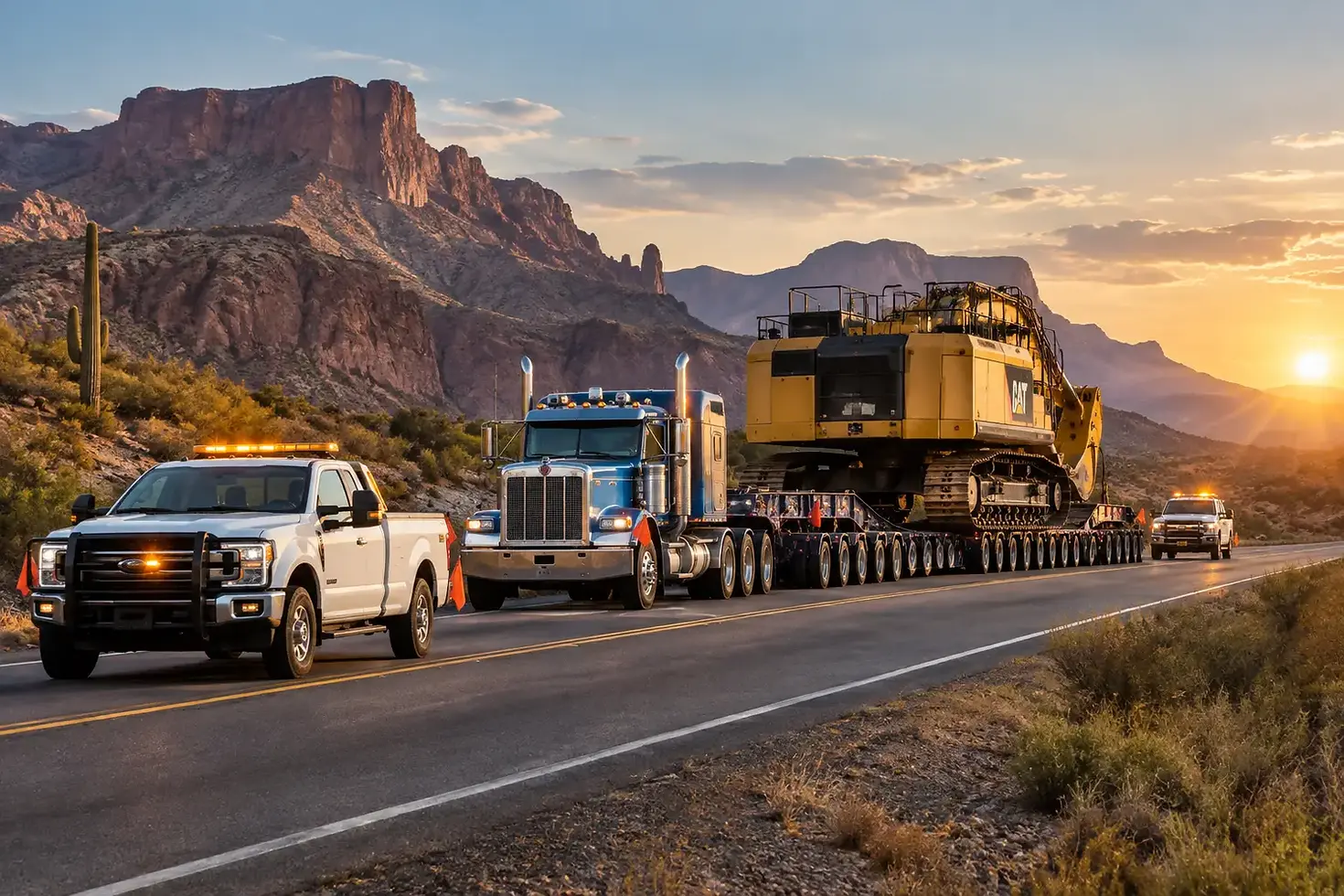
Escort Car Coordination for Oversize Loads

A loaded RGN can be legal on paper and still lose half a day at the first bad turn. That is why escort car coordination for oversize is not something to handle after the permit is approved. For a wide excavator, long paving spread, crane component, or multi-axle heavy haul combination, the pilot car plan has to match the route, permit conditions, loading sequence, and jobsite access plan from the start.
Customers sometimes see escorts as a permit requirement and little more. In practice, the right escort crew protects the move from low clearances, traffic conflicts, missed turns, work-zone surprises, and problems that are expensive to correct once the truck is committed. On Southwest routes, a few inches of width, a restricted travel window, or a tight interchange can determine whether a move runs cleanly or sits until the next approved travel period.
Escort Car Coordination for Oversize Starts With the Permit
The permit establishes the rules, but it does not guarantee the route will work in field conditions. Permit requirements can specify the number of escorts, their position ahead of or behind the load, operating hours, lighting, flags, and communication procedures. Those conditions vary by state, load dimensions, and sometimes by individual route segment.
The mistake is treating an Arizona, Nevada, or California permit as a generic approval. A move may require a front escort through a narrower urban section and different coverage once it reaches an open highway. A load that is under an escort threshold in one jurisdiction may trigger additional pilot-car requirements after crossing a state line. Wide, long, and high are separate issues, and an overweight multi-axle configuration can add route restrictions even when the load is not exceptionally wide.
Experienced planners review the permit alongside the actual loaded dimensions. That means measured width at the widest point, true loaded height after the machine is secured, overall length, axle spacing, and gross weight. A dozer with blade removed may need a different escort plan than the same machine moved with the blade installed. A crane boom section may be relatively light but create a long rear overhang that changes how intersections and ramp turns must be handled.
Route Recon Is More Than Checking a Map
A route survey is most valuable when it answers specific operational questions. Can the load make the turn from the highway ramp without crossing a fixed obstruction? Does a bridge have the vertical clearance shown on the permit? Is there enough recovery room if traffic blocks the planned turn? Can the truck safely pull over if a tire, securement, or hydraulic issue needs attention?
This matters on corridors such as I-10, I-17, I-40, and US-93, but it matters even more on the final miles. The interstate portion of a move from Phoenix to Kingman may be straightforward. The access road into a mine, solar site, paving plant, or active construction project is often where the real difficulty begins. Narrow gates, soft shoulders, overhead utilities, parked equipment, and inadequate turnaround space can turn a planned delivery into a field problem.
A good escort driver is not simply looking for hazards. They are confirming decisions before the truck reaches the point of no return. If a construction zone has shifted lane barriers since the route was planned, the lead escort needs to identify that early enough for dispatch and the driver to make a legal adjustment. Waiting until a 12-foot-wide load is at the closure leaves few good options.
High Loads Need a Different Level of Attention
Height problems are less forgiving than width problems. A wide load can sometimes use controlled lane positioning. A high load cannot negotiate with a bridge, signal arm, utility line, or low-hanging branch.
For high equipment, the pilot-car plan may include a height pole and an escort operator specifically trained to use it. That is not a formality. The pole must reflect the actual permitted height, including clearance margin required by the move plan. The escort needs to be far enough ahead to identify an issue before the load reaches it, while still maintaining reliable radio contact with the truck.
Load height also affects trailer choice. A lowboy may work for one excavator, while an RGN or a lower deck configuration is needed to bring another machine under a critical clearance. Reducing height can eliminate route restrictions and escort complications, but it may add loading time or require disassembly. The right answer depends on the machine, the route, and the cost of creating a simpler move.
Assign Clear Roles Before the Truck Rolls
Escort cars are most effective when everyone understands who has authority over what. The truck driver controls the truck and makes final decisions about safe vehicle operation. The lead escort reads the road ahead, manages immediate route hazards, and communicates lane position or stopping instructions. The rear escort protects the back of the load, monitors following traffic, and watches rear overhang, lighting, flags, and securement conditions.
Radio communication should be decided before departure, including the channel, call signs, and plain-language commands. Vague messages create mistakes. “Move over” is not as useful as “Driver, shift one lane left after the next signal” or “Stop at the shoulder ahead, low line reported at the driveway.” Cell phones are useful for coordination, but they are not a replacement for live radio communication when the load is moving.
The pre-move discussion should also cover fuel stops, inspection points, travel windows, route changes, and the delivery sequence. If the jobsite cannot receive the load until a crane clears a gate or a grader moves out of the haul road, the escort crew needs to know before arriving at the entrance. Staging an oversize load on a narrow public road is rarely a workable backup plan.
Timing Can Be as Important as the Number of Escorts
Many oversize loads have permitted travel restrictions around morning and afternoon traffic, weekends, holidays, or darkness. Contractors often focus on the pickup appointment, but the useful question is whether the entire route can be completed inside the permitted travel window.
A 100-mile move may look short until fueling, inspections, traffic, construction zones, and a slow jobsite entry are included. If the route requires the load to clear an urban area before peak traffic, dispatch cannot assume a late loading delay will be recovered on the road. That can force an overnight hold, add escort hours, and affect equipment availability the next day.
There is also a tradeoff between starting early and starting prepared. Leaving before a machine is fully cleaned, attachments are secured, and dimensions are confirmed can create more delay than it saves. For equipment moves, a disciplined load-out is usually the faster option. Remove loose material from tracks and decks, secure buckets or attachments according to the transport plan, confirm fuel and hydraulic leaks are addressed, and make sure any required disassembly has actually been completed before the trailer is loaded.
Jobsite Access Must Be Coordinated With the Escort Plan
The escort requirement does not end at the highway exit. Delivery often involves backing into a laydown yard, crossing an active haul road, or entering a site where ground conditions are changing by the hour. The lead escort may need to control traffic at the gate, check overhead clearance, or communicate with the site superintendent. The rear escort may be the only person with a clear view of tail swing, rear trailer tracking, and public traffic during a backing maneuver.
For a heavy excavator on a lowboy or RGN, the unloading area needs enough length and firm ground for the tractor and trailer to align. A Landoll can be a better choice for certain equipment and tight delivery situations, but it is not automatically the answer for every machine. Grade, traction, deck angle, machine clearance, and the available working room all matter. Escort coordination should support that unloading plan, not be treated as a separate highway task.
At Flat Out Services, planning typically starts by tying the escort requirement to the full move: trailer configuration, permitted dimensions, travel window, route constraints, and site conditions. That approach avoids the common failure of booking pilot cars only after the permit arrives, when the best travel time or the right route may already be unavailable.
Questions to Settle Before Booking Pilot Cars
Before an oversize move is dispatched, the hauling team, customer, and escort provider should be aligned on four items: the confirmed loaded dimensions, the permitted route and restrictions, the exact pickup and delivery access points, and the expected loading and unloading schedule. If any of those are uncertain, the escort plan is uncertain too.
Do not assume an escort provider can solve a poor route or an unprepared jobsite from the cab of a pickup. Their value is greatest when they are given accurate information early and can help identify conflicts before the equipment is loaded. A well-coordinated escort crew gives the driver room to operate safely, gives the customer better schedule visibility, and keeps a difficult move from becoming an expensive roadside decision.
For the next oversize move, treat pilot cars as part of the transport plan, not an add-on. That small shift in planning usually shows up where it matters most: fewer surprises between the loading yard and the jobsite.


Comments