


Best Trailer for Heavy Equipment Jobs

A 20,000-pound machine can look straightforward sitting in a yard. It stops looking simple the second you have to load it legally, keep overall height in check, and get it to a jobsite without burning half a day on the wrong trailer. That is why the best trailer for heavy equipment is never a one-size-fits-all answer. It depends on the machine, the route, the loading conditions, and whether the move needs standard equipment transport or a true heavy haul setup.
If you are moving skid steers between local jobs, your answer will be different than if you are hauling an excavator, a dozer, or a crusher component across state lines. Trailer selection affects permit needs, loading time, axle weights, jobsite access, and risk. Get it right and the move stays on schedule. Get it wrong and you can end up with clearance problems, unstable loading, or a load that cannot move until the equipment is changed out.
What makes the best trailer for heavy equipment?
The best trailer for heavy equipment is the one that fits the machine safely and legally without creating extra handling problems. That means you are looking at five things first - operating weight, overall dimensions, ground clearance, axle placement, and how the machine will be loaded and unloaded.
Weight is usually the first filter. A compact loader may fit on several trailer types, while a 70,000-pound excavator immediately narrows the field. Height matters just as much. A machine that technically fits on a deck may still be too tall once it is chained down and rolling under bridges or power lines. Length and width also decide whether the machine can sit correctly on the deck with proper weight distribution.
Then there is the loading environment. If you are loading in a yard with ramps and room to maneuver, one trailer type may work fine. If you are picking up from a tight site with uneven ground, another trailer may save serious time and reduce risk. That is where experience matters. The best trailer on paper is not always the best trailer in the field.
Lowboy trailers for tall and heavy machines
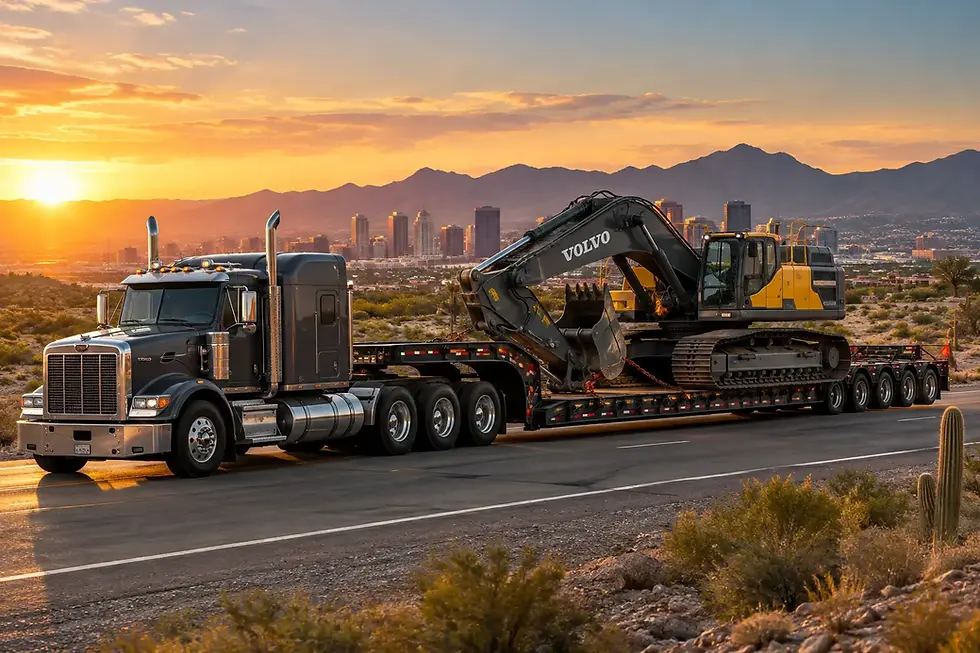
For many contractors and equipment managers, the lowboy is the first answer when the load gets serious. Lowboys are built for heavier equipment and lower deck height, which helps control overall loaded height. That matters for excavators, dozers, loaders, and other machines that get tall fast once they are on a trailer.
A lowboy works well when the machine is too heavy or too tall for a standard flatbed or step deck. The lower deck gives you more room under height limits, and the design is better suited to concentrated machine weight. For a lot of heavy construction equipment, this is the practical choice because it balances hauling capacity with legal movement.
That said, not every lowboy is the same. Deck length, axle count, and neck style all matter. A lighter machine may only need a standard lowboy, while larger machines may call for additional axles or more specialized configurations. If the weight is pushing into heavy haul territory, the trailer has to match both the machine and the permit plan.
RGN trailers when loading ease matters
An RGN, or removable gooseneck trailer, is often the best trailer for heavy equipment that needs to be driven on from the front. Once the gooseneck detaches, the trailer forms a low loading angle that works well for tracked and wheeled equipment.
This is a strong option for machines with limited ground clearance, long wheelbases, or loading concerns that make rear ramps less practical. Driving straight onto the deck can be safer and more controlled than trying to climb steep ramps, especially with larger equipment.
RGNs are common for heavier and taller machinery because they combine a low deck with practical loading. They are especially useful when the equipment operator needs a clean, direct approach onto the trailer. On jobs where loading time matters and the machine is a challenge to ramp, an RGN can be the right call.
The trade-off is that not every move needs that level of trailer. For smaller equipment, an RGN may be more trailer than the job requires. But when the machine is large enough, loading simplicity becomes a real operational advantage.
Landoll tilt decks for versatile loading
A Landoll tilt deck trailer is a smart choice when the equipment mix changes often or when pickup and delivery sites are less predictable. These trailers tilt to create a loading angle without separate ramps, which can speed up loading for many kinds of equipment.
Landolls are often used for forklifts, smaller construction machines, scissor lifts, and equipment that benefits from easy roll-on capability. They are also useful when ground conditions or site constraints make traditional ramp loading awkward. The tilt function can reduce loading headaches and improve efficiency for mid-size machines.
This trailer type shines on jobs where flexibility matters more than maximum payload. It is not the answer for every overweight machine, but it is a strong tool for equipment that needs quick, controlled loading without a lot of setup. For dealers, rental operations, and contractors moving mixed fleets, that versatility has real value.
Step decks and flatbeds for lighter equipment
Not every equipment move calls for a lowboy or RGN. Step deck trailers can handle certain machines that are too tall for a flatbed but do not require a true heavy equipment trailer. If the weight is manageable and the machine dimensions fit, a step deck can be an efficient option.
Flatbeds are even more limited for self-propelled machinery, but they can still be used for attachments, smaller units, or equipment that can be loaded safely by crane or forklift. The problem is that many buyers focus only on whether the machine physically fits, not whether it loads safely or keeps legal height.
That is where mistakes happen. A trailer may look cheaper or more available, but if it creates permit issues, slow loading, or unsafe securement angles, it was the wrong choice from the start.
When multi-axle heavy haul is the real answer
At a certain point, asking for the best trailer for heavy equipment means asking for the right heavy haul configuration. Once machine weights climb well beyond standard trailer capacity, you are no longer choosing between common deck styles alone. You are dealing with axle groupings, bridge law, route restrictions, and state permit requirements.
That is where multi-axle setups come in. A 9-axle or other specialized configuration spreads weight properly and makes legal movement possible for oversized and overweight machinery. This is common with larger mining equipment, major industrial components, and big earthmoving machines.
These moves are not just about trailer choice. They are about engineering the entire haul correctly. The trailer, tractor, route, permits, and escort requirements all have to work together. If one part is off, the whole move slows down.
How to choose the right trailer before the truck shows up
The fastest way to avoid problems is to treat trailer selection like an operational decision, not a dispatch detail. Start with accurate machine specs, not estimates. Shipping weight, transport dimensions, attachment details, and whether anything can or should be removed all affect the trailer decision.
It also helps to think through site conditions on both ends. Is there room for a detachable trailer to line up? Is the loading surface stable? Will the receiving site have enough space to unload safely? These details matter just as much as the machine spec sheet.
If the route runs through areas with tighter bridge clearances or stricter permit controls, lower deck height may become the deciding factor. In the Southwest, especially around Arizona and Nevada corridors, route planning can be as important as trailer selection because terrain, access roads, and permitting timelines can change the best approach.
For most commercial shippers, the right move is to work with a carrier that runs this equipment directly and can match the machine to the trailer in-house. That cuts down on bad assumptions and broker-layer confusion. A company like Flat Out Services, with lowboys, Landolls, RGNs, and multi-axle heavy haul equipment in its own fleet, can make that call based on what will actually move the load safely and legally.
There is no single best trailer for heavy equipment
If you want the honest answer, the best trailer for heavy equipment depends on what you are moving and what can go wrong if you choose badly. Lowboys are strong for tall, heavy machines. RGNs are excellent when front loading makes sense. Landolls bring flexibility for many mid-size machines. Step decks fit some lighter loads. Multi-axle combinations handle the jobs that standard trailers cannot touch.
The right trailer is the one that protects schedule, safety, and compliance at the same time. When the machine is expensive and the job clock is already running, that is the only answer that matters.


Comments