


Kingman Arizona Lowboy Trucking That Fits the Job
- Flat Out Services
- Jun 18
- 6 min read

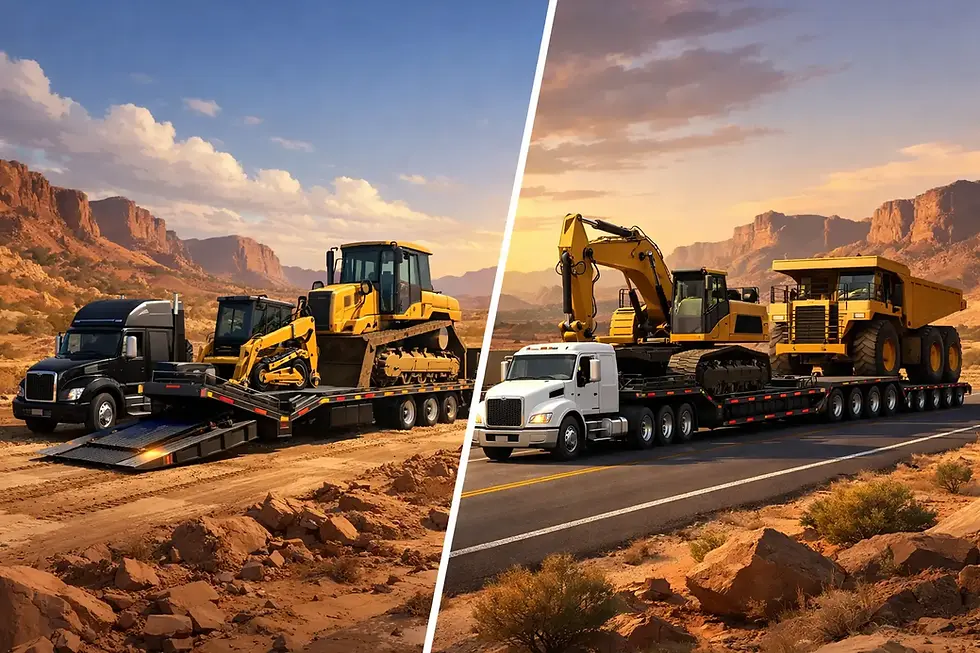
Kingman sits in the middle of work that does not move on standard freight. One day it is a dozer headed to a highway project off I-40, the next it is a loader coming out of a quarry, or a crane component staging for a shutdown. That is where kingman arizona lowboy trucking becomes a real equipment logistics question, not just a truck order.
Lowboy work in this part of Arizona is about matching trailer, axle setup, permit requirements, and route conditions to the machine in front of you. If that part gets missed, the job slips. If it gets handled correctly, the machine shows up legal, on time, and ready to work.
What kingman arizona lowboy trucking usually involves
In Kingman, lowboy hauling is tied closely to construction, mining, utility, paving, and heavy civil work. The equipment is often too tall, too heavy, or too awkward for a standard flatbed. A lowboy gives you deck height that matters in Arizona, especially once overall load height starts pushing bridge and wire clearance limits.
That sounds straightforward until you look at the range of machines that can fall under the same request. A 35,000-pound mini-ex spread package is one thing. A 90,000-pound excavator with a hammer, counterweight, and wide track frame is another. A scraper, asphalt paver train, or articulated haul component can change the whole trailer plan again.
Around Kingman, route selection matters just as much as trailer choice. Access to I-40 and US-93 is a plus, but the final miles into a mine site, plant, utility corridor, or rough jobsite can create the real challenge. Tight turns, soft shoulder, overhead interference, and steep transitions at entrances all affect how a machine should be loaded and what trailer is practical.
When a lowboy is the right tool
A lowboy is the right answer when deck height is the limiting factor, when machine weight needs concentrated support, or when loading angle and securement geometry favor a dedicated heavy equipment trailer. Excavators, dozers, loaders, compactors, trenchers, and many crane components fit naturally into this category.
But lowboy trucking is not always one-size-fits-all. Some machines move better on an RGN because the detachable neck gives safer loading for tracked units with low ground clearance or long wheelbase equipment. Some need a Landoll because pickup conditions do not allow room for neck detach operations, or because the machine is in a yard where speed and flexibility matter more than pure heavy-haul configuration.
That trade-off is where experience shows. If the trailer gets chosen from a desk without understanding machine dimensions, attachment layout, and site conditions, you can lose time before the haul even starts.
Equipment commonly moved in and out of Kingman
Most lowboy moves in the area revolve around equipment that construction and mining operations use every day. That includes excavators, dozers, wheel loaders, motor graders, rollers, pavers, backhoes, and crushers. It can also mean support equipment such as generators, manlifts, drill support units, and plant components that are heavy but not always oversized in every dimension.
For mining and aggregate work, weight is often the deciding factor. A machine may not look extreme on paper, but axle loading, deck concentration, and legal bridge formula can still push it into a more specialized setup. That is when multi-axle combinations and permit planning start to matter.
Trailer selection is where the job gets won or lost
People outside heavy haul tend to treat lowboy as a generic term. On real jobs, it is more specific than that. Trailer type affects loading method, legal dimensions, route flexibility, and whether you can even get to the machine.
A standard lowboy works well for many mid-range construction machines. An RGN is often better for taller or heavier tracked equipment because loading is cleaner and safer. A Landoll tilt deck can solve site access issues, dealer transfers, and recovery-style moves where the machine is disabled or loading space is limited.
Once machine weight climbs, axle count becomes the bigger issue. That is where 7-axle, 8-axle, or 9-axle combinations may come into play. In Arizona, that is not just about hauling capacity. It is about distributing weight legally and keeping the route permitable.
Flat Out Services works in exactly that zone of decision-making, where the trailer is selected around the machine and the route, not around whatever happens to be available that day. That matters in Kingman because many moves start on a major corridor but finish in places that punish the wrong setup.
Kingman route and permitting realities
Kingman gives good access to major freight corridors, but heavy haul does not move by map alone. The route that looks shortest is not always the route you can permit. Height restrictions, construction activity, bridge postings, utility crossings, and municipal restrictions can all affect the move.
I-40 and US-93 are common heavy haul arteries for equipment moving between Phoenix, Las Vegas, Bullhead City, Lake Havasu, and Northern Arizona. But the moment the load leaves those corridors, the route needs closer scrutiny. County roads, industrial spurs, and mine access roads can limit turning room or make escort timing more difficult.
Permits also depend on machine configuration. If an excavator boom can be tucked and the bucket removed, the move may stay within a more workable envelope. If attachments stay installed, width and weight may still be manageable, but height and overhang may push the route into a different permit category. The same applies to dozers with blades, loaders with buckets, and paving machines with side extensions.
This is one reason experienced heavy haul carriers ask for exact dimensions, photos, and attachment details before quoting. It is not paperwork for the sake of paperwork. It is the difference between a legal move and a jobsite delay.
Why timing around Kingman is not just pickup and delivery
Contractors usually call because they need the machine moved fast. That is fair. But with lowboy work, fast only works if the load is staged correctly and the route is ready.
A machine that is parked nose-in against a berm, boxed by other equipment, or not detached from support gear can burn hours. So can missing keys, dead batteries, or attachments that were supposed to be removed but are still hanging on the machine. In mining and industrial yards, site induction requirements and escort procedures also affect how quickly loading can begin.
Weather can also change the day, even in the desert. Wind matters on taller loads. Monsoon conditions can affect dirt access roads and approach angles. Extreme heat does not stop hauling by itself, but it does change how crews plan around tires, hydraulics, and wait times on exposed jobsites.
Good kingman arizona lowboy trucking starts before the truck rolls. The cleaner the machine prep and access plan, the smoother the transport.
What contractors should have ready before calling
The best heavy haul conversations start with machine make and model, overall weight, transport dimensions, and whether attachments are staying on or coming off. Photos help because they show what a spec sheet does not - bucket position, ripper length, guard packages, aftermarket additions, tire size, and jobsite access conditions.
It also helps to know whether the machine is running, whether loading assistance is available, and whether pickup or delivery has any site restrictions. A legal city street entrance is different from a rough mine road with a cattle guard and wash crossing.
If the move is time-sensitive, say so early. Sometimes the solution is not just dispatching a truck faster. Sometimes it is changing trailer type, splitting components, moving after permit approval, or staging the machine to a better pickup point.
The cost side depends on more than miles
Lowboy pricing around Kingman is shaped by weight, dimensions, trailer type, axle count, permit needs, escorts, route complexity, and loading conditions. Mileage matters, but on oversize and overweight work, it is only one piece of the job.
A short move with difficult site access and permit complications can cost more than a longer legal haul on open highway. The same machine can also price differently depending on whether it is ready to roll or requires extra handling. That is why accurate job details lead to better numbers and fewer surprises.
The real value is execution
Most equipment managers are not looking for a lecture about trucking. They want to know whether the carrier understands the machine, can permit the route, can show up with the right trailer, and can get the load delivered without creating a second problem at the destination.
That is the standard for serious lowboy work in and around Kingman. The region has enough highway access to move equipment efficiently, but enough terrain, industrial access issues, and oversize restrictions to expose weak planning fast. A carrier that understands lowboys, RGNs, Landolls, axle spreads, and Southwest routing will usually save more time than a cheap rate ever could.
If you are moving iron through Kingman, the right question is not just who has a truck open. It is who has already thought through the machine, the route, and the last 200 feet at both ends of the move.


Comments