


Industrial Machinery Rigging Guide for Safe Moves

A 70,000-pound industrial press can be sitting on a clean concrete pad with plenty of room around it and still be a difficult move. The problem is rarely just weight. It is the machine’s actual center of gravity, whether its lifting points are rated and accessible, what sits underneath the trailer path, and whether the receiving site can unload it without stopping the job. This industrial machinery rigging guide focuses on the decisions that need to be settled before a crane hook or trailer ramp arrives.
Start With the Machine, Not the Truck
Customers often begin with a rough machine weight and dimensions. That is useful for a preliminary conversation, but it is not enough to build a safe rigging or hauling plan. A shipping weight may exclude tooling, hydraulic oil, attachments, skids, counterweights, spare components, or temporary shipping frames. For industrial machinery, the listed weight can also reflect a base configuration that no longer matches what is in the field.
The working number is the verified transport weight, along with the overall length, width, height, and axle or support-point loading. A long machine with most of its weight at one end can create a very different trailer-loading problem than a compact machine at the same gross weight. A machine may fit within a trailer’s total capacity yet overload a concentrated section of deck, exceed a landing area’s bearing capacity, or leave the truck with poor steer-axle weight.
Before scheduling, provide the hauling and rigging team with the manufacturer data plate, drawings if available, photos from all sides, the machine’s current configuration, and dimensions taken in its transport condition. Photos should show lifting lugs, fork pockets, removable components, ground clearance, and the actual access road. A photo of the load alone does not answer whether a lowboy can get into the site, turn around, and load clear of overhead lines.
An Industrial Machinery Rigging Guide Begins With a Lift Plan
Rigging is not another word for securing equipment to a trailer. Rigging addresses how machinery is picked, supported, controlled, and set down. Securement addresses how it remains restrained during transport. Both require planning, but they solve different risks.
A proper lift plan identifies the verified weight, center of gravity, approved pick points, rigging angles, crane capacity at the planned radius, travel path, and landing area. It also accounts for what happens if the center of gravity is not where the drawing says it is. A machine modified over years of production may have added motors, guards, control cabinets, or product-handling equipment that shift the balance substantially.
Rated Pick Points Are Not Assumptions
One common mistake contractors make is treating any convenient structural opening as a lifting point. A hole in a frame member, an eye bolt installed for maintenance, or a forklift pocket may not be rated for the load or for the angle created by a sling. Using it anyway can bend a frame, damage precision equipment, or create a dropped-load event.
If manufacturer lifting points are unavailable or questionable, the lift needs a qualified evaluation before work begins. That may mean using engineered lifting beams, spreader bars, temporary lifting frames, or an alternate handling method. The faster-looking option is often not actually faster once a failed pick damages the machine or shuts down the site.
Sling angle matters as much as sling capacity. As sling legs move closer to horizontal, tension rises quickly. A two-leg bridle that appears generously sized at a steep angle can be overloaded when spread wide to clear a machine housing. Spreader bars can keep the sling legs more vertical while reducing compression into fragile panels or electrical enclosures. They add setup time and require room, but they are often the right call for wide, high-value machinery.
Ground Conditions Are Part of the Lift
Crane charts assume the crane is level and properly supported. The pad or soil under outriggers has to carry those concentrated reactions, not simply the overall crane weight. Fresh asphalt, trench backfill, utility corridors, underground vaults, and thin concrete slabs can all change the plan.
The same applies to forklifts and gantries. A forklift may have enough rated capacity but lack the wheelbase, mast clearance, or tire loading needed for a particular move. Gantries can be effective inside a facility where crane access is limited, but their runway, header room, and floor capacity must be confirmed. The right handling method depends on site constraints, not just the equipment available that morning.
Match the Trailer to the Load and the Route
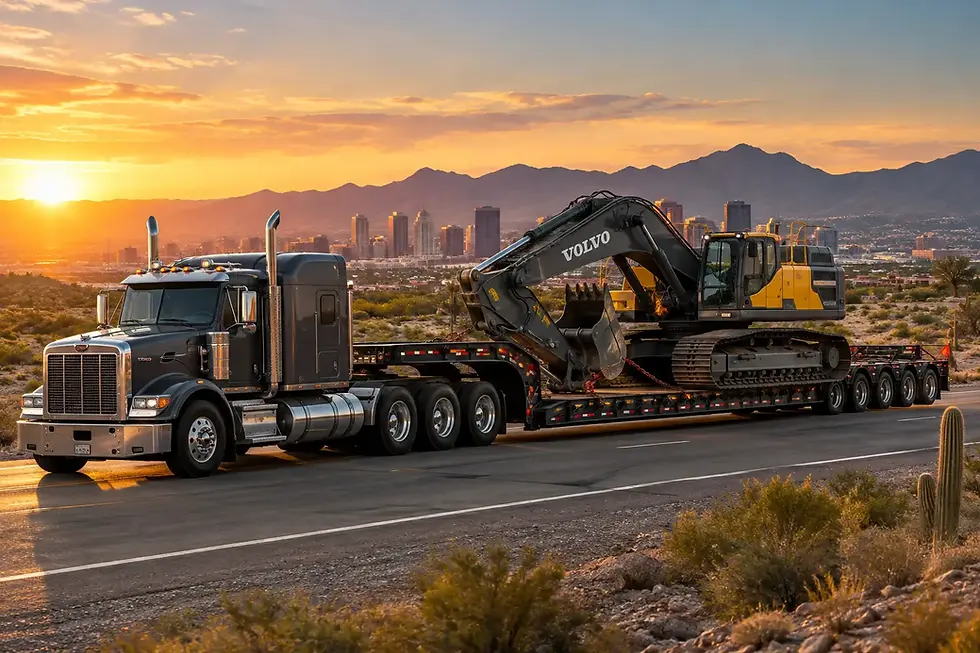
After the lifting method is defined, the transport team can select the trailer. An industrial machine that is low and compact may travel well on a lowboy. A tall machine may require a double-drop lowboy or an RGN to reduce loaded height. Equipment that must be loaded from ground level, cannot be lifted safely by a crane, or is being removed from a constrained yard may be a better Landoll tilt-deck candidate.
Trailer choice is a compromise among deck height, deck length, capacity, loading method, and route restrictions. Lower is usually better for height, but the lowest deck is not automatically the best deck. A very low machine on an RGN may have limited ground clearance at transition points. A load with a concentrated footprint may need steel plates, cribbing, or a different deck arrangement to spread weight correctly.
For heavier machinery, axle configuration drives the permit and route conversation. Additional axles distribute weight and may make a move legal, but they also increase overall length, turning radius, and setup complexity. A multi-axle configuration can be the right answer for a heavy transformer skid or large industrial component, yet it may not work through a tight facility entrance or around a jobsite laydown area.
Flat Out Services plans these details from the load outward. The question is not simply, “What trailer can carry it?” It is, “What legal configuration can load it safely, clear the route, and unload it where the machine needs to go?”
Permits and Routing Cannot Be an Afterthought
Oversize permits are not a formality added after the truck is booked. Permit requirements determine when the load can move, which roads it can use, whether escorts are required, and sometimes which trailer configuration is acceptable. Arizona, Nevada, and Southern California routes can add real constraints through bridge postings, construction zones, urban curfews, restricted highways, and heat-related operating considerations.
Height is especially easy to underestimate. Measure from the road surface to the highest transport point after the machine is blocked, secured, and loaded on the selected trailer. Do not rely on an unloaded trailer deck-height specification. Tire pressure, suspension position, dunnage, and the load’s actual resting point all affect the final number.
Route planning must include the first and last mile. A permitted route may be clear while the plant driveway has low limbs, a narrow gate, a steep crown, or an overhead pipe rack. On mining and remote construction sites, access roads can change after rain or active grading. Experienced heavy haul teams confirm site access before dispatch because a truck turning around with a long multi-axle load is not a small inconvenience.
Prepare the Machine for Loading and Transit
Machinery preparation protects both the equipment and the schedule. Disconnect or secure loose components, lower and lock moving assemblies, cap exposed hydraulic lines, and protect sensitive controls and instrumentation. Remove attachments when doing so reduces width, height, or damage risk, but only if removal and reinstallation can be handled safely at both ends.
Fluid management depends on the machine, the trip, and the manufacturer’s requirements. Draining every system is not always necessary or desirable. However, leaks must be corrected before loading, and tanks, reservoirs, doors, guards, and movable assemblies must be secured. A hydraulic leak discovered on a loaded trailer can delay a permitted move and create a cleanup problem at the site.
Securement must restrain forward, rearward, and lateral movement without damaging the machine. Chains, binders, direct tie-downs, blocking, and protection at contact points are selected around the equipment’s structure and manufacturer guidance. A chain placed around a convenient cylinder rod or unprotected edge is not a solution. It is a damage claim waiting to happen.
Plan the Receiving Site Before the Load Leaves
The receiving crew needs more than an estimated arrival time. They need to know trailer type, loading direction, required crane or forklift capacity, landing dimensions, anticipated unload duration, and the space needed for the truck to maneuver. If a crane is handling the unload, confirm its arrival, setup location, outrigger support, and lift plan before the haul truck is rolling.
Sequencing matters on active jobsites. A machine that arrives before its pad, crane, or rigging crew is ready may sit on the trailer and disrupt the driver’s legal hours or the next scheduled move. Conversely, a late machine can leave a crane and installation crew standing by. The best window is the one where the site is actually ready, not merely the earliest opening on a calendar.
For precision machinery, the final set should also be planned separately from the transport unload. Getting a machine onto the floor is not the same as placing it on foundations, aligning it, or transferring it onto skates. Separate those scopes clearly so no one assumes the truck driver, rigger, millwright, or site crew is handling work that has not been assigned.
The practical test for any machinery move is simple: can every handoff happen safely and without improvisation? If the answer depends on finding another forklift, changing trailer types at the last minute, or hoping a gate clears the load, the plan is not ready. Confirm the machine, the lift, the trailer, the route, and the receiving site early - then the move has a much better chance of arriving exactly as the project needs it.


Comments