


Dealer to Jobsite Equipment Delivery Planning

A machine can be sold, released, and ready at the dealer yard while the project still loses a day waiting on transport. Dealer to jobsite equipment delivery is not simply a matter of finding an available truck. The move has to match the machine, the legal route, the delivery window, and the actual conditions at the receiving site. Miss one of those details and a routine delivery can turn into a delayed permit, a failed load-out, or a truck sitting outside a jobsite gate with nowhere safe to unload.
For contractors and equipment managers, the best time to plan the move is before the purchase order is finalized or the dealer commits to a release date. That gives the hauler time to select the right trailer, verify dimensions, build a legal route, and coordinate the machine handoff without forcing bad decisions at the last minute.
Start With the Delivered Configuration, Not the Sales Spec
Dealer literature is useful, but it is not always the final authority for transport planning. A listed operating weight may exclude attachments, counterweights, fuel, buckets, blade extensions, or dealer-installed options. A machine described as "transport width" may still need mirrors folded, a boom positioned correctly, or an attachment removed before it is legal to move.
The information that matters is the equipment's as-delivered configuration: overall length, width, height, weight, axle or track spacing, attachment details, and whether components can be removed. For an excavator, that means knowing whether the bucket travels with the machine, whether the boom can be lowered within height limits, and whether a hydraulic thumb changes width or securement access. For a dozer, blade width and rear ripper configuration can determine whether the load stays on a standard lowboy or requires a wider permitted setup.
Customers often assume a machine under a certain operating weight can go on any lowboy. Weight alone does not decide it. A 50,000-pound machine with concentrated track loading may require a different deck and axle arrangement than a heavier machine with a longer footprint. The goal is not merely getting the equipment onto a trailer. It is distributing the load correctly, keeping axle weights legal, and retaining enough flexibility for the route.
Trailer Choice Drives the Entire Delivery Plan
A standard lowboy is often the efficient answer for conventional excavators, wheel loaders, and many dozers. It provides a low deck height, practical loading angles, and a straightforward setup when the dimensions fit. But it is not the answer to every dealer delivery.
A Landoll tilt deck can be the better choice for equipment that needs a level loading approach, has limited ground clearance, or must be picked up from a yard without a loading dock or ramp. It can also reduce handling steps for certain attachments and smaller specialized machines. The tradeoff is deck height and capacity. A tilt deck that works well for a compact paving component may not have the deck depth or axle capacity required for a large excavator or loader.
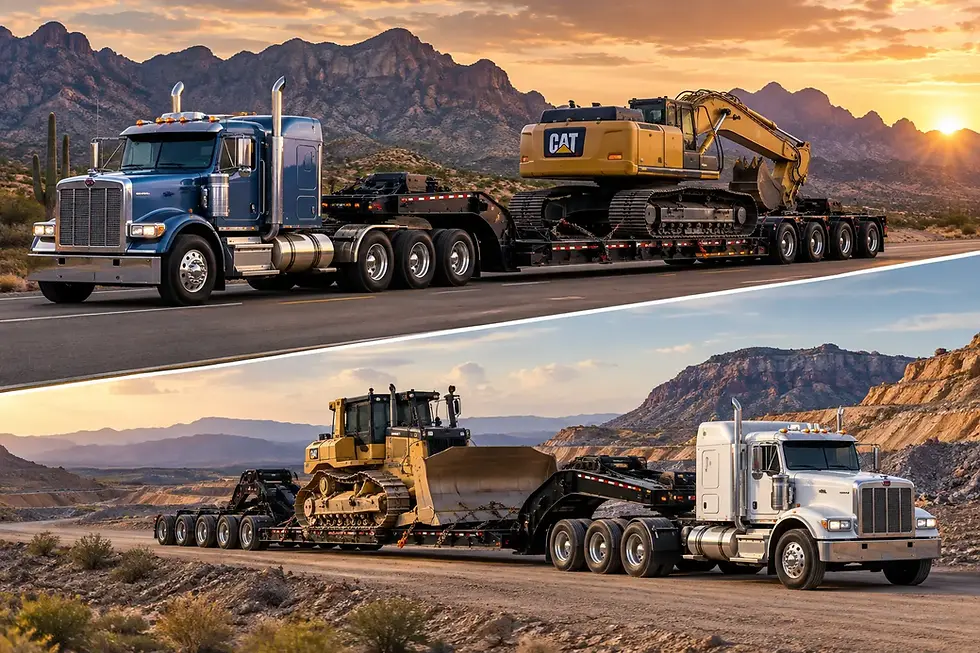
For taller, heavier, or more difficult equipment, an RGN can be the practical option. The detachable gooseneck gives the machine a direct drive-on path and a lower well, which can make the difference on height-sensitive routes. With heavier loads, multi-axle configurations are not an upgrade added for appearance. They are used to spread weight across more axles, meet bridge and axle-group limits, and support permit requirements.
That distinction matters on Southwest routes. The most direct route from a dealer in Phoenix to a project near Kingman may look simple on a map, but legal weight and height restrictions can change the usable route. A nine-axle combination may create a compliant plan for a load that cannot legally move on a lighter setup, but it may also require more room for turns, more detailed permit review, and tighter coordination at the jobsite.
Permits and Routing Should Be Set Before the Truck Is Dispatched
Oversize permits are often treated as paperwork that happens after a truck is booked. In practice, permitting is part of the operating plan. Permit dimensions establish the routes available, the travel hours, required escorts, and restrictions around construction zones, bridges, utility conflicts, or urban streets.
A route that is legal for a 12-foot-wide load is not automatically legal for a 14-foot-wide machine. The same is true of height. An excavator that appears to clear a bridge on a dealer spec sheet may become too tall after the trailer deck height, track position, and boom placement are considered. Experienced heavy haul planners work from loaded height, not machine height alone.
This is especially relevant between Arizona, Nevada, and Southern California, where a delivery can involve multiple permit jurisdictions and different operating restrictions. Interstate corridors may be the obvious choice, but the final miles often cause the real problem. A jobsite entrance off US-93, a mine road in Northern Arizona, or a tight industrial approach in Las Vegas can require more planning than the highway portion of the move.
One mistake contractors make is giving the hauler only the jobsite address. A street address does not show gate width, overhead lines, turning space, road condition, laydown location, or whether the entrance is shared with active public traffic. A delivery pin is helpful, but a usable delivery plan needs more.
The Dealer Yard and Jobsite Need a Shared Loading Plan
The dealer release process can affect the pickup as much as the transport itself. Before dispatch, confirm that the equipment has been inspected, fueled to an appropriate transport level, cleaned enough for securement points to be accessible, and released by the correct department. Confirm who has the keys, who can operate the machine, and whether the attachment is installed or staged separately.
If a machine is sold with a bucket, forks, coupler, counterweight, or blade extension, decide early how each piece will travel. Removing a component can reduce width or height and simplify permitting, but it also adds handling time at both ends. Keeping it attached may be more efficient if it remains legal and can be secured properly. There is no automatic right answer. The best choice depends on the machine configuration, trailer capacity, route limits, and how soon the machine must go to work after unloading.
At the receiving end, the jobsite needs a clear unloading area with firm ground, adequate turning room, and no conflict with crews, cranes, or active paving operations. Soft shoulder conditions and loose imported fill are common reasons a delivery plan changes on arrival. A loaded lowboy cannot safely maneuver like a pickup truck, and a heavy-haul combination needs room to straighten out before backing or turning.
If the jobsite cannot receive the machine at the planned time, a nearby yard or designated staging area may be a better solution than forcing a delivery into an unsafe window. That is not always cheaper, because it can add handling and a second move. But it can protect the schedule when site access is uncertain.
Schedule the Delivery Around Site Readiness
Fast delivery is valuable only if the project can use the equipment when it arrives. A machine delivered before the operator is assigned, the work area is prepared, or the attachments are available can become an expensive piece of parked iron. On the other hand, waiting until the morning work is scheduled to begin leaves no room for a permit delay, traffic restriction, or loading issue at the dealer.
For critical equipment, build practical time into the plan. That may mean delivering late the prior day, staging at a secure yard, or scheduling the move around a concrete pour, lane closure, or crane pick. In our experience, the least expensive transport plan on paper is not always the least expensive plan for the project. A slightly higher-cost configuration or earlier delivery window can prevent a crew, rental replacement, or subcontractor from standing by.
Flat Out Services approaches dealer deliveries as field operations, not just point-to-point freight. The trailer, permit, route, loading method, and site conditions have to work together before the truck leaves the yard.
Information to Have Ready Before Requesting a Haul
A complete request reduces back-and-forth and gives the hauler a real basis for planning. Have the machine make and model, serial number if available, current photos, dimensions, operating weight, attachment list, pickup contact, release date, and exact delivery location ready. Include any known site restrictions, required arrival times, gate procedures, and whether an operator will be present to load and unload.
Photos are particularly useful when the machine has unusual attachments, damage, limited access around tie-down points, or a configuration that differs from standard specifications. A few clear photos from the side, rear, and operator station area can prevent incorrect trailer assumptions.
The best dealer to jobsite equipment delivery is usually the one nobody talks about after it is complete. The machine arrives legal, secure, undamaged, and positioned where the crew can put it to work. Getting there takes more planning than booking a truck, but that planning is what keeps transport from becoming the first problem on a new job.


Comments