


Weight Distribution Planning Guide for Heavy Haul

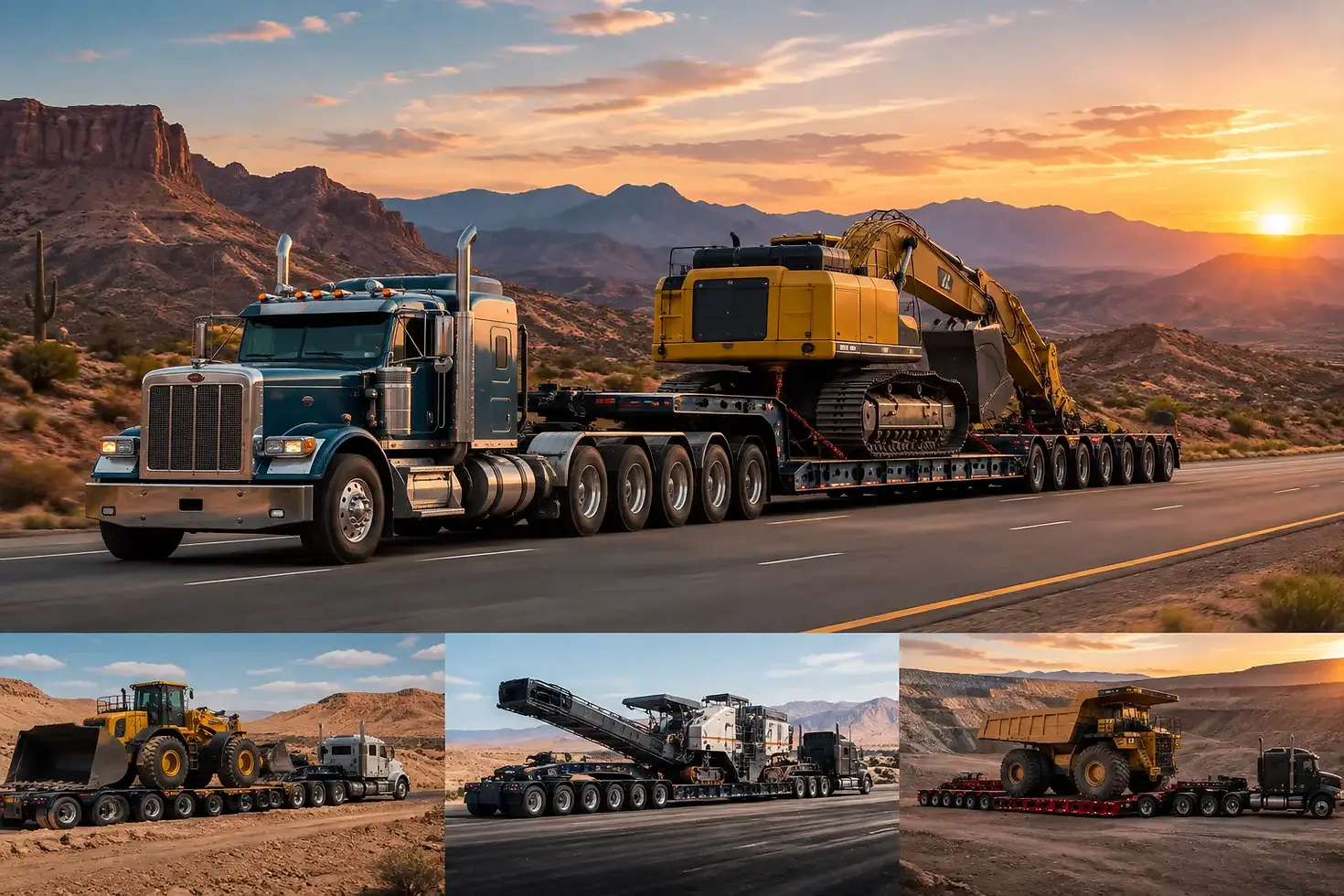
A 90,000-pound excavator can be a straightforward move or a permit problem before the truck leaves the yard. The difference is usually decided during weight distribution planning, not at the scale house. This weight distribution planning guide covers how experienced heavy haul crews evaluate machine weight, axle groups, trailer configuration, loading position, and route restrictions before committing equipment to a job.
For contractors, the practical question is not simply, “Can this trailer carry it?” A better question is, “Can this specific truck, trailer, and axle layout carry it legally and safely on the route, at the time the job needs it moved?” Those are different questions, particularly across Arizona, Nevada, and Southern California, where permit conditions, bridge limits, construction zones, and restricted travel windows can change the plan.
Start With Real Machine Weights, Not Brochure Weights
Published operating weight is a useful starting point, but it is not always the transport weight. An excavator may have a hydraulic thumb, larger bucket, counterweight package, guarding, added tools, fuel, or mud packed into the undercarriage. A wheel loader might travel with forks, a coupler, or a bucket that changes both total weight and balance.
One mistake contractors make is providing the base model number without the actual configuration. A CAT 336 and a CAT 336 equipped for a specific production job may not produce the same hauling plan. The same applies to dozers with rear rippers, graders with attachments, and cranes moved with components separate from the carrier.
Before selecting the transport equipment, confirm the machine model, serial plate weight if available, attachments, overall width, overall height, track or tire condition, and whether anything can be removed. Separate transport of a bucket, blade extension, counterweight, or attachment can sometimes reduce permit complexity. Other times, splitting the load creates an extra truck, more handling, and more site coordination than the move justifies. It depends on the route and the schedule.
Trailer Choice Sets the Weight Distribution Plan
Trailer selection is not just about deck length. It determines where the machine sits, how the weight transfers across axle groups, ground clearance, loading method, and how much flexibility remains if the actual scale weights are different than expected.
Lowboy, RGN, or Landoll?
A fixed-neck lowboy is often a practical choice for common construction equipment when the weight and height work. Its lower deck helps control overall loaded height, but it can have limits on well length, loading angle, and axle capacity depending on the configuration.
An RGN is often the better answer for larger excavators, dozers, scrapers, cranes, and high-value equipment that needs a low deck and drive-on loading. Removing the gooseneck reduces the ramp angle and avoids asking an operator to climb a machine over a steep rear ramp. That matters for low-clearance equipment, long track frames, and machines that cannot safely load at a sharp angle.
A Landoll tilt deck can be efficient for equipment that needs quick loading without detaching a neck. It is not automatically the right answer for every oversize machine. The deck angle, weight rating, axle position, and loaded height still have to work. For some moves, the speed gained at pickup is outweighed by a less favorable axle distribution or a permit issue.
For the heaviest work, multi-axle trailers and combinations up to nine axles spread the load across more points of contact. More axles can increase legal carrying capacity, but they also increase turning radius, route restrictions, setup time, and cost. Adding axles is not a cure-all. If the route has tight urban turns, weak structures, or limited staging space, the larger configuration can create a different operational problem.
The Machine’s Position on the Deck Matters
Once the trailer is selected, the machine has to be placed where each axle group stays within allowable limits. Move a tracked excavator forward a few feet and the tractor drives can overload. Move it too far back and trailer axles may carry too much weight or the kingpin weight may fall outside the target range.
This is why experienced operators do not load strictly by visual center. The center of gravity is rarely at the geometric center of the machine. Excavator counterweights, dozer blades, rear rippers, loader engines, and crane structures all change where the load is concentrated.
Track direction also matters. An excavator may load boom-forward or counterweight-forward depending on deck length, height, axle weights, securement access, and the ability to swing the house into a transport position. A dozer may need the blade raised, removed, or positioned to manage overall length and deck clearance. The correct orientation is the one that produces legal weights, practical securement, and safe loading and unloading - not simply the orientation that is fastest at the yard.
After loading, scale weights verify the plan. A calculated estimate is useful, but field conditions can change it. The machine may be heavier than listed, the deck may sit differently than assumed, or fuel and attachments may add enough weight to matter. If axle weights are close to a limit, a small repositioning can save a major delay.
Permits Are Built Around the Actual Configuration
Permit planning begins with dimensions, gross weight, axle weights, axle spacing, and route. A permit office does not approve a machine model name. It reviews a specific loaded configuration.
That distinction matters on Southwest corridors. A move from Phoenix to Kingman or Las Vegas may look simple on a map, but the permit route can be shaped by bridge formulas, local restrictions, overhead clearance, lane width, construction activity, and escort requirements. A route that works for a five-axle lowboy may not work for a multi-axle RGN, even if both can physically carry the machine.
Oversize and overweight are separate issues. A load can be within legal width but require an overweight permit due to axle loading. It can also be light enough for its axle configuration but need oversize routing because the blade, boom, or machine width exceeds standard limits. Contractors sometimes focus on gross weight and miss the dimensional restriction that drives travel hours or escort requirements.
Permits should be planned early when a job has a fixed mobilization date. A last-minute equipment move leaves less room to adjust the configuration if a permit condition changes. It can also force less efficient travel timing, especially where metro-area restrictions limit oversized movement during peak traffic periods.
Route Planning Includes the Last Mile
Interstates are usually the easy part. The final few miles often determine whether the move goes cleanly.
A mine entrance, solar site, subdivision under development, paving project, or industrial yard may have soft shoulders, narrow gates, buried utilities, sharp turns, low branches, parked equipment, or limited room to detach an RGN. The truck can be legal on I-10 and still be unable to safely deliver at the site without advance coordination.
Ask where the truck will stage, where the equipment will unload, who controls site access, and whether another machine is available to assist if needed. Confirm the approach direction. A tight turn that works when entering from one side may be impossible from the other, particularly with a long multi-axle combination.
Ground conditions deserve the same attention. A loaded heavy haul unit needs firm access and room to maneuver. Recent rain, loose decomposed granite, unfinished base material, or a steep unloading area can turn a normal delivery into a recovery risk. If site conditions are questionable, plan an alternate unloading point before dispatch.
Equipment Preparation Protects the Schedule
Weight distribution is only useful if the machine arrives ready to load. Remove loose material, secure doors and panels, identify hydraulic leaks, lower or pin components as required, and make sure the machine can be safely driven or winched onto the trailer. Operators should know whether attachments are traveling with the machine or on a separate deck.
Fuel level is also a planning item. It may not dramatically change the move for every machine, but on a tight axle-weight plan, several hundred gallons of fuel can matter. Do not drain fuel automatically. The decision should account for weight, fire safety, jobsite needs, and the availability of fuel at destination.
At Flat Out Services, this is the planning work that happens before a truck is assigned: match the actual machine to the right trailer and axle configuration, then verify that the permit route and jobsite can support the plan. It is less dramatic than solving a problem on the shoulder, but it is far more reliable.
A good heavy haul plan leaves room for reality. Confirm the machine configuration early, provide accurate dimensions and attachments, and give the hauler a clear picture of both pickup and delivery access. That gives the crew options before the move becomes urgent - when options are cheapest and the schedule is still under control.


Comments