


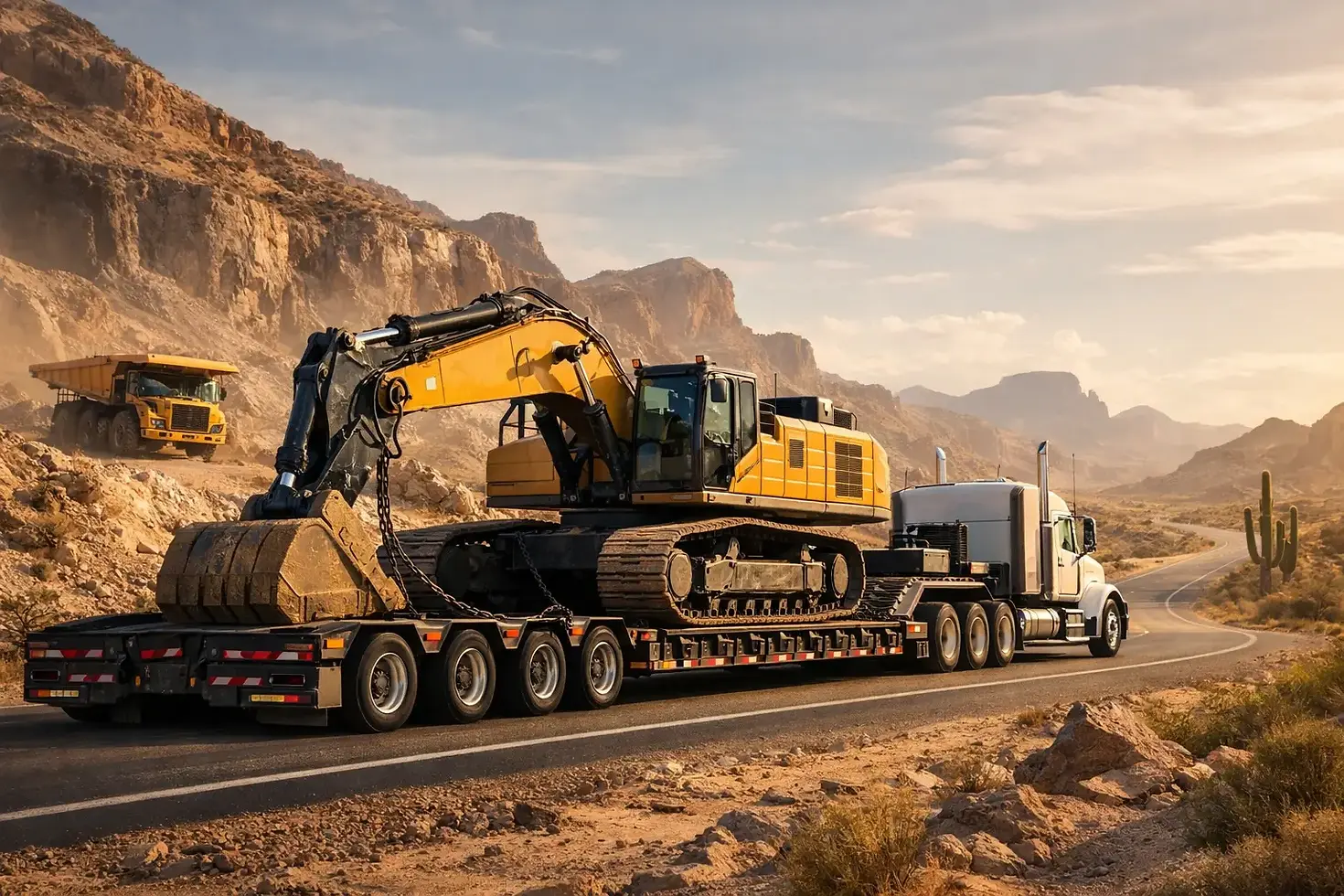
Mining Equipment Transport: What Matters Most

A mining move usually starts going sideways long before the truck shows up. It starts when someone assumes the machine is just another dozer, another loader, or another support piece that can be booked on a standard lowboy with a rough delivery window. Mining equipment transport does not work that way, especially when the machine is headed into or out of an active site with tight production schedules, limited access, and permit-sensitive dimensions.
The hard part is not just getting the load from point A to point B. The hard part is making the right transport decisions early enough that the move stays legal, loadable, and workable at both ends. In our experience, the best plans are built around the machine’s actual transport profile, not the machine’s brochure weight or someone’s estimate from the last time it moved.
What mining equipment transport really depends on
Contractors and mine managers often focus first on total weight. Weight matters, but it is only one part of the decision. Overall width, loaded height, axle spacing, ground clearance, boom or blade configuration, and where the machine can actually be loaded all change the transport plan.
A Caterpillar 777 component, a wheel loader, and a track drill may all fall under the same internal category of mining equipment, but they are not hauled the same way. One may fit best on an RGN because deck height is the deciding factor. Another may ride better on a multi-axle lowboy because axle group distribution is the real issue. Another may need a Landoll because the loading location will not allow neck detachment or there is no room to stage a conventional lowboy setup.
That is where experience matters. Good heavy haul planning is not about picking the biggest trailer available. It is about matching the machine to the trailer, the trailer to the route, and the route to the permit conditions.
Trailer choice in mining equipment transport
The most common mistake is assuming the trailer decision is simple. It usually is not.
When a lowboy is the right call
A conventional lowboy is often the practical choice for mid-size mining support equipment, tracked machines, and loads that need a lower deck without going to a more specialized configuration. If the machine loads cleanly, the deck length works, and axle weights stay manageable, a lowboy is efficient and straightforward.
But lowboys have limits. If the machine is too tall once loaded, or if weight concentration is too severe over a short footprint, the move may need more axles or a different trailer style altogether.
When an RGN makes more sense
For taller or heavier machines, an RGN is often the better answer because the removable neck allows easier loading and usually gives better deck height. That matters in mining corridors where overhead restrictions can turn a simple move into a route problem fast.
RGNs are also useful for machines that do not load well over ramps or that need a more controlled loading angle. The trade-off is operational space. If the pickup or delivery point is tight, soft, uneven, or congested, detaching and reattaching the neck may be more difficult than people expect.
When a Landoll solves the real problem
A Landoll tilt deck is not always the first trailer people think of for mining work, but there are situations where it is the best tool available. If the machine is smaller but access is poor, or if loading has to happen in a confined yard, roadside area, or service location, the Landoll can save time and reduce setup complications.
It is not the answer for every oversized mining load. Deck height and weight capacity can rule it out quickly. Still, for support equipment, smaller loaders, service trucks, or machines that need a simpler loading method, it can be the right decision.
Axle configurations are not a paperwork detail
Customers often assume axle count is just about legal compliance after the trailer has been chosen. In reality, axle configuration often drives the whole plan.
A heavy mining machine with a short, concentrated weight footprint can overload an axle group even when the total gross looks manageable on paper. That is why multi-axle combinations matter. A 9-axle setup is not overkill if the goal is to distribute weight correctly, meet permit requirements, and avoid forcing a bad route just because the trailer is too limited for the load.
This is especially true in Arizona and Nevada, where route-specific conditions can change the equation. Bridge formulas, local restrictions, and permit approvals do not care that the machine moved a different way six months ago. Every move has to be evaluated on its own dimensions, axle loading, and route conditions.
The cheapest axle setup is not always the least expensive move. If a lighter configuration creates permit issues, longer routing, escort complications, or offloading problems, the initial savings disappear fast.
Permit strategy starts earlier than most people think
Permit planning should start as soon as the machine and destination are known. Waiting until the equipment is ready to load is how schedules get blown up.
Mining equipment transport often involves oversize permits across multiple jurisdictions, and each one may have different rules for width, height, length, weight, travel times, escorts, and restricted corridors. The route from Phoenix to a mine site in northern Arizona, for example, is not just a line on a map. It may include bridge considerations, pilot car requirements, city restrictions, and time-of-day limits that affect when the truck can move.
One mistake contractors make is treating permits like an administrative box to check. Permit strategy is operational planning. It determines trailer configuration, travel windows, staging needs, and sometimes whether partial disassembly makes more sense than moving the machine complete.
A machine that is technically movable in one piece may still be a poor one-piece move if permit conditions force major delays or ugly routing. Pulling a blade, bucket, counterweight, or other component can make the overall job cleaner, faster, and more predictable.
Routing is about jobsite reality, not just road clearance
People tend to think route planning is mostly about overpasses. Clearance is part of it, but mining moves usually get complicated closer to the site.
Access roads, mine entrances, cattle guards, soft shoulders, grade changes, and limited turn radius often create more trouble than the highway segment. The truck still has to get in, get out, and unload safely. A route that works for a legal flatbed or even a standard lowboy may not work for a stretched multi-axle configuration.
That is why experienced heavy haul teams ask questions that can sound overly specific at first. Is the entrance gated? Is there room to turn around? Is the unloading area compacted? Can another truck or service vehicle block the only approach? These are not minor details. They decide whether the move happens smoothly or burns half a day in field adjustments.
In Southwest mining and construction corridors, heat, grade, and remote access also matter. A route that looks acceptable on a map may not be the best option for a loaded heavy haul running through a steep or isolated section with limited recovery options.
Loading and equipment prep make or break the move
A surprising number of delays come from machines that are not truly ready to load.
Mining equipment should be measured in transport configuration, not working configuration. Booms, handrails, mirrors, ladders, buckets, and attachments all affect legal dimensions. Fuel level can matter. So can debris packed into the undercarriage. If the machine needs components removed, that work should be planned before the truck is onsite, not after.
Loading method matters too. Tracked equipment with poor ramp transition can hang up if the trailer choice is wrong. Rubber-tire machines may need a different securement approach than people expect, especially if articulation, attachments, or weight balance create movement concerns. On heavier moves, even small positioning changes on the deck can affect axle weights enough to change the permit outcome.
This is where an asset-based operation has a real advantage. The people planning the move are working from the actual trailer, actual axle options, and actual loading methods available, not a generic promise that the right truck will be found later.
The best mining moves are planned backward
The cleanest way to think about mining equipment transport is to start at delivery and work backward. Where will the truck unload? How much space is available? Does the site allow neck removal? Is the ground stable? What time can the receiving crew actually handle the machine? Once those answers are clear, trailer selection, route planning, permit timing, and pickup scheduling all get sharper.
That approach avoids a common problem in heavy haul: planning around dispatch convenience instead of field reality. A fast pickup that creates a bad unload is not a good move.
Flat Out Services works in the kind of Southwest corridors where those details matter every day. The difference between a smooth equipment move and a costly delay is usually not luck. It is knowing when to use a lowboy instead of an RGN, when more axles save time, when to break down the machine, and when the site itself is the real transportation challenge.
If you are planning a mining move, the useful question is not just how much the machine weighs. The better question is what has to be true for that machine to load, travel, permit, and unload without surprises.


Comments