


How to Choose Heavy Haul Trucking Companies
- Flat Out Services
- May 27
- 6 min read

A missed delivery window on a dozer, crusher, or excavator does not just create a shipping problem. It can idle crews, stall concrete, delay site access, and throw off the whole job schedule. That is why choosing between heavy haul trucking companies is less about getting a truck booked and more about making sure the move gets handled legally, safely, and without excuses.
Some companies are built for that kind of work. Some are not. On paper, plenty of carriers say they handle oversized and overweight freight. In practice, heavy haul is a different class of transport. It takes the right trailers, the right axle setups, route planning that accounts for real restrictions, and a team that knows how to deal with permits, escorts, loading conditions, and delivery timing before the truck ever rolls.
What heavy haul trucking companies actually do
A true heavy haul carrier does more than move freight from point A to point B. The job starts with figuring out what the equipment actually is, how much it weighs, where the weight sits, what dimensions matter, and what trailer configuration will keep the load legal and stable.
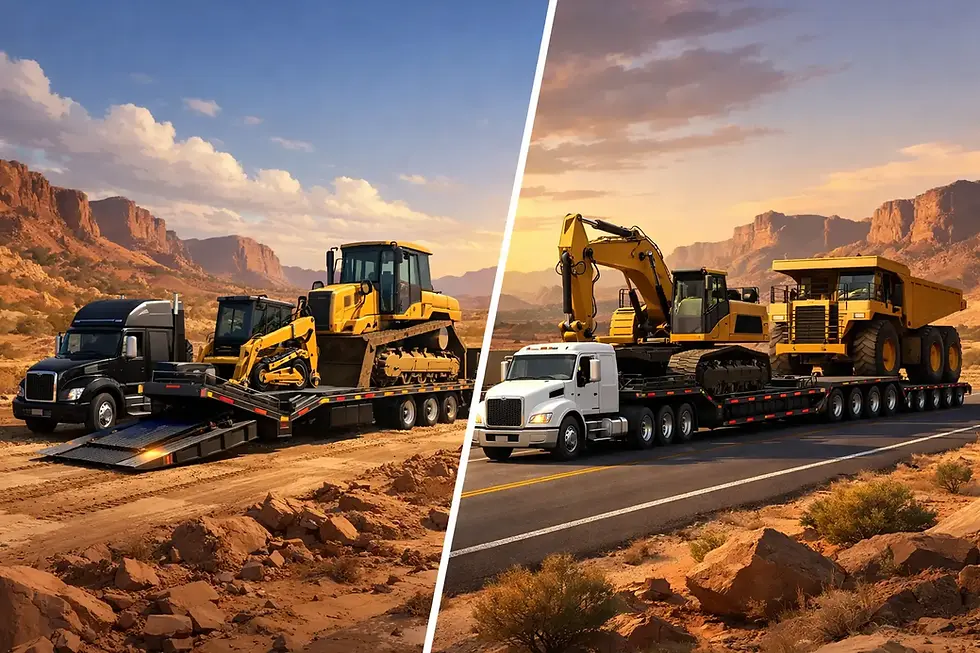
That could mean a lowboy for construction equipment with height concerns, an RGN for machines that need drive-on loading, a Landoll tilt deck for equipment that is awkward to load, or a multi-axle setup when the weight demands more than a standard heavy spec trailer can handle. The equipment choice is not a detail. It is the difference between a legal move and a bad plan.
From there, the carrier should be handling route review, permit planning, loading coordination, securement, and delivery scheduling. For oversize loads, even a short run can get complicated fast. Bridge limits, restricted travel hours, municipal rules, state permit lead times, and escort requirements all affect whether a shipment moves cleanly or sits.
Not all heavy haul trucking companies operate the same way
This is where buyers get burned. A company may present itself as a transporter, but the actual job is handed off through a broker network. That does not always mean the move will fail, but it does add layers between the customer and the truck doing the work.
When there is a permit issue, a loading problem, or a change at the delivery site, extra layers slow everything down. If your crew is waiting and the machine is needed that day, that matters. Direct communication with the carrier running the truck usually means faster decisions and cleaner execution.
Asset-based carriers have more control because they are scheduling their own fleet, their own drivers, and their own trailer inventory. That matters on specialized moves where the wrong trailer or the wrong driver can create real delays. If a company owns lowboys, RGNs, step decks, Landolls, and multi-axle equipment, that tells you they are set up for actual heavy haul work instead of trying to source capability after the quote is signed.
What to ask before hiring a carrier
The first question is simple. Are you the carrier, or are you brokering this load out? A lot of confusion gets cleared up right there.
Then get into capability. Ask what trailer they would use for your machine and why. If the answer is vague, that is a problem. A carrier that understands equipment transport should be able to talk through deck height, loading method, weight distribution, and any permit concerns without sounding like they are guessing.
You also want to know who handles permits and routing. On heavy equipment moves, those are not side tasks. They are central to whether the load moves on time and stays legal. If the carrier is experienced, they should already be thinking about dimensions, gross weight, axle spacing, state lines, and local access issues.
Finally, ask how they handle site conditions. Not every pickup is from a clean equipment yard. Some loads are sitting on a jobsite, in a pit, at a plant, or on uneven ground with limited room to maneuver. That changes loading strategy. It may also change trailer choice.
Red flags when comparing heavy haul trucking companies
Low price by itself is not a win in this business. If one quote comes in far below the rest, there is usually a reason. It may be missing permit costs, escorts, route complications, or realistic scheduling. It may also be based on the assumption that the company can find someone else to haul it later.
Another red flag is generic language. If every answer sounds like standard freight talk, you are probably not dealing with a true heavy haul operation. Oversize and overweight transport has specifics. You should hear specifics.
Poor communication early on usually gets worse once the load is booked. If it is hard to get a straight answer before pickup, it will not improve when there is a weather issue, a permit revision, or a delivery change. Commercial shippers do not need polished sales talk. They need real status, fast.
One more red flag is no clear explanation of legal compliance. A serious carrier should be able to explain how they approach permits, dimensions, securement, route review, and timing restrictions. If compliance sounds like an afterthought, move on.
Why trailer selection matters more than most buyers think
A lot of transport problems start with the wrong trailer choice. That can mean excess height, bad loading angles, poor weight distribution, or unnecessary rework at pickup.
For example, a lowboy makes sense when deck height is the issue and the machine needs to stay under route limits. An RGN is often the better call for larger tracked equipment because it allows safer loading and unloading without cranes. A Landoll can be the right fit for certain machines that are hard to load conventionally or need tilt deck access. Step decks help with loads that fit the weight profile but need more deck flexibility than a flatbed provides.
Then there are loads that go beyond standard heavy haul and require 9-axle or other multi-axle configurations. Once you are in that territory, experience matters even more. The move is no longer just about hauling. It is about engineering the load to travel legally across the planned route.
Regional experience counts, especially in the Southwest
If you move equipment through Arizona, Nevada, and the surrounding region, local knowledge helps. Desert routes, urban congestion, mountain grades, and state permitting differences all affect timing and equipment choice.
A carrier working regularly through Phoenix, Kingman, Las Vegas, and the broader Southwest is more likely to spot issues before they become delays. That does not mean a regional carrier cannot run nationwide. It means they understand the lanes where a lot of construction, mining, and industrial equipment is already moving.
For project managers and procurement teams, that kind of familiarity cuts down on surprises. The route may still be complicated, but the carrier has seen similar moves before and knows where problems tend to show up.
The real cost of choosing the wrong company
When a heavy haul move goes sideways, the damage is rarely limited to freight cost. You can lose site time, labor time, crane time, and production time. If the load shows up late or cannot be delivered as planned, every downstream task starts moving.
That is why the cheapest quote is often the most expensive decision. A dependable carrier costs what it costs because the work is being done correctly - proper trailer, proper planning, legal permits, securement, and direct coordination from pickup to delivery.
Companies like Flat Out Services are built around that model. The point is not to sound bigger than the job. The point is to control the job from the start so the load gets moved without broker confusion, handoff delays, or preventable problems.
What a good heavy haul partner looks like
The best heavy haul partner is direct, realistic, and prepared. They ask the right questions up front. They want machine specs, photos, pickup conditions, delivery requirements, and timing. They do not promise impossible transit times just to win the load.
They also understand that your shipment is tied to operations, not just transportation. If an excavator has to be on site before a crew mobilizes, or if a piece of plant equipment has a shutdown window, the move needs to line up with that reality. Good carriers plan around the job, not around wishful thinking.
When you are evaluating heavy haul trucking companies, look past the quote sheet. Look at control, equipment, communication, and whether the company sounds like it has actually moved the kind of iron you need hauled. The right carrier makes a difficult move feel organized. That is the standard worth paying for.


Comments