


How an Arizona Heavy Haul Company Plans Moves
- Flat Out Services
- Jul 22
- 6 min read

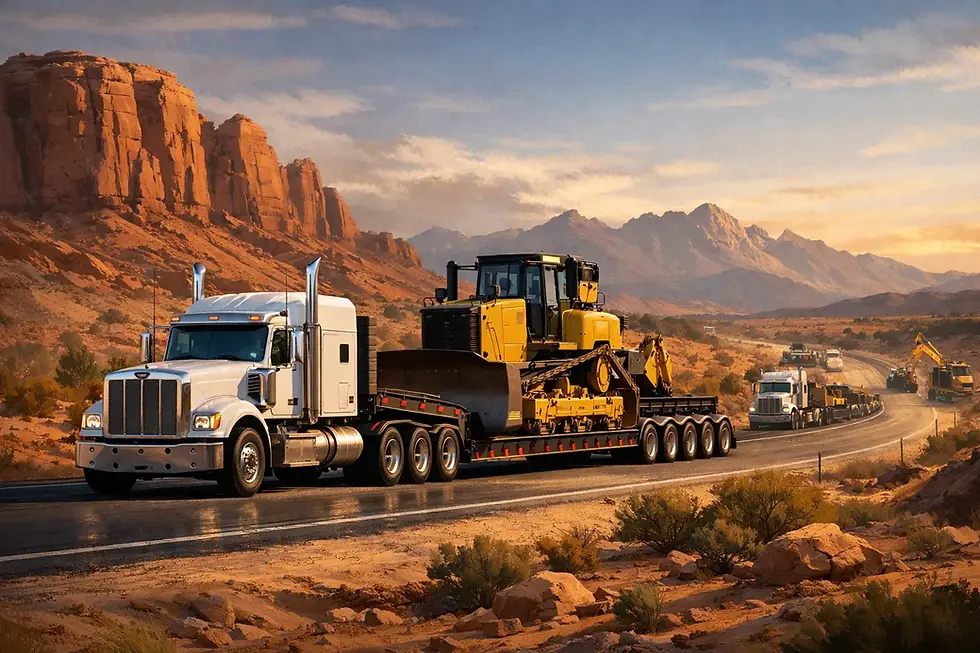
A 90,000-pound excavator can be a routine move or a week of preventable problems. The difference is usually decided before the truck arrives. An Arizona heavy haul company should be looking at machine dimensions, axle weights, permit restrictions, route geometry, and the conditions at both ends of the move as one operating plan, not as separate line items on a quote.
For contractors and equipment managers, the lowest transportation number is rarely the useful number if it assumes the wrong trailer, misses an escort requirement, or sends a loaded truck toward a bridge restriction. Heavy haul work in Arizona is often straightforward only after the details have been handled correctly.
What an Arizona Heavy Haul Company Evaluates First
The first question is not simply, “What does the machine weigh?” Weight matters, but it does not decide the whole move. A Caterpillar 336 excavator with the boom positioned correctly may fit a different trailer and permit category than the same machine loaded with the boom left high, a bucket attached, and the counterweight creating an unfavorable axle distribution.
An experienced dispatcher wants the complete transport configuration: operating weight, overall length, transport height, width, attachment dimensions, ground clearance, and any removable counterweights or components. Manufacturer specifications are a starting point, not a final loading plan. Added guarding, rock buckets, stick extensions, machine-mounted GPS hardware, and aftermarket tire configurations can change the practical dimensions.
The pickup and delivery locations deserve the same attention. A machine may be legal on the highway but difficult to load at a tight equipment yard with overhead lines, soft shoulders, or no room to turn an RGN. At an active jobsite, the issue may be a muddy access road, a paver spread blocking the laydown area, or a site superintendent who needs the machine delivered after crews clear a haul road. Those conditions affect trailer choice and scheduling.
Trailer Choice Is a Transport Decision, Not a Preference
Customers sometimes ask for a lowboy when the machine actually needs an RGN, or request a Landoll because it avoids arranging a loading ramp. Each trailer has a role, and forcing the wrong option usually adds time or risk.
A standard lowboy works well for many excavators, dozers, loaders, and paving machines when deck height and weight distribution stay within legal and permit limits. It is often the efficient answer for a predictable machine move with accessible loading conditions.
A removable gooseneck, or RGN, earns its place when a heavy machine needs to be driven on at ground level or when the load requires a lower deck and more axle capacity. Larger excavators, scrapers, crane components, and machines that cannot safely climb ramps are common RGN candidates. The tradeoff is that an RGN needs room to detach, load, reconnect, and turn. A cramped urban yard or narrow mine access can make that process harder than the highway miles.
Landoll tilt decks are useful for equipment that can be winched or driven onto a tilted deck, particularly when loading flexibility matters. They are not automatically the answer for every oversize machine. Deck angle, breakover clearance, load height, and final axle weights still have to work. A low-clearance machine can hang up during loading, while a tall machine may create a height problem once the deck returns to transport position.
For heavier or more concentrated loads, multi-axle configurations matter. A 9-axle setup is not simply a bigger truck. It is a way to distribute weight across more axle groups so the load can meet permit requirements, bridge formulas, and route restrictions. The additional axles can make a move legal and practical, but they also add length, turning requirements, cost, and loading complexity. More axles are justified when they solve a real weight or bridge issue, not because they look like extra insurance.
Axle Weights Can Change the Entire Plan
Gross weight is only one part of compliance. A load can be under an anticipated gross weight and still be a problem if too much weight sits on a particular axle group. That is why machine placement on the deck is deliberate. Moving an excavator forward or backward by a small distance can change the steer, drive, jeep, and trailer axle weights enough to require a different configuration.
This is especially relevant with dozers and wheel loaders. A dozer’s blade and ripper create a different balance than an excavator’s counterweight. A wheel loader may look compact, but its tire size and center of gravity can create width, height, and securement considerations that do not show up in a basic weight estimate.
Permits and Routing Need to Be Planned Together
Oversize permits are not permission to take any highway that appears convenient. A permit is tied to the load dimensions, axle configuration, and approved route. If any of those change after planning, the permit strategy may need to change too.
Arizona routes can create practical differences that are easy to overlook from a map. Interstate 10 may be the logical connection for a Phoenix-to-Southern California move, but construction zones, lane restrictions, and delivery access still need review. Interstate 17 grades and northern Arizona weather can affect timing and route choices for tall or heavy loads headed toward Flagstaff. The US-93 and Interstate 40 corridors around Kingman are important equipment routes, but turning movements, fuel access, and restricted local roads near the pickup or delivery point can be the actual constraint.
Route planning also means looking beyond state lines. A move between Las Vegas and Phoenix may involve differing permit requirements, travel-hour rules, and escort provisions. An experienced heavy haul operation determines where the load becomes overwidth, overheight, or overweight under each jurisdiction's rules rather than assuming one permit approach covers the entire trip.
Height is frequently underestimated. Contractors may measure the machine on the ground but not account for trailer deck height, suspension position, or the highest point of a boom, cab guard, exhaust stack, or attachment. A few inches can determine whether a route can use the most direct interstate path or requires a longer route to avoid low structures. Removing a component can be cheaper and faster than building the entire trip around it, but only if removal, loading, and reassembly can be done safely without disrupting the project.
Loading Preparation Prevents On-Site Delays
The truck cannot fix an unprepared machine. Before dispatch, confirm that the equipment runs, steers, brakes, and can be positioned for loading. If it is inoperable, say so early. Winching, lifting, or loading a disabled machine changes the equipment, labor, and site conditions required.
Attachments should be addressed before the truck is on the clock. An excavator bucket may be carried with the machine, loaded separately, or removed if it creates an avoidable length or weight issue. Crane mats, counterweights, sticks, blades, and paving components may need separate trailers. Trying to combine every component onto one trailer can save a truck in theory while creating an overlength, overweight, or poorly balanced load in practice.
Securement is part of the plan, not a final task at the gate. Tie-down points must be accessible, the deck must be clear where chains need to run, and loose materials must be removed from the machine. Greasy tracks, damaged attachment points, and mud-packed undercarriages all slow down securement and can require a different loading approach.
At the jobsite, designate a responsible contact who can direct the driver to the actual loading area. “Meet at the gate” is not enough on a large grading, mining, or highway project. The driver needs a safe route in, a place to turn, clear overhead space, and an area where loading will not conflict with haul trucks, cranes, or active crews.
Scheduling Around Real Restrictions
A heavy haul schedule is not the same as a standard delivery appointment. Permit travel windows, escort availability, weather, traffic restrictions, and daylight loading requirements can control the timeline. A load that is physically ready at 4 p.m. may not be able to start its permitted movement until the following morning.
One mistake contractors make is scheduling the machine move for the same hour they need the machine working. Allow time for loading, securement, permit-compliant travel, site entry, unloading, and final inspection. This matters most when the machine is needed to open a new phase of work, support a crane pick, or replace a down unit at a mine or paving operation.
Direct, asset-based hauling helps here because the people planning the move understand the available trailers and drivers instead of relaying details through a broker chain. At Flat Out Services, the planning focus is matching the actual machine and site conditions to the available heavy haul configuration before a problem becomes a roadside delay.
The best information a contractor can provide is simple: current machine photos from all sides, serial or model information, dimensions and attachments, pickup and delivery contacts, site access details, and the true deadline. With those details in hand, the transport plan can be built around the job instead of asking the job to adapt after the truck arrives.


Comments