


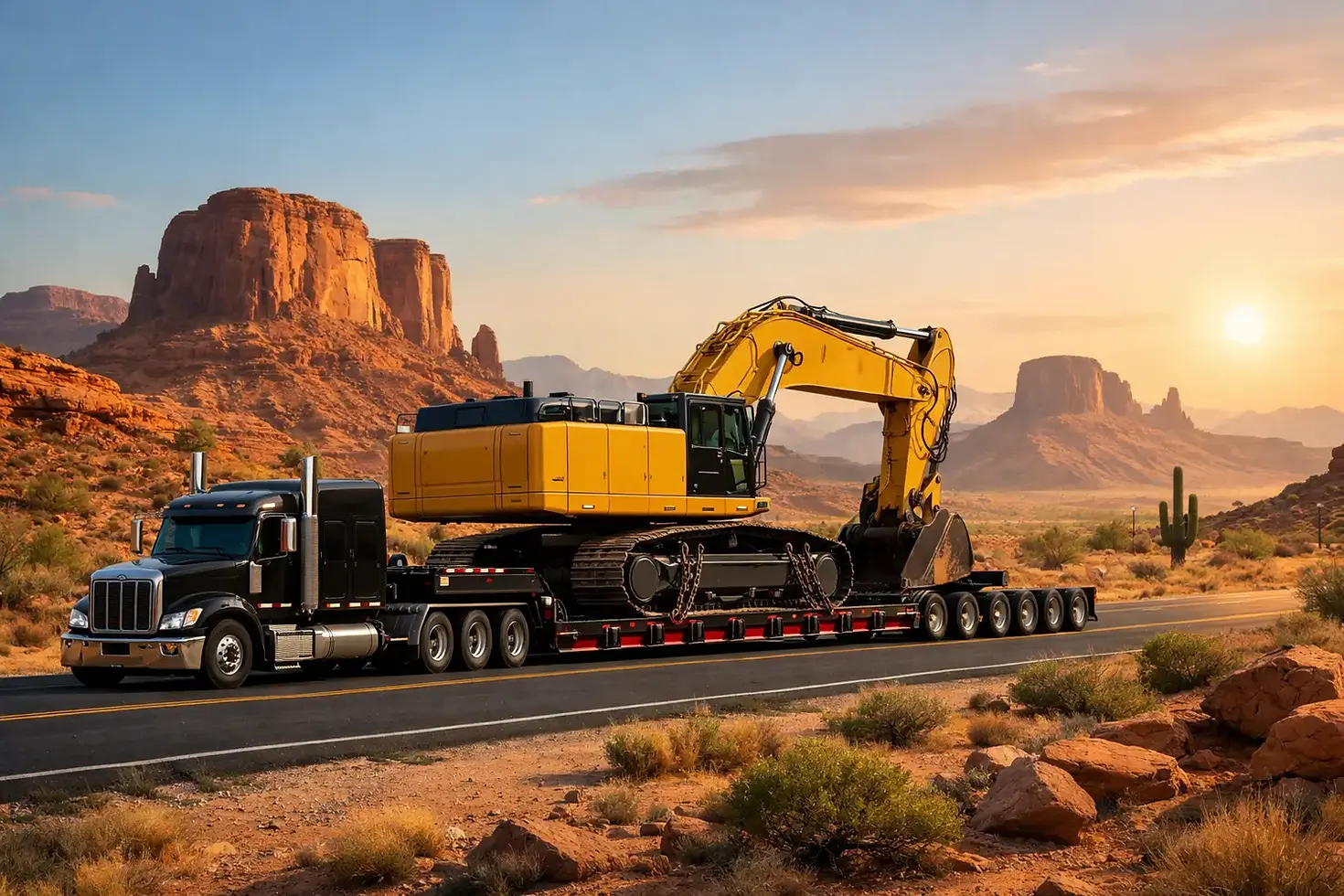
Cat 395 Excavator Transport in Arizona

A Cat 395 is the kind of machine that changes the whole transport plan. Once you get into this class of excavator, you are not talking about a routine lowboy move from one subdivision project to the next. Cat 395 excavator transport in Arizona usually means a full oversize and overweight move with real planning behind it - trailer selection, axle count, route review, permit timing, and jobsite access all matter before the machine ever starts climbing the deck.
In Arizona, that matters even more because the route can change fast depending on where the machine is going. A move out of Phoenix is different from a mine haul in northern Arizona. A run toward Tucson is different from hauling west toward Kingman or toward the California line. Grades, bridge restrictions, urban traffic windows, and permit requirements all affect how the load gets built and when it can move.
What makes a Cat 395 difficult to haul
The Cat 395 sits in a weight and size class where assumptions cause delays. Transport weight depends on the exact machine setup, but with bucket, counterweight, stick, and other attachments involved, the load can quickly push beyond what a standard detachable lowboy should handle without modification or disassembly. Width and overall loaded height are also major factors, especially if the machine is moving with components left installed to save field labor.
That is why experienced heavy haul carriers start with the actual machine configuration, not the brochure spec. Long-reach arrangement, bucket size, guarding, quick coupler, aftermarket work, and whether the counterweight is coming off all change the transport plan. If a contractor says, "It's just a 395," that is not enough information to quote or schedule the move correctly.
For this size excavator, the transport solution often involves an RGN or a multi-axle lowboy setup built for concentrated weight. In some cases, the cleanest path is to break the machine down and move major components separately. That can mean more loading time up front, but it may reduce permit complications, improve route options, and lower the chance of getting hung up on height or bridge issues.
Cat 395 excavator transport in Arizona starts with the route
Arizona is not one uniform hauling environment. The right route for a Cat 395 depends on whether the machine is heading to a freeway job in metro Phoenix, a solar site in the desert, a mine corridor in the north, or a remote civil project with county road access.
Interstate moves look simple on paper, but oversize and overweight loads do not move like normal traffic. There may be restricted travel windows, metro area timing limits, and approval requirements based on gross weight and axle spacing. A route on I-10 or I-17 can work well if the axle group matches the permit and the height is under control. If not, the carrier may need to reroute around structures or travel at different times to stay legal.
US-93 and I-40 create their own issues. Those corridors are common for equipment heading between Phoenix, Kingman, Las Vegas, and northern Arizona, but bridge ratings, lane widths, and enforcement exposure are not things to guess at. The route has to fit the load, not the other way around.
For mine and project work, the final miles are often the hard part. The permit route may get the machine close, but soft access roads, tight gate entries, overhead obstructions, and uneven loading areas can turn a legal haul into a jobsite problem. A carrier that handles heavy equipment regularly in Arizona will ask about the pickup and delivery surface, room to turn, and whether another machine is available to assist with unloading if needed.
Trailer choice matters more than people think
For a Cat 395, trailer choice is not just about capacity. It is about deck height, axle distribution, loading angle, and how the machine sits once it is secured. A standard lowboy may work for smaller excavators every day, but this class of machine usually calls for specialized heavy haul equipment.
An RGN is often the practical choice because it gives a lower deck height and cleaner loading for large excavators. That lower deck can make the difference between a permitted legal-height move and a route that becomes impossible without major disassembly. Multi-axle combinations also help distribute the weight where the permit requires it.
There are situations where a 9-axle setup makes sense, especially when the machine is moving with enough installed weight that axle concentration becomes the controlling issue. That is where asset-based heavy haul capacity matters. When the carrier controls the trailer fleet and knows how to configure it for the load, decisions happen faster and with fewer surprises. You are not waiting on a broker to figure out what trailer might be available from someone else.
Permits, escorts, and timing
A Cat 395 move in Arizona is usually won or lost in the pre-move paperwork and scheduling. Permits are not just a formality. They define the route, the approved dimensions and weights, and the conditions under which the load can travel.
If the machine dimensions are wrong on the permit because the bucket or stick length was guessed, the load can get delayed before it clears the yard. If the axle spacing on the permit does not match the actual trailer configuration, that is another problem. For large excavator moves, permit accuracy has to match the machine and the exact hauling setup.
Escort requirements depend on the final dimensions and route. Height poles may be needed on some moves. Travel may be restricted to daylight hours, and some metro areas may have tighter windows to avoid commuter traffic. When the move is tied to a shutdown, paving sequence, or mine production schedule, those restrictions need to be accounted for early, not after the crew is already waiting.
Loading and securement are not routine on a 395
Loading a machine this size is not the same as putting a mid-size excavator on a detachable and chaining it down. Ground bearing pressure at the loading point, ramp angle, trailer position, boom placement, and final weight balance all matter. If the pickup yard is uneven or soft, loading may need to happen somewhere else.
Securement also has to reflect the real machine geometry. The way the boom and stick are positioned affects overall length and weight distribution. Bucket placement can change front axle loading on the tractor and neck. Counterweight position matters. So does whether components are removed and loaded as separate pieces.
This is where heavy haul experience shows up quickly. A crew that regularly moves large excavators knows how to set the machine on the deck so the permit, route, and axle group all work together. A crew that does not will burn time adjusting after the machine is already loaded.
Arizona conditions change the transport plan
Heat, distance, and terrain are part of the move. Summer hauling in Arizona puts extra pressure on tires, hydraulic systems, securement checks, and scheduling. Long grades between elevation changes affect how the load is pulled and where checks need to happen. Wind exposure in open corridors can also change travel conditions for a tall excavator load.
Project timing matters too. A machine coming off one job and heading straight to another usually does not have much margin for permit delays or trailer availability problems. Contractors and equipment managers need realistic pickup timing, not vague promises. That is why direct communication with the actual hauling operation matters on these moves.
Flat Out Services works in this kind of environment because the move is not theoretical. It is a real machine, on a real schedule, moving through Arizona corridors where route details and equipment setup decide whether the load goes smoothly or sits.
When breakdown transport makes more sense
Not every Cat 395 should move assembled. If the planned route creates height problems, bridge issues, or difficult county access, stripping the bucket, stick, or counterweight can be the better decision. It adds labor and may require an assist machine or crane on one end, but it often opens safer and cleaner route options.
That trade-off depends on schedule and site conditions. If field labor is available and the route is tight, breakdown transport may save a day of delays. If the machine needs to move fast between major highway-accessible projects, a more assembled move on the right multi-axle trailer may be worth it. There is no one-size-fits-all answer with a 395.
For contractors planning one of these moves, the best starting point is simple: give the actual machine configuration, pickup and delivery locations, and any jobsite restrictions up front. That saves time and gets the transport plan built around the machine you really have, not the one someone assumed. On a Cat 395 in Arizona, that is usually the difference between a move that works and one that starts late.


Comments