


Construction Equipment Hauling Done Right
- Flat Out Services
- 1 day ago
- 6 min read

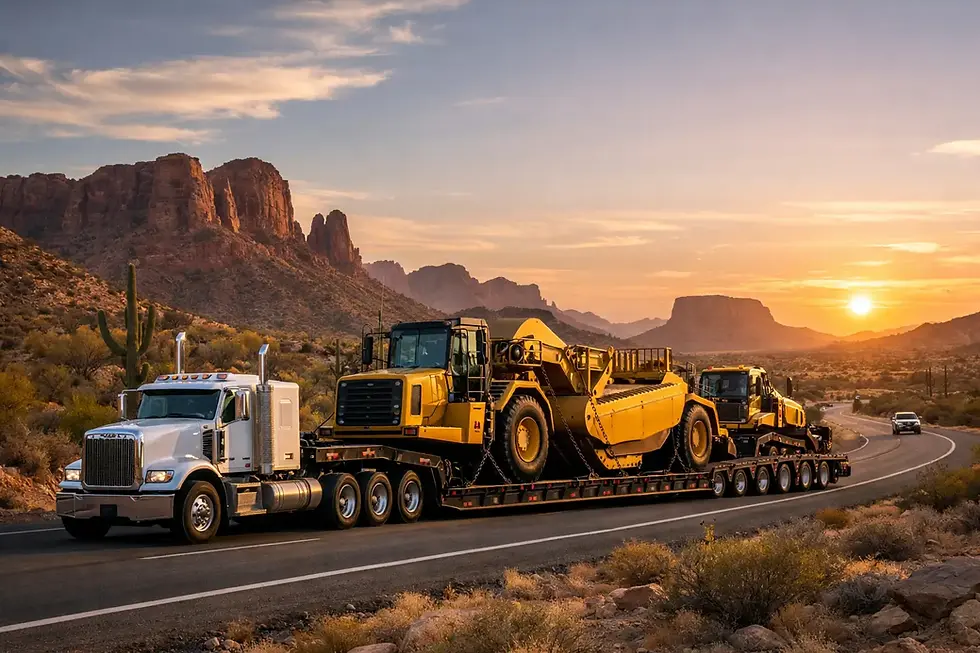
A scraper sitting still at 6:30 a.m. can burn more money than the truck moving it. That is why construction equipment hauling is rarely just about finding a trailer and a driver. The real work happens before the truck shows up - matching the machine to the right trailer, building a legal axle configuration, checking route limits, and making sure the pickup and delivery sites will actually support the move.
Contractors often assume transport gets easier once the machine is loaded. In practice, that is when bad planning starts to show. A machine that is too tall on the wrong lowboy, a permit route that ignores a weak bridge, or a delivery site with no room to detach an RGN can turn a routine move into a day-long problem.
What experienced construction equipment hauling actually involves
For most construction fleets, the machine itself is only one part of the decision. Transport strategy changes based on dimensions, operating weight, attachment setup, loading method, jobsite conditions, and how quickly the equipment needs to go back to work.
Take a Caterpillar 336 excavator versus a mid-size wheel loader. Both are common moves, but they do not haul the same way. The excavator may need boom positioning, bucket removal, and a lower deck height to stay legal on overall height. The wheel loader may load quickly on a Landoll if weight works, but tire width, bucket width, and axle spacing can change whether that is the smart choice or just the fast one.
This is where experienced heavy haul planning matters. The goal is not simply to move the machine. The goal is to move it legally, without wasting field time, and without creating jobsite delays on either end.
Trailer selection is where most good moves start
A lot of transport problems trace back to trailer selection. Customers sometimes ask for a specific trailer because that is what hauled the machine last time. That can be useful, but it is not always the best answer for the next move.
A lowboy is often the right fit for heavier excavators, dozers, and many paving machines because deck height helps control overall loaded height. An RGN becomes valuable when the machine needs to drive on from the front and when weight and length justify a more specialized setup. A Landoll tilt deck can be the right call for certain loaders, smaller rollers, support equipment, or machines moving between tighter locations where simple loading matters more than maximum capacity.
The trade-off is speed versus capability. A Landoll can be efficient, but not every piece of equipment belongs on one. A lowboy or RGN may take more planning, but they often solve height, weight distribution, or loading angle issues that a simpler trailer cannot.
One mistake contractors make is focusing only on gross weight. Gross weight matters, but deck length, neck style, axle spread, and loaded height are just as important. A machine that fits by weight can still be the wrong load if the boom sticks too high, the counterweight loads too far back, or the axle group cannot be balanced correctly.
Lowboy, RGN, or Landoll?
There is no universal best trailer for construction equipment hauling. It depends on the machine and the route.
Lowboys are common because they handle a wide range of excavators, dozers, and other heavy iron while keeping the load lower. RGNs are often the better choice for large or heavier machines that need a stable loading approach and better weight distribution options. Landolls earn their place when the move needs flexibility, faster loading, or better access at pickup and delivery, but they are not a substitute for a true heavy haul setup when dimensions push past practical limits.
If the move starts looking close on multiple variables, close usually means it deserves a different trailer.
Permits and axle configurations are not paperwork details
Oversize permits are often treated like an administrative step. In real operations, permits shape the whole move. Width, height, weight, length, and axle spacings all affect what route is available, what time the load can move, and whether escorts are needed.
That matters a lot in the Southwest, where construction and mining routes can involve state highways, municipal restrictions, bridge limitations, and long stretches between practical alternates. A legal setup from Phoenix to Kingman may not be the same setup you would want on a move heading into Southern California or up through northern Arizona.
Axle configuration is part of that strategy, not a last-minute adjustment. More axles spread weight, but they also change turning behavior, route flexibility, loading geometry, and the amount of room needed at the site. A 9-axle combination can solve one problem while creating another if the pickup yard or delivery point is tight.
Experienced heavy haulers think through those trade-offs early. If a machine can move on fewer axles legally and safely, that may simplify permits and routing. If it cannot, forcing a lighter configuration usually costs more time later.
Route planning is about clearance, access, and real conditions
A map route and a haul route are not the same thing. That shows up fast with oversized construction equipment.
Bridge heights, utility conflicts, turn radiuses, road construction, school-zone restrictions, and local permit conditions all change what looks like the shortest path. The fastest route on paper can be the wrong route for an excavator with the stick pinned high or a dozer blade that pushes width into escort territory.
Then there is site access. A delivery point may be only a few miles off the highway, but if the entrance is soft, narrow, or crowded with parked equipment, unloading becomes the real challenge. We have found that some of the hardest parts of a move happen in the last 300 feet, not the last 300 miles.
That is why experienced planners ask questions that sound basic but are not. Is the machine running? Can it self-load? Is there room to pull straight in and detach? Is the ground stable enough for concentrated axle loads? Are there overhead lines at the jobsite entrance? Those details drive transport decisions as much as permit dimensions do.
Equipment prep can save hours, or ruin a schedule
Machines rarely show up exactly as the transport plan assumes. Buckets are left installed, masts are not folded, counterweights stay on, and jobsite crews expect the hauler to sort it out on arrival.
Sometimes that works. Often it does not.
For construction equipment hauling, prep should be treated as part of the move, not something separate from it. On excavators, boom and stick position matters for height and center of gravity. On dozers, blade width and ripper position affect legal dimensions and securement approach. On paving equipment, loose components and fragile controls may require a different loading plan than the machine's weight alone would suggest.
If attachments need to come off, that should be decided before dispatch, not after the truck reaches the yard. If the machine is non-running, loading method changes again. You may need winching, blocking, a different trailer angle, or more room than the site can easily provide.
Customers often assume a running machine is automatically easier. Usually it is, but not always. A running machine with limited steering, weak brakes, or poor track condition can be more unpredictable than a dead machine loaded with a controlled plan.
Scheduling has to match the job, not just the truck
A good haul schedule accounts for permit windows, travel restrictions, loading time, and site readiness. It also accounts for the cost of being early or late.
If a crane assist crew, paving crew, or excavation team is waiting on a machine, transport timing becomes a field operations issue, not just a dispatch issue. On the other hand, showing up too early to a locked site or unfinished laydown yard creates the same kind of waste.
This is one reason direct, asset-based heavy haul operations tend to make cleaner decisions than brokered moves. The people planning the move understand the trailer, axle setup, and route realities tied to that specific load. That reduces the back-and-forth that causes bad assumptions.
For contractors moving equipment across Arizona, Nevada, and Southern California corridors, local route familiarity also matters. Interstate access is only part of the picture. The real value is knowing where oversize loads slow down, where escorts become a bottleneck, and which site conditions tend to create unloading problems.
Flat Out Services works in those conditions every day, and that kind of regional experience changes how a move gets planned from the start.
Why the cheapest quote is often the most expensive move
Price matters. Every equipment manager knows that. But construction equipment hauling is one of those areas where a cheap rate can hide expensive assumptions.
If the quote is built around the wrong trailer, incomplete dimensions, or a permit plan that falls apart after dispatch, the savings disappear fast. The machine sits, the crew waits, and someone has to explain why a move that looked simple is now delayed.
The better question is not just what the haul costs. It is what level of planning is built into that price. A hauler who asks detailed questions up front is usually not making the move harder. They are trying to keep it from going sideways once the truck is committed.
When a heavy haul team starts by looking at the machine, trailer, route, permits, loading method, and delivery conditions together, the move tends to go smoother because the plan matches the real job. That is the difference between just booking transport and actually managing risk.
The most useful thing you can do before your next equipment move is simple: treat hauling as part of project planning, not as a last-day task. That is usually where the expensive mistakes start.


Comments