


Heavy Equipment Transport Cost Guide

A 35,000-pound excavator going 60 miles can cost more to move than a heavier machine going twice as far. That is why any honest heavy equipment transport cost guide has to start with one point: miles matter, but they are not the main thing. In heavy haul, price follows the transport plan. Trailer choice, axle count, permits, route restrictions, loading conditions, and timing usually move the number more than the odometer does.
Customers often assume transport pricing is mostly weight plus distance. In practice, experienced heavy haul carriers price risk, legal requirements, and time on task. A machine that loads clean on an RGN from a paved yard is one kind of job. A machine with a wide stick, questionable brakes, no loading area, and a delivery point inside an active project with limited access is a different job entirely, even if the distance is short.
What actually drives heavy equipment transport cost
The first cost driver is the machine itself, but not just its published operating weight. What matters is transport weight, overall width, transport height, deck length needed, axle loading, and whether parts need to be removed. A Caterpillar 336 excavator may be manageable on one setup if the boom is tucked and the bucket comes off. A larger mining loader or scraper may require a completely different trailer configuration because the axle weights and dimensions change the permit class and route options.
The second driver is trailer selection. This is where cheap quotes often fall apart. If the machine fits legally and safely on a standard lowboy, that is usually a more efficient move than building a larger combination around it. But forcing a machine onto the wrong trailer to save money on paper often creates delays, reloads, permit issues, or height problems.
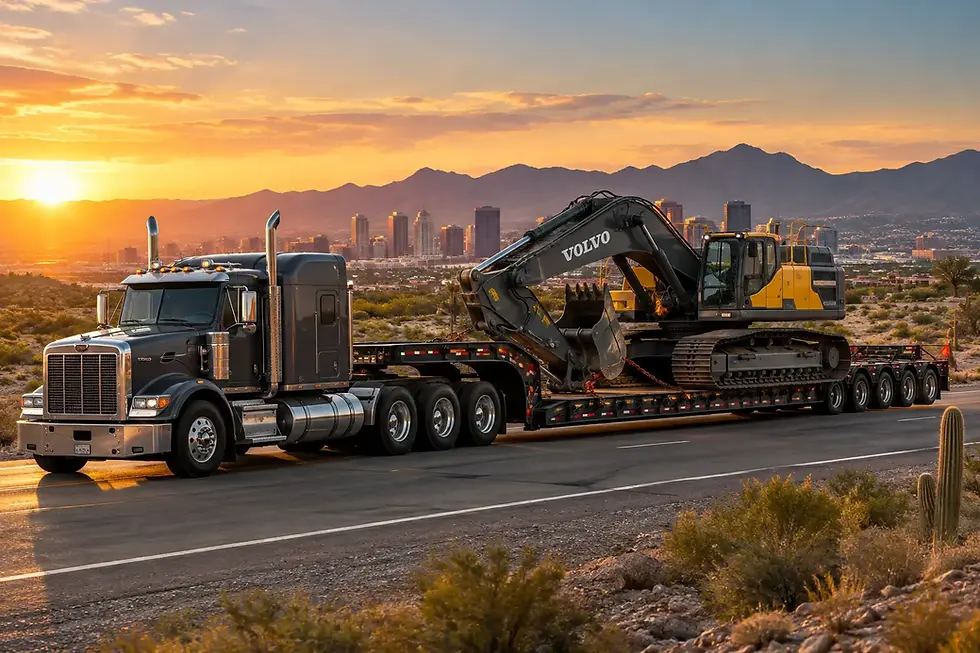
An RGN works well when ground loading is straightforward and you need low deck height for taller equipment. A Landoll tilt deck transportation can be the better answer for certain machines, auction pickups, or locations where loading angles and site conditions make detach trailers less practical. Multi-axle heavy haul setups come into play when axle weights or concentrated loads would overload a lighter configuration. Those trailers cost more because they should. More axles, more iron, more permit work, and more route limitations mean more time and more planning.
Trailer selection and cost are tied together
A practical heavy equipment transport cost guide should explain why trailer choice affects more than the line item for equipment. It changes the whole move.
Take a dozer as an example. If the blade width keeps the load in oversize territory, the rate is not just higher because the machine is wider. Now you may need additional permits, restricted travel windows, pilot cars in some jurisdictions, and a route that avoids problem bridges or tight urban turns. If removing the blade makes the load legal or easier to route, the total transport cost may drop even after accounting for labor to remove and reinstall it. That is the kind of tradeoff experienced haulers evaluate early.
The same goes for cranes and paving equipment. Machines with odd weight distribution can require more deck space or more axle spread than customers expect. A shorter machine is not automatically cheaper if the weight is concentrated badly. We have found that concentrated axle loading is one of the least understood cost drivers by contractors who do not arrange heavy haul moves every week.
Permits are not a minor add-on
Permits are often treated like a small extra, but on many oversized moves they drive the schedule and the route, which then drives the cost. In Arizona, Nevada, and Southern California, heavy equipment transportation planning can change based on width, height, gross weight, axle spacing, county rules, city restrictions, and planned travel times. A load that is legal in one state line crossing may need a different strategy 30 miles later.
That matters because permit work is not just a filing fee. It is route review, bridge analysis in some cases, curfew planning, escort coordination, and timing around utility conflicts or local restrictions. If a move requires a longer route to stay legal, your cost goes up even if the machine itself never changed.
One mistake contractors make is treating permits like a final paperwork step. In reality, permit strategy should shape the quote from the beginning. If your transporter is asking detailed questions about transport dimensions, attachments, exact pickup and delivery points, and site access, that is not overcomplicating the job. That is how costly surprises get avoided.
Loading conditions can change the price fast
Two identical machines can have very different transport costs if one is sitting in a clean equipment yard and the other is buried at a rough jobsite with limited maneuvering room. Loading method matters.
Ground-loading onto an RGN is usually efficient when the machine runs well and the site is level enough to line up safely. A machine that does not run, has a hydraulic issue, or cannot climb onto a trailer normally may require winching, cranes, jacking, or additional support equipment. That adds time, labor, and liability.
Jobsite access is another major factor, especially on mining and industrial projects throughout the Kingman trucking service area. Tight gates, overhead utilities, soft ground, steep approaches, and active crews around the loading zone all slow the move down. On urban project sites, the machine itself may be easy to haul, but getting truck and trailer in and out without shutting down site activity can be the real cost issue.
Distance matters, but not the way people think
There is a fixed-cost floor on heavy equipment moves. Mobilizing the truck and trailer, assigning the right driver, planning the route, handling permits, and loading the machine all happen whether the trip is 25 miles or 250. That is why short hauls can look expensive on a per-mile basis.
Longer hauls spread those fixed costs out, but they bring their own issues. More state lines, more permit coordination, more exposure to travel restrictions, and more chance that timing slips on either end. A Phoenix heavy haul may be straightforward on one machine and complicated on another depending on size and legal route options. A Las Vegas heavy haul project heading into Southern California may look simple on a map but become more expensive if the load triggers stricter width or height controls.
Timing is a real cost factor
If a machine needs to move tomorrow morning, the cost may be higher than if the move can be planned two or three days out. That is not just because of truck availability. Rush moves reduce routing options, compress permit timelines, and can force a carrier to dedicate equipment that was scheduled elsewhere.
There is also a difference between urgency and efficiency. We have seen jobs where waiting half a day for the right trailer saves more money than forcing the first available truck onto the move. Fast response matters, but experienced dispatchers know when speed helps and when it creates rework.
Equipment prep is where customers can save money
The cleanest way to control transport cost is preparing the machine properly before the truck arrives. Remove loose attachments when practical. Know the true transport dimensions, not the brochure dimensions. Make sure the machine starts, steers, and can be positioned for loading. Have the pickup contact ready, the loading area clear, and the delivery site confirmed.
This is especially important on oversize machines. If the hauler arrives and finds the boom was not lowered as described, the tires are flat, or the blade still needs to come off, the quote may no longer match the job. Most pricing disputes in heavy haul do not start with rate games. They start with bad load information.
Cheap quotes usually leave something out
A low quote is not always wrong, but it usually deserves questions. Is the trailer actually right for the machine? Are permits included? Are escorts included where required? Is loading assistance assumed? Is route planning based on actual dimensions or a guess? Is detention built in if the jobsite delays the truck?
In specialized hauling, missing one of those details does not just affect billing. It can stop the move. Asset-based carriers that run their own lowboys, Landolls, RGNs, and multi-axle combinations generally have a better handle on these variables because the quote is tied to actual available equipment, not a generic market rate.
That is one reason experienced contractors often value a detailed quote over a fast vague one. The detailed quote tells you somebody thought through the move.
How to use this cost guide when requesting pricing
If you want an accurate number, provide the exact machine model, serial if available, transport dimensions, attachment details, running condition, pickup and delivery addresses, and any site restrictions. Mention if the machine is in a yard, on dirt, inside a project, or behind a narrow gate. If timing is flexible, say that too. Flexibility can create better equipment matches and lower total cost.
The best transport pricing comes from treating the move like an operation, not a commodity. Professional heavy equipment transportation is not just truck plus trailer. It is matching the machine, the route, the permits, and the loading plan before the first wheel turns. That is where costs are controlled, and that is usually where expensive mistakes are prevented.


Comments