


RT Crane Transport: What Actually Matters
- Flat Out Services
- 22 hours ago
- 6 min read

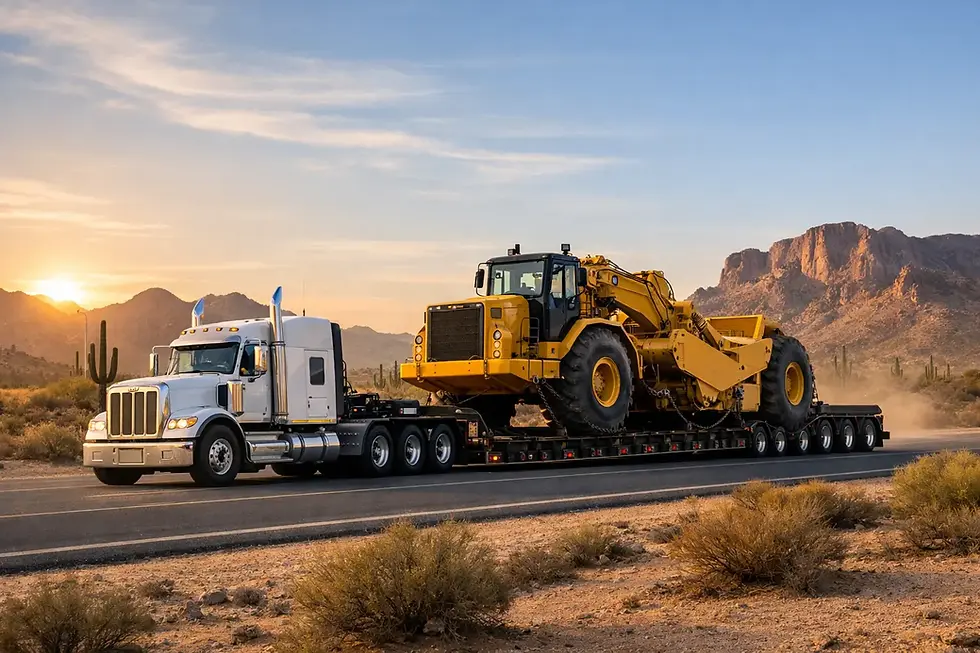
An RT crane can look simple to move compared with a truck crane or crawler, right up until the dimensions and jobsite conditions start working against you. That is where RT crane transport gets misjudged most often. Contractors see a rubber-tire machine and assume the move will be straightforward, but the real planning usually comes down to transport width, gross weight, tire and axle loading, boom and counterweight configuration, and how much room exists to load and unload safely.
Rough terrain cranes are built to move around jobsites, not to run long distances on public roads at transport speed. Even when the crane can technically travel under its own power for a short reposition, hauling it is usually the smarter call once distance, traffic exposure, permit limits, and job schedule are factored in. The mistake is thinking the question is just, can this crane be hauled? The better question is, what trailer setup and permit strategy gets it there legally, safely, and without burning half a day at each end.
RT crane transport is mostly a planning job
The crane itself is only part of the load. What matters first is the actual transport configuration. On many RT models, the shipping dimensions change depending on whether the boom is fully nested, whether the swing lock is functioning properly, whether the counterweight stays on, and whether the hook block, outriggers, jib components, or auxiliary attachments are removed.
Customers often assume published brochure weight is enough to quote a move. In practice, brochure numbers can get you in trouble fast. The transport team needs actual configuration details, because a rough terrain crane that looks like a legal lowboy load on paper can turn into an oversize and overweight move once fuel, rigging, optional counterweight, and attachments are accounted for. A few thousand pounds or a few inches of width can completely change axle requirements, permit routing, and escort needs.
That is why experienced heavy haul carriers ask more questions than some customers expect. They are not slowing the process down. They are trying to avoid sending the wrong trailer, building the wrong permit package, or showing up to a site where the crane cannot be loaded as configured.
Trailer choice for RT crane transport
A lot of RT crane transport moves go on a lowboy or RGN, but that does not mean every crane belongs on the same trailer. The trailer decision depends on deck height, axle spread, loading angle, machine weight, and site conditions.
Lowboy and RGN setups
For many rough terrain cranes, a detachable gooseneck lowboy or RGN is the cleanest option because it keeps overall height down and gives a controlled loading angle. That matters when you are dealing with cranes that already sit tall or have limited tolerance for steep transitions. A lower deck can be the difference between a manageable oversize permit and a route that becomes difficult or impossible because of bridge and overhead restrictions.
The tradeoff is that not every site works well for an RGN detach. If the pickup point is tight, soft, uneven, or crowded with material and parked equipment, getting room to drop the neck and line up the crane can be a problem. Good transport planning accounts for that before dispatch, not after the truck arrives.
Landoll and tilt deck situations
Some contractors assume a Landoll is the answer anytime the crane needs to be loaded quickly. Sometimes it is. A Landoll can be a solid choice when site access is tight and the crane size is still within practical trailer capacity and deck height limits. It can also help where ground conditions make a full detach awkward.
But Landolls are not the fix for every RT crane. Deck height is the big limiter. If the crane is already pushing height, putting it on the wrong trailer can turn a routine move into a route problem. That is why experienced carriers do not pick trailers based on loading convenience alone.
Multi-axle heavy haul combinations
Once the RT crane gets into heavier classes, especially with limited disassembly or difficult state weight thresholds, multi-axle configurations start to make more sense. The point is not just carrying the weight. It is distributing it in a way that works with permit requirements and bridge formulas across the route.
That is where real heavy haul judgment matters. A lighter trailer might physically carry the machine but create permit problems because the axle spacing or concentrated load is wrong for the route. A heavier multi-axle setup may cost more up front but save time and trouble by opening better routing options.
Weight and width change the whole move
With rough terrain cranes, width is often the first issue, but not always the hardest one. A crane can be within a manageable width range and still become a difficult haul because the weight lands poorly on the trailer or the boom position creates height issues.
One mistake contractors make is focusing on maximum rated lift capacity instead of transport dimensions. A 50-ton RT and an 80-ton RT are not just separated by chart capacity. They can require very different hauling plans. Tire size, axle layout, superstructure geometry, counterweight design, and boom structure all affect how the load sits and how the permit office sees it.
If the crane can be stripped into a more favorable transport setup, that usually helps. Removing the hook block, pulling jib sections, reducing fuel, and hauling counterweight separately can make a meaningful difference. The tradeoff is added labor, extra handling, and more coordination at pickup and delivery. If the crane needs to be working immediately on arrival, disassembly savings on the road can be lost at the jobsite.
Permits and route strategy in the Southwest
This is where RT crane transport separates experienced heavy haul operators from general equipment haulers. Arizona, Nevada, and Southern California do not reward guesswork. Routes that look fine on a map can fall apart because of bridge postings, construction restrictions, city permit windows, overhead clearance concerns, or escort triggers.
A crane move from Phoenix to Las Vegas, for example, is not just an interstate run. It is a permit and timing exercise. Width may drive escort requirements. Weight may determine which route segments are even available. Delivery timing can matter if the final miles involve municipal restrictions or a jobsite with limited access during working hours.
The same applies in mining and infrastructure corridors. A route that is acceptable for a dozer or excavator is not automatically a good route for a rough terrain crane. Crane transport often has different height and load distribution concerns, and the pickup or delivery points are frequently less forgiving.
In our experience, permit strategy should be built around the actual operating schedule, not added at the end. If a crane must arrive for a critical pick the next morning, the load plan, route, escorts, and loading timeline need to support that from the start. Too many delays come from treating permits like paperwork instead of part of operations.
Loading and unloading are where problems show up
Most transport issues with RT cranes do not start on the highway. They start in the yard or on the jobsite. The trailer arrives, and suddenly there is not enough room to swing into position, the ground will not support the setup, the crane is parked nose-in between other machines, or the machine has a mechanical issue that makes loading unsafe.
A rough terrain crane may drive well enough on site but still be a bad loading candidate if steering is inconsistent, brakes are weak, a tire is damaged, or the swing lock will not hold properly. Those details matter because loading onto a lowboy is a controlled maneuver, not a casual reposition.
Good site preparation is simple but often skipped. The crane should be accessible, attachments identified, loose items secured, transport dimensions confirmed, and loading ground checked ahead of time. If counterweight or rigging is coming off, there should be a plan for who handles it and where it rides. If escort vehicles are needed, the schedule should reflect that, not assume they will appear on short notice.
One reason asset-based heavy haul carriers tend to perform better on these moves is that trailer selection, dispatch timing, and load method are all being managed together. That matters when the machine, the route, and the jobsite all have constraints.
Common assumptions that cost time
The first bad assumption is that all RT cranes haul about the same. They do not. Even within similar capacity classes, transport dimensions and loading behavior vary a lot by manufacturer and model.
The second is that the cheapest trailer option is the most efficient one. Sometimes a smaller setup saves money. Other times it creates permit delays, awkward loading, or route restrictions that cost more than the trailer upgrade.
The third is that roadability means the crane can just be driven there. For very short repositioning, maybe. But once public exposure, wear, escort issues, and operator time are considered, hauling usually makes more operational sense.
Flat Out Services sees this regularly on Southwest crane and equipment moves - the load that goes smoothly is usually the one that was planned around real dimensions, actual site conditions, and the route that fits the machine, not the route someone hopes will work.
If you are pricing an RT crane move, the useful question is not just what it costs per mile. Ask what configuration makes the move legal, what trailer keeps height and loading risk under control, what pieces should come off before transport, and what the jobsite needs to have ready when the truck shows up. That is usually where the schedule gets protected.


Comments