


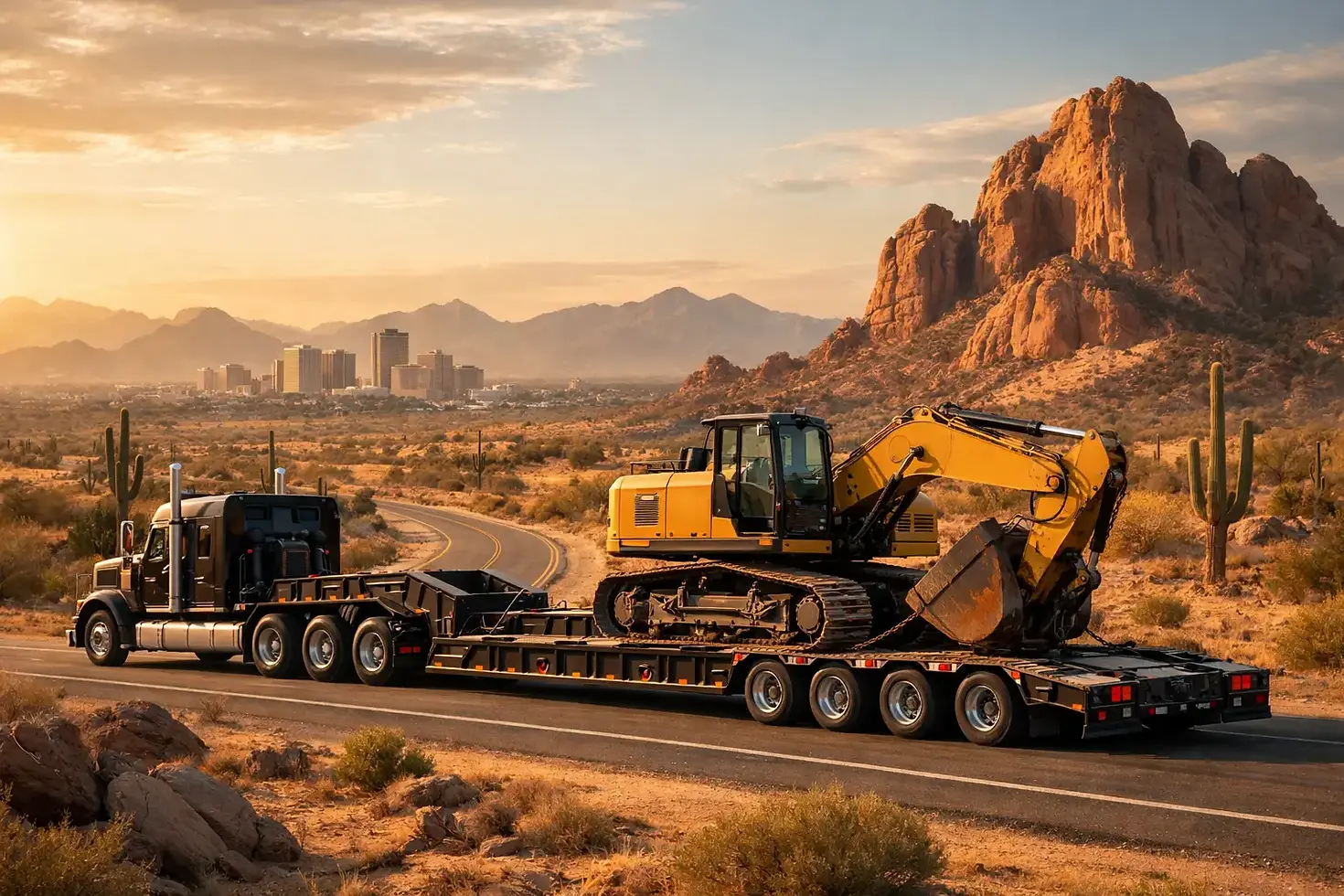
Phoenix Lowboy Trucking Services That Fit the Load
- Flat Out Services
- Aug 10
- 6 min read

A machine can be ready to leave a Phoenix yard at 6:00 a.m. and still miss its planned delivery window because the transport plan was built around a rate instead of the load. Phoenix lowboy trucking services are not just about putting an excavator or dozer on a trailer. The real work is matching deck height, axle count, load position, permit dimensions, route restrictions, and jobsite access before the truck arrives.
For contractors and equipment managers, the difference shows up in avoidable problems: a machine that is too tall for the permitted route, a trailer that cannot safely bridge the load, a delivery scheduled before the dirt crew has built a workable access ramp, or a crane component that requires more axle capacity than the initial dimensions suggested. Heavy haul planning has to start with the machine and the route together.
What Phoenix Lowboy Trucking Services Should Solve
A lowboy is usually the right starting point when deck height matters. Most construction equipment is taller than it is difficult to load, and lowering the deck can keep a move within a more practical overall height. That matters around Phoenix, where routes may look straightforward on a map but can include bridge clearances, utility conflicts, restricted interchanges, and construction zones that change how an oversize load can travel.
But "lowboy" is not one trailer category with one capability. A fixed-neck lowboy, detachable gooseneck lowboy, RGN, and multi-axle configuration all solve different problems. A 50,000-pound excavator may fit well on a standard lowboy if its overall dimensions and axle weights work. A heavier CAT 374-class excavator, large scraper, or industrial component may require a detachable trailer and additional axles to distribute weight legally.
The common mistake is treating trailer choice as a loading issue only. It is also a permitting issue. A lower deck may solve height, while a longer well may solve load placement. More axles may make gross weight legal but add length, turning radius, and route constraints. The best configuration is rarely the biggest trailer available. It is the setup that can carry the equipment legally while remaining practical at both ends of the move.
Trailer Selection Starts With Real Machine Information
Accurate machine information prevents expensive changes on move day. Manufacturer operating weight is useful, but it is not always the transport weight. Buckets, rippers, counterweights, couplers, hydraulic hammers, blade extensions, and fuel level can change both total weight and axle distribution.
An excavator is a good example. Removing the bucket may reduce length and improve loading clearance, but the boom position and track placement still determine how the machine sits over the trailer axles. Loading it too far forward can overload the tractor or neck. Loading it too far back can create trailer axle issues or reduce steering control. The driver and dispatcher need enough information to place the machine correctly before it climbs the ramps.
Dozers bring a different set of decisions. Blade width may require a wider permit, and a rear ripper can affect overall length. In some cases, removing blade corners or transporting an attachment separately is less expensive than moving a wider load under more restrictive permit conditions. That is not always the right answer. Added disassembly takes labor, creates another item to track, and can delay the machine at delivery. The point is to compare the entire move, not just the haul price.
Paving equipment often adds another concern: fragile or low-clearance components. A paver may technically fit a trailer, but approach angle, loading method, and tie-down locations still matter. A Landoll tilt deck can be useful for certain equipment because it reduces the breakover issue associated with ramps. For larger or heavier machines, an RGN may provide the lower loading angle and deck capacity required. Neither is automatically better. The machine, its ground clearance, and the loading location decide it.
Axle Count Is About More Than Total Weight
Arizona legal weight limits are not a simple gross-weight calculation. Axle spacing, axle group weights, bridge formula considerations, and permit requirements all affect the configuration. A load can be under a stated trailer capacity and still require a different axle arrangement to travel legally.
This becomes especially relevant on heavy construction and mining equipment. A multi-axle setup, including a 9-axle combination when the load calls for it, spreads weight across more points. That can make a move permitable that a lighter configuration cannot handle. The tradeoff is more equipment, more operational complexity, and sometimes a less forgiving delivery site.
At Flat Out Services, this is why equipment dimensions alone are not enough to quote or plan a heavy move. Weight tickets, serial-number specifications, attachment details, and photos of the machine are often more useful than a quick description such as "large excavator." They allow the haul plan to be built around actual transport conditions rather than assumptions.
Permits and Routes Need to Be Planned Together
Oversize permits are not an administrative detail that can be handled after dispatch. They define when, where, and sometimes how a machine can move. Width, height, length, gross weight, axle weights, and the combination's configuration all influence the permit and route review.
For a Phoenix-area move, the route may involve I-10, I-17, Loop 202, surface streets, restricted work zones, or a final stretch through an industrial area with tight turns and overhead utilities. The interstate portion may be easy. The last two miles may determine the trailer selection, escort need, delivery time, and whether equipment must be unloaded at an alternate location.
Height is particularly unforgiving. Contractors sometimes assume a lowboy automatically solves a tall-load problem. It helps, but it does not eliminate the need to calculate loaded height. Track pads, exhaust stacks, cab guards, booms, and transport position all matter. A few inches can change a route from routine to highly restricted.
Route planning also matters on longer Southwest corridors. A Phoenix-to-Kingman or Phoenix-to-Southern California machine move can involve grade changes, wind exposure, highway restrictions, and permit requirements that differ across jurisdictions. For a move into Nevada, the equipment configuration that is legal and practical in Arizona still has to work under Nevada's permit conditions. An experienced carrier checks the full route rather than assuming the border crossing is a paperwork formality.
Loading and Delivery Conditions Can Make or Break the Move
Lowboy transport depends on a workable loading environment. That means firm ground, enough room to line up the truck and trailer, clear access for the machine, and a safe path off the deck. A soft equipment yard, a narrow demolition site, or a jobsite with active crews and stacked materials can turn a standard load into a recovery problem.
One mistake contractors make is scheduling a truck before the machine is actually transport-ready. If attachments are still installed, the machine is buried behind other equipment, fuel and fluid concerns have not been addressed, or the operator is unavailable, the load can lose valuable time. On an oversize move, that delay can affect permitted travel hours, escort scheduling, and the next day's equipment commitments.
Preparation should be practical and specific. Verify transport weight with all attachments accounted for. Confirm width with blades, mirrors, guards, and extensions included. Secure loose components and identify any parts that need to travel separately. Make sure the machine can start, steer, brake, and load under its own power unless a different loading plan has been arranged. If it is inoperable, say so early. Winching or loading disabled equipment changes the trailer and site requirements.
Delivery deserves the same attention. A lowboy can get to the jobsite and still be unable to unload safely if there is no room to turn, no stable landing area, or no machine operator waiting. For a large dozer or excavator, the unloading area must account for ramp angle, track travel, and the machine's ability to clear the trailer before turning. A little advance coordination protects the schedule far better than trying to solve access after the truck is on site.
Get a Useful Quote, Not a Guess
A heavy haul quote should reflect the actual move, not a generic equipment category. Provide the pickup and delivery addresses, machine make and model, transport weight, overall dimensions, attachments, running condition, requested dates, and site photos when access is questionable. If the move has a hard shutdown date or requires delivery before a crew mobilizes, say that up front.
It also helps to identify what matters most. Some moves are driven by lowest direct cost. Others need the shortest practical timeline, a specific delivery window, or a configuration that avoids excess disassembly. Those priorities can lead to different trailer and permit strategies. There is no value in selecting a cheaper setup if it leaves a high-cost paving crew or crane crew waiting on site.
The best time to solve a difficult Phoenix equipment move is before the trailer is dispatched. Give the hauler complete machine details, describe the site honestly, and make route and permit planning part of the schedule from the start. That is how a lowboy arrives with the right deck, the right axles, and a workable plan to get your equipment moving again.


Comments