


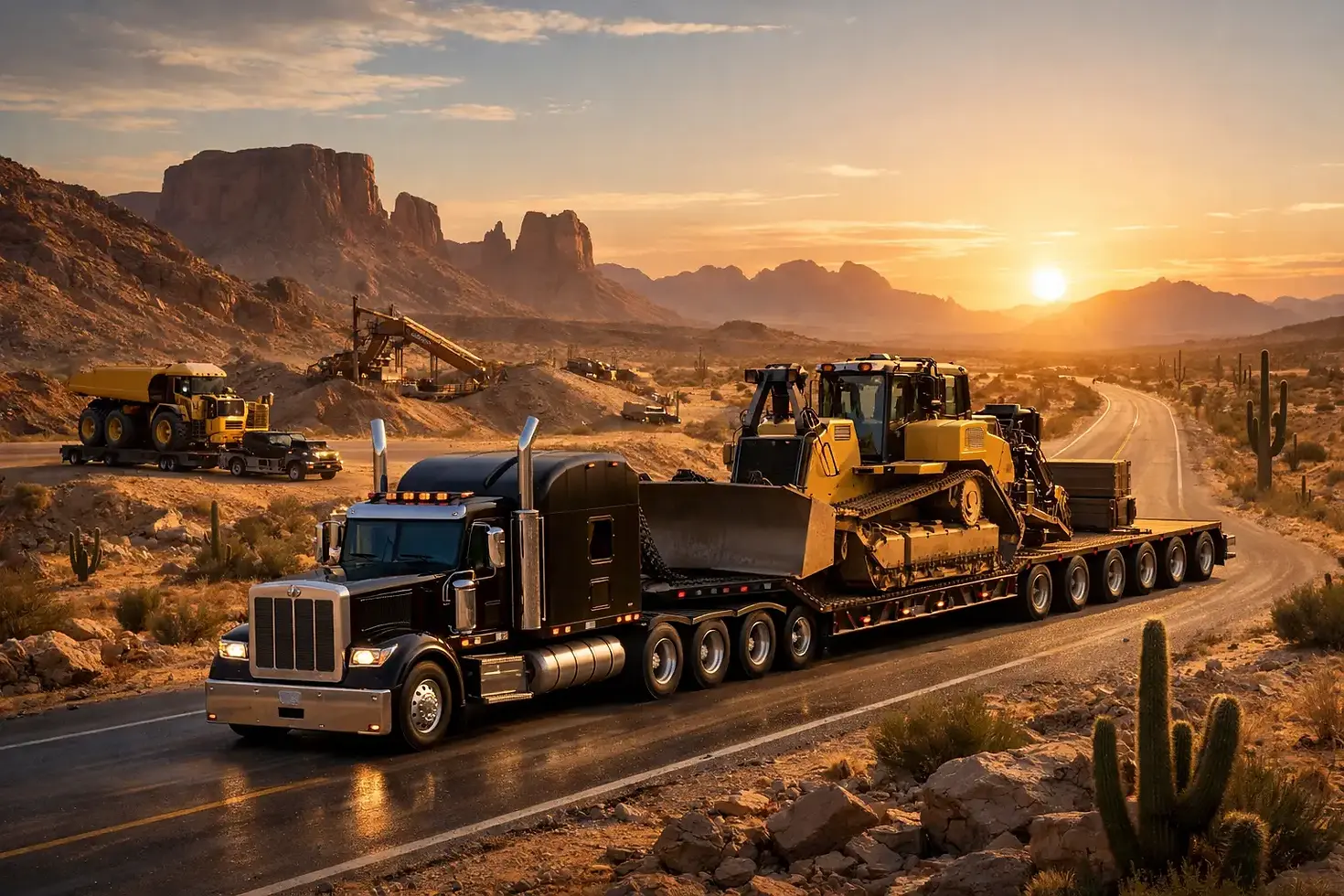
Phoenix Heavy Haul Trucking Company Guide

A 95,000-pound excavator headed from a Phoenix yard to a highway project outside Flagstaff is not a load you hand off and hope for the best. Ground clearance matters. Axle spacing matters. Permit timing matters. If the machine has a stick that will not tuck cleanly or the route hits bridge restrictions, the wrong plan burns a full day fast. That is where a phoenix heavy haul trucking company earns its keep.
For contractors, dealers, and project managers, the real question is not whether a carrier owns a truck. It is whether they understand how to move oversized and overweight equipment across Arizona without losing time on permits, route conflicts, loading issues, or the wrong trailer setup. In Phoenix, that matters more than it does in a lot of markets because the city sits at the center of so many Southwest equipment moves. Loads head north on I-17, west toward California, east on I-10, and northwest through Wickenburg toward Kingman and Las Vegas. Each corridor brings different constraints.
What a phoenix heavy haul trucking company actually does
A true heavy haul carrier is not just moving freight from dock to dock. The work starts with the machine itself. An excavator, wheel loader, scraper, crane component, or paving spread all load differently, scale differently, and create different legal issues. The carrier has to know whether the load fits a standard lowboy, needs an RGN for safer loading, or calls for a Landoll because the pickup point has no ramp or the machine cannot be loaded conventionally.
That decision affects almost everything that comes after it. Trailer choice changes overall deck height, loaded length, axle weight distribution, and route options. A machine that looks manageable on paper can turn into a permit problem if deck height puts it over a key threshold or if axle groups are wrong for the route. A company doing this work every day will catch that before dispatch, not after the truck is already sitting at the yard.
In Phoenix, heavy haul work also means dealing with urban traffic, active jobsite access, municipal restrictions, and the handoff between city movement and long-haul corridor planning. A load coming out of central Phoenix may be legal once it reaches the interstate, but getting from the yard gate to that interstate can be the harder part.
Trailer setup matters more than the quote
A lot of transport issues come down to equipment matching. If a carrier sends the wrong trailer, the job starts behind. For smaller or moderately oversized equipment, a lowboy may be the right answer because it keeps deck height down and handles common construction machines well. For taller or heavier units, an RGN often makes more sense because it simplifies loading and provides better deck position for legal and permit management.
There are cases where a Landoll is the better fit, especially for machines that are not ideal for detached-gooseneck loading or where site conditions are tight. In the Southwest, that shows up often on dealer transfers, auction pickups, and machines parked in places that were never designed for easy heavy haul access.
When weights climb, axle count becomes the deciding factor. Multi-axle setups, including 9-axle combinations, are not there for appearance. They spread weight, improve compliance, and open up options for larger machines that cannot move safely or legally on a simpler trailer. For equipment managers, that is the difference between one clean move and a string of avoidable delays.
Phoenix routing is straightforward until it is not
From a distance, Phoenix looks simple because of the freeway network. In practice, routing is where experience shows. A carrier has to account for permit language, bridge postings, local time restrictions, escort requirements, and whether the machine dimensions trigger a route survey or utility coordination. Height is a frequent issue, but length and weight create just as many problems depending on the corridor.
A move from Phoenix to Tucson is a different planning exercise than Phoenix to Kingman or Phoenix into Southern California. Northbound work on I-17 can introduce grade, weather, and traffic complications, especially with heavier combinations. Westbound and northwest moves often involve permit timing and corridor constraints that need to be handled before the truck rolls.
That is why route planning should not be treated as paperwork. It is an operating decision. The right company checks the actual path, not just the city pair. They think about where the truck can stage, whether the pickup site supports trailer detachment, and what happens if the machine dimensions are not what the customer was originally told.
Permits are not a side task
Oversize and overweight permits are one of the clearest separators between a basic transporter and a real heavy haul operation. Arizona moves quickly compared with some states, but that does not mean every load is simple. Weight, axle configuration, overall dimensions, county rules, and destination access all affect approval.
The details matter. If the machine description is off, if axle weights do not match the application, or if the route is assumed instead of verified, the permit process slows down or comes back wrong. Then the truck sits while the job waits. For contractors trying to keep paving crews, excavation crews, or crane schedules on track, that delay is expensive.
This is where direct asset-based carriers tend to outperform brokered moves. The people planning the haul understand the actual trailer, the real axle groupings, and the practical loading sequence. They are not quoting first and figuring it out later. Flat Out Services operates in that lane, with the kind of lowboy, Landoll, RGN, and multi-axle capability that matters when the load is more than a simple legal machine transfer.
Equipment type changes the whole move
Not all heavy equipment creates the same hauling problem. A Caterpillar excavator may have manageable transport weight but awkward boom positioning. A wheel loader can be easier on dimensions but still require close attention to tire width and bucket configuration. Scrapers, dozers, and paving trains each bring their own transport issues.
Crane hauling is another category entirely. Even when the base unit moves on one trailer and components move separately, the transport plan has to line up with site schedule, assembly sequence, and legal routing. Mining equipment adds another layer because many pickup and delivery points are remote, with uneven surfaces, limited turning room, or access roads that are fine for off-road haul trucks but poor for highway equipment trying to load safely.
An experienced carrier asks the questions that prevent mistakes. Are blades removed? Does the counterweight come off? Is the machine operational? Can it self-load, or does it need assistance? Are there low attachments that will drag on a transition? Those are not minor details. They determine trailer choice, loading time, permit class, and risk.
Why Phoenix is a serious heavy haul hub
Phoenix sits in the middle of construction, infrastructure, dealer inventory movement, and equipment redeployment across Arizona and the broader Southwest. Machines cycle between metro projects, paving jobs, mining regions, and out-of-state work. That creates demand for carriers that can react quickly but still handle the legal and technical side correctly.
A phoenix heavy haul trucking company working this market has to be comfortable with short-notice jobsite pulls, dealer-to-jobsite deliveries, and long regional runs. They also need to understand that fast response is only useful when backed by the right iron. Sending a standard setup to a load that needs a heavier axle package wastes everybody's time.
That is one reason experienced contractors often prefer carriers with their own equipment and direct control over dispatch. Less handoff usually means fewer surprises. If a machine needs a 9-axle configuration, escort coordination, or a revised route because of height, the decision can be made inside the operation instead of bouncing through layers.
What buyers should watch for
The best heavy haul jobs usually look calm from the outside. That is because the work was done before the truck arrived. Machine dimensions were confirmed. Loading method was decided. Permit timing was handled. The route was checked against the actual trailer setup.
If a carrier is vague about trailer type, axle count, or how they plan to handle permits, that is usually a sign. Heavy haul is not a place for generic answers. The same goes for companies that quote before asking about attachments, machine operability, pickup conditions, or destination restrictions. Those details are the job.
In Phoenix and across Arizona, the right carrier is the one that understands both the machine and the map. They know when a lowboy is enough, when an RGN is safer, when a Landoll solves an access issue, and when the load needs a full multi-axle plan from the start. They treat route planning and permits as part of execution, not admin work.
When your equipment has to be on the next site without drama, that kind of preparation is what keeps iron moving and crews working.


Comments