


Landoll Versus Lowboy Hauling: Which Fits?

A Landoll and a lowboy can both move construction equipment, but treating them as interchangeable is how a straightforward move turns into a loading delay, permit problem, or avoidable mobilization cost. In landoll versus lowboy hauling, the right answer comes from the machine's dimensions and weight, but also from how it can be loaded, where it is going, and what the route will tolerate.
A 25,000-pound excavator headed from a Phoenix yard to an accessible jobsite may be an efficient Landoll move. That same excavator with a tall cab, wide track stance, or a long route through restricted corridors may need a lowboy. The trailer is not selected because one is generally better. It is selected because it gives the load the best legal, practical path from pickup to final placement.
The Core Difference Between a Landoll and a Lowboy
A Landoll is a hydraulic tilt-deck trailer. The deck lowers to the ground, allowing wheeled and tracked equipment to drive onto it without separate loading ramps. Once the machine is in position, the deck returns to transport position. That loading method is its main advantage, particularly for machines that can safely drive on and off under their own power.
A lowboy uses a dropped deck between the gooseneck and rear axles. Its lower deck height creates the clearance needed for taller equipment and often provides the axle capacity required for heavier machines. Fixed-neck, mechanical detachable gooseneck, hydraulic detachable gooseneck, and RGN configurations all fall within the broader lowboy category, but they do not solve the same problems.
The practical distinction is this: a Landoll is often chosen for loading convenience and flexibility. A lowboy is often chosen for height control, weight distribution, and specialized heavy-haul capacity.
When a Landoll Is the Better Hauling Choice
Landolls earn their place on moves where equipment needs to be loaded quickly and cleanly with minimal ground setup. A skid steer, compact track loader, forklift, telehandler, small paver, wheel loader, or excavator within the trailer's legal working range may be a strong fit. The tilt deck eliminates the need to manage steep ramps, and it can be useful at yards where a detachable trailer does not have room to pull forward, detach, and reload.
This matters at active jobsites. A contractor may need a machine pulled out of a tight laydown area before crews arrive, or a rental return may need to happen at a yard with limited maneuvering room. A tilt deck can shorten the loading sequence when the equipment is mobile and the ground is reasonably firm and level.
Landolls also work well for shorter regional moves involving equipment that is not especially tall or heavy. For example, a properly sized tilt deck can be a practical option for a smaller excavator or loader traveling between Phoenix, Kingman, and Northern Arizona, assuming overall height, gross weight, and axle weights remain legal for the route.
That last condition matters. Customers sometimes focus only on whether the machine physically fits on the deck. Experienced dispatchers first look at loaded height, center of gravity, deck capacity, axle group ratings, and how far the machine must be positioned to distribute weight correctly. A machine that fits may still be a poor Landoll load if it creates an axle issue or requires a permit that does not make operational sense.
Landoll limitations that matter in the field
A Landoll deck is higher than a lowboy deck. That difference can decide the move before loading even starts. Equipment that approaches legal transport height on a tilt deck can exceed height limits on bridges, signs, utility crossings, or jobsite entrances. The same machine may travel more comfortably on a lowboy with a lower well.
Tilt-deck loading also depends on site conditions. Soft dirt, a pronounced slope, loose aggregate, or a confined area can complicate loading. The trailer needs stable ground and enough straight-line space for the machine to approach safely. Loading a tracked machine onto a tilted deck is routine when conditions are right, but it should not be treated as a cure for a poorly prepared pickup location.
A Landoll is not automatically the lower-cost choice, either. It may reduce loading time, but a lowboy can avoid permit costs, routing restrictions, or escort requirements by keeping a tall machine lower. The lowest line-item rate is not always the lowest overall move cost.
When a Lowboy Is the Better Hauling Choice
Lowboys are built for equipment that demands a lower deck, greater weight capacity, or a more controlled loading arrangement. Larger excavators, dozers, scrapers, cranes, drilling equipment, paving spreads, and industrial components are common candidates. The exact trailer depends on machine size and configuration, but the operational objective stays the same: get the load low, distribute weight correctly, and build a legal route around it.
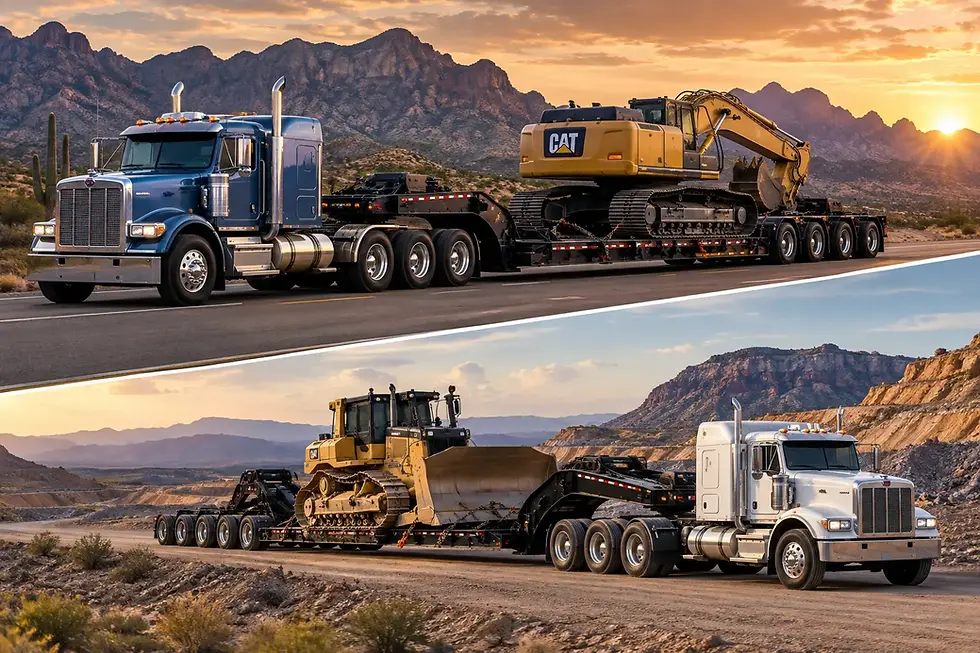
A detachable lowboy or RGN is often the better choice for tracked equipment that is heavy, tall, or difficult to load onto a tilt deck. Detaching the front creates a ground-level approach, allowing the machine to drive onto the well without using ramps. This is especially valuable for low-clearance machines and equipment with long track frames.
Deck height is frequently the deciding factor. A tall excavator may be legal or close to legal on a lowboy, then become a high-load permit issue on a Landoll. In the Southwest, clearance planning cannot be reduced to an interstate route on a map. Off-highway approaches, overpasses, construction detours, utility lines, and entrances to mines or remote projects all deserve attention.
Weight and axle configuration change the trailer decision
Lowboy hauling becomes more specialized as machine weight increases. A three-axle lowboy may work for one excavator, while a heavier machine requires additional axle groups, a jeep, a booster, or a multi-axle configuration. The goal is not simply to carry the total weight. It is to place that weight legally across the tractor and trailer axles while accounting for state permit requirements.
One mistake contractors make is providing only the machine's published operating weight. That number is a starting point, not a final transport weight. Buckets, couplers, counterweights, blade extensions, GPS masts, work tools, fuel level, and loose attachments can all change the actual move. A detachable counterweight or boom configuration can also change loaded length and axle placement.
For oversize and overweight equipment, the trailer choice drives permit strategy. A lower deck may reduce overall height. More axles may lower axle weights. A different configuration may change route restrictions, travel windows, escort requirements, and whether the load can cross a particular structure. Those decisions need to happen before the truck arrives, not after a machine is sitting at the gate.
Landoll Versus Lowboy Hauling: Questions That Decide the Move
Before assigning a trailer, a heavy-haul team needs more than a machine make and model. The useful questions are operational:
What are the machine's actual transport dimensions with the attachment, boom position, and any removable components?
What is the verified transport weight, including tools, fuel, and accessories?
Can the equipment drive safely, and does the pickup or delivery site allow a straight, stable loading approach?
Is the machine going to a developed yard, a constrained urban project, a mine road, or a remote construction site?
Does the route include low structures, narrow turns, steep grades, restricted travel hours, or permit-sensitive highways?
Those details reveal the real trailer requirement. A lowboy can be the correct choice even when a Landoll could physically carry the machine. Conversely, using an RGN for every machine can add cost and loading complexity where a tilt deck would do the job safely and efficiently.
Loading Method Is Part of Jobsite Planning
Loading is not a separate task from hauling. It affects the whole schedule. A Landoll may allow a contractor to load a mobile machine at first light and clear the site quickly. A detachable lowboy may require more setup, but it can be the safer choice for a larger dozer, excavator, or specialized paving machine.
Equipment preparation matters regardless of trailer type. Remove or secure loose tools, verify that attachments are approved for transport position, account for machine width, and confirm that personnel are available to operate the equipment. If an attachment needs to travel separately, that needs to be planned as part of the load configuration, not discovered after the permit has been issued.
At Flat Out Services, trailer selection starts with those details because trailer availability alone is not a transport plan. The best configuration is the one that can load safely, run legally, meet the delivery window, and get the machine positioned where the receiving crew can use it.
Do Not Let Trailer Preference Override the Route
Some moves are decided by the machine. Others are decided by the route. A lowboy may keep the load under a height threshold and preserve more routing options. A Landoll may make sense on a local move but become less attractive when a longer corridor introduces clearance concerns. For heavier equipment, added axles may protect axle weights but increase turning requirements at tight jobsite access points.
That is why accurate pickup and delivery information is as valuable as a machine spec sheet. Photos of the access road, gate opening, loading area, and final placement zone can prevent costly assumptions. So can advance notice of site restrictions, security procedures, crew schedules, and any requirement to deliver outside normal hours.
The practical choice is rarely about loyalty to one trailer type. Give the hauling team the actual machine dimensions, verified weight, attachment details, site conditions, and required delivery time. That information makes it possible to select a Landoll or lowboy based on the move in front of you, not a guess made from a distance.


Comments