


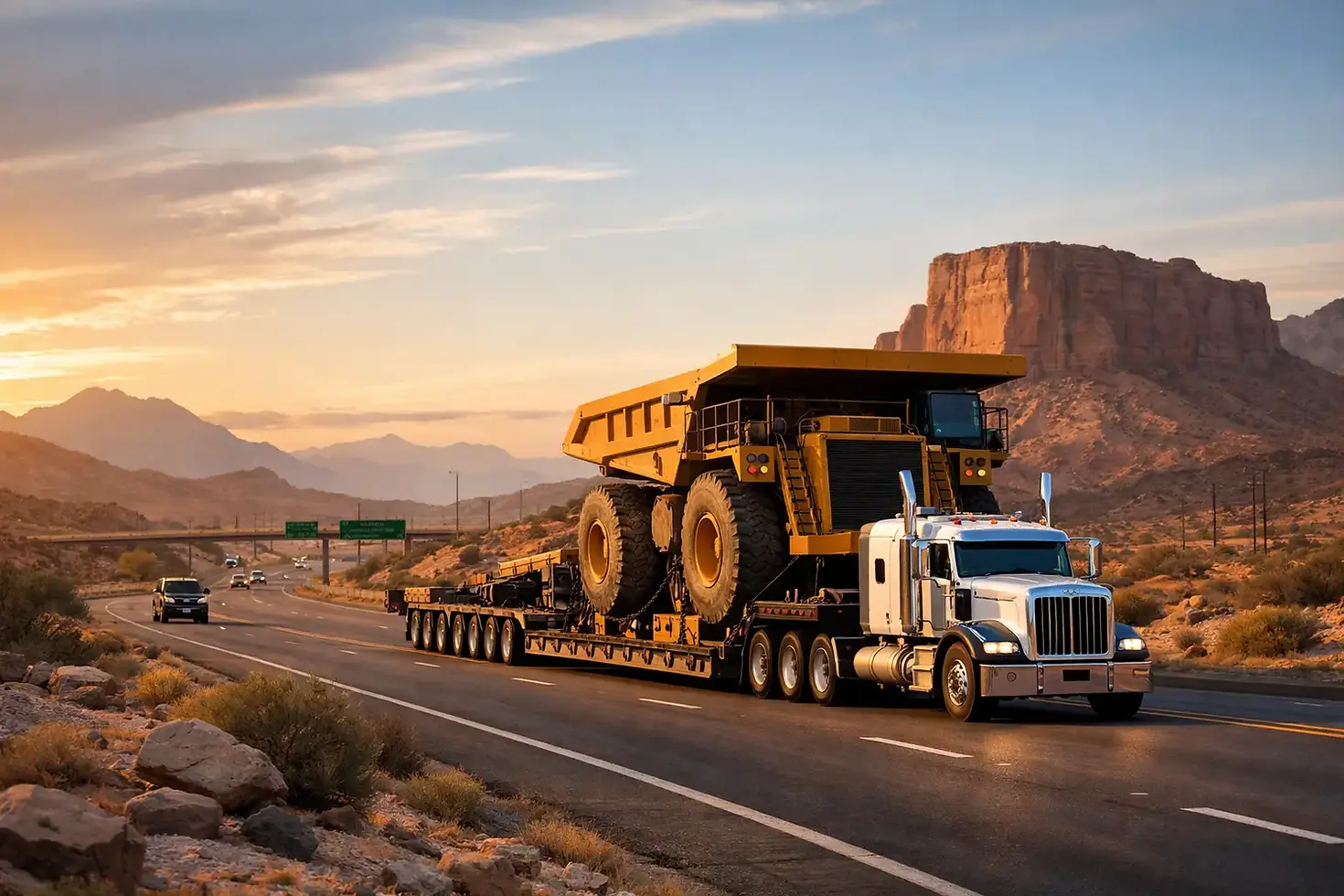
Heavy Haul Along Interstate 40 Requires a Plan
- Flat Out Services
- Aug 8
- 6 min read

A heavy haul along Interstate 40 can look straightforward on a map: get the machine loaded, run east or west, and meet the crew at the next job. In practice, I-40 is often only one part of the move. The real work is matching the machine, trailer, permitted dimensions, interchange access, and jobsite conditions before a truck is dispatched.
For contractors moving equipment between Kingman, Northern Arizona, Las Vegas, and Southern California, I-40 is a major working corridor. It serves mining areas, highway work, paving operations, equipment yards, and active construction sites. But its usefulness does not eliminate the usual oversize constraints. A loaded RGN may have a legal route on the interstate and still face a problem at the exit, at a fuel stop, or on the final two miles of county road into the site.
Interstate 40 Heavy Haul Starts With the Actual Machine
The machine description on a dispatch sheet is not enough to plan a move. A 50,000-pound excavator, for example, can travel very differently depending on the boom position, counterweight configuration, track width, attachment, and whether the customer wants the bucket or hydraulic hammer moved with it. The same applies to dozers with blades, wheel loaders with buckets, and paving equipment with extensions that were never removed after the last project.
Experienced heavy haul planning starts with loaded dimensions and axle weights, not an unloaded catalog weight. That means confirming the machine model, serial range if needed, actual operating weight, overall width, height in transport position, and every attachment that will ride with it. It also means asking what has to be on the trailer versus what can travel separately.
Customers often assume that keeping every component together saves time. Sometimes it does. Other times, removing a blade, bucket, counterweight, or boom component lowers the permitted height or width enough to avoid a more restrictive route, an additional escort requirement, or a longer permit lead time. The tradeoff is jobsite labor and reassembly time. There is no universal answer, but it should be decided before the truck arrives.
Trailer Choice Changes the Route and the Permit
A lowboy is not automatically the right answer just because the load is heavy. Trailer selection affects deck height, length, axle spacing, load distribution, loading method, and what permits are required. It also affects whether the carrier can safely get in and out of the jobsite.
A Landoll tilt deck can be the practical choice for equipment that needs to be winched, rolled, or loaded without a fixed dock or ramp setup. It can save time on certain moves, especially when the pickup location is a dealer yard, auction site, or tight construction staging area. It is not the answer for every machine. Deck height and weight capacity can make a lowboy or RGN the better fit for taller or heavier equipment.
For a large excavator, scraper, crane component, or industrial machine, an RGN may provide the well depth and loading angle needed to control overall height. Once the load gets into serious gross weight territory, multi-axle configurations become part of the conversation. A 9-axle setup is not used just to make a load look more substantial. Additional axles distribute weight to meet bridge formula and state permit requirements while reducing concentrated loading on structures along the route.
That does not mean more axles are always better. More axle groups can add trailer length, turning requirements, loading complexity, and cost. On a move that includes narrow jobsite access or a difficult backing approach, the configuration has to work at both ends, not only on I-40.
Height Is Often the Constraint Nobody Measured
Interstate bridges are generally not the first concern on an approved route. The concern is the entire route. A tall load may clear the interstate but encounter low utility lines, older overpasses, traffic signals, signs, or private access structures once it leaves the highway.
A practical plan accounts for the loaded trailer height, not just the machine height. A machine that appears comfortably below a target dimension while sitting on the ground can become a high-load problem once it is positioned on a trailer deck. Boom cylinders, exhaust stacks, cab guards, and raised attachments are common surprises.
When the dimensions are close, loading orientation matters. Turning an excavator, lowering a boom correctly, or placing an attachment on a separate trailer can change the final height enough to make the permit and route more manageable. These are field decisions, not paperwork details.
Permits Are Route-Specific, Not a One-Time Approval
A permit for an oversize or overweight move is tied to specific dimensions, weight, axle configuration, and route conditions. It is not a blanket permission to run any road that appears convenient. The permitted route may specify interstate segments, approved connectors, travel hours, escort requirements, and restrictions around construction zones or city limits.
This matters on I-40 because the route often connects to US-93, I-17, I-15, state highways, mine roads, and local streets with very different restrictions. A route from Kingman toward Las Vegas can have a different planning profile than an I-40 move toward Flagstaff or a western run into Southern California. Weather, elevation, wind exposure, seasonal traffic, and active roadwork can all affect the practical plan.
One mistake contractors make is treating the permit as the carrier's isolated responsibility. The carrier handles the permit process, but the customer controls information that affects it: the actual machine configuration, requested delivery time, pickup readiness, attachments, and jobsite access. A late change to the load can require the route and permit plan to be revisited. That is far cheaper than discovering a dimensional change after the truck is loaded.
The Interstate Is Usually the Easy Part
The difficult points on an I-40 equipment move are often the first and last mile. A wide machine may exit the interstate legally and then find a narrow turn lane, a congested fuel station, soft dirt at the site gate, or parked equipment blocking the unload area.
Before scheduling, confirm the approach to the pickup and delivery sites. The heavy haul team needs room to enter, turn, position the trailer, load or unload, and leave without creating a recovery job. This is especially important with detachable goosenecks and multi-axle trailers. The trailer may need firm, reasonably level ground for loading, and the machine needs enough clear space to climb on or off in a controlled line.
At active jobsites, coordination matters as much as access. The unload area should be cleared of pickups, pallets, material stacks, and other equipment. If the machine will be unloaded directly into a work zone, the superintendent should account for traffic control, spotters, and the time needed to secure the delivery area. A truck waiting for a grader to move or a gate to be opened can push a tightly scheduled permitted move into a restricted travel window.
Equipment Preparation Prevents Expensive Delays
A machine can be mechanically sound and still not be transport-ready. Tracks should be clear of excessive mud and debris. Tires need to be serviceable. Hydraulic leaks, loose covers, unsecured doors, and damaged tie-down points need attention before loading. For machines with attachments, the plan should identify exactly what is staying on the machine and what is traveling separately.
Fuel level also deserves a quick discussion. Fuel adds weight. On a load that is already close to a permit threshold, a full tank can affect axle weights. Draining fuel simply to chase a lower number is not always practical, particularly on remote projects, but it should be considered as part of the complete weight picture.
Machine availability is another frequent problem. If an excavator is still working when the truck arrives, the haul is no longer on schedule. The operator may need time to clean the undercarriage, remove a bucket, fold access steps, or stage the machine where the trailer can reach it. Setting a realistic ready time is better than giving a target time that only works if every task goes perfectly.
Build the Schedule Around Restrictions, Not Wishful Timing
Oversize travel windows, escorts, traffic conditions, and delivery-site availability can all limit when the truck can move. A load may not be able to depart at the same hour a standard legal-load truck would. It may need to stop before a restricted period, even if the destination is only a short distance away.
That is why a move should be scheduled backward from the required unload time. Start with the delivery window, identify the permitted travel periods, factor in loading time, route miles, fuel and inspection stops, escort coordination, and contingency for jobsite delays. The answer may be an early pickup, a staged overnight position, or a different delivery day.
At Flat Out Services, the practical objective is not to put the biggest trailer under every machine. It is to select a legal, workable configuration that gets the equipment to the next job without creating trouble at the scale, on the route, or at the site gate.
When you are planning a heavy haul along Interstate 40, provide the machine details early, verify the final access before permits are submitted, and make sure the equipment is actually ready to load. Those three steps give the hauling plan room to work when the road, the permit, and the jobsite do not line up perfectly.


Comments