


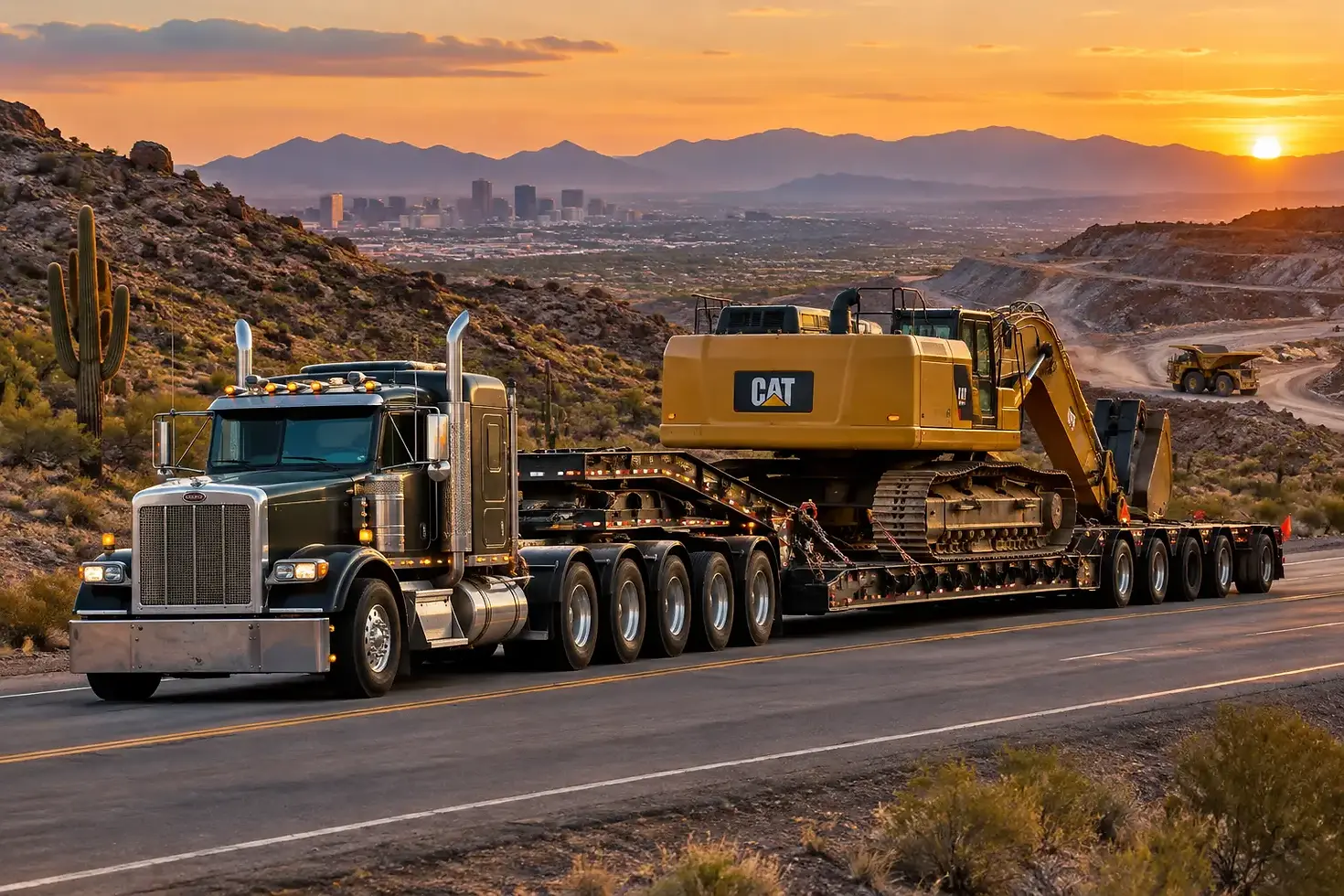
Construction Equipment Transport Phoenix Done Right

A 70,000-pound excavator can look like a straightforward move from a Phoenix equipment yard to a jobsite. It is not. Construction equipment transport Phoenix work is usually won or lost before the truck arrives - when someone confirms the actual transport dimensions, selects the trailer, checks the route, and makes sure the receiving site can take the load.
The machine's operating weight is only one part of the plan. Boom position, counterweight, track width, attachment weight, overall height, axle loading, permit restrictions, and site access all affect how the move should be handled. A carrier that treats every machine like a basic lowboy load can create avoidable delays, rework, or a load that is legal on paper but impractical at the jobsite.
Construction Equipment Transport Phoenix Starts With the Real Machine
The first question should not be, "What does it weigh?" It should be, "What exactly is moving in its transport configuration?" An excavator with the boom tucked and bucket removed may fit a different trailer and permit envelope than the same machine loaded with a hydraulic hammer. A dozer with a blade installed may be too wide for the selected route. A wheel loader may be within gross weight limits but too tall once it sits on the deck.
Customers often provide an approximate model number and operating weight, which is useful for a preliminary conversation but not enough for final dispatch. Experienced heavy haul planners confirm the machine model, serial number when available, shipping weight, width, height, length, attachments, and whether it runs. Photos are often just as useful as a spec sheet because they show guarding, aftermarket attachments, tire condition, or a boom arrangement that changes the loading plan.
This matters especially with used equipment coming from an auction, dealer yard, or an inactive project. The listed weight may not reflect added guarding, rock buckets, ripper assemblies, or material left in the bucket. A few thousand pounds can change axle spacing requirements and the permit category.
Trailer Choice Is an Axle-Load Decision
A lowboy is not automatically the right answer just because the load is heavy. The right trailer depends on deck height, machine clearance, load distribution, loading method, and the legal axle weights that apply to the planned route.
A standard lowboy can be efficient for many excavators, loaders, and smaller dozers. Its lower deck helps control height, and it is often the quickest setup when the machine can climb ramps safely. But a lowboy has limits. Ground clearance, ramp angle, deck length, and concentrated weight may rule it out for a long crawler machine or a piece with low undercarriage components.
A removable gooseneck, or RGN, earns its place when a machine needs to be driven onto a detached deck, when ramp angles need to be reduced, or when the weight requires more axle capacity. Multi-axle configurations are not a sign of overcomplication. They spread weight where it needs to go and can make the difference between a legal, permitted move and a plan that cannot run.
Landoll tilt decks are useful for certain equipment because they reduce handling and allow a controlled ground-level loading approach. They are not the answer for every oversized machine. A tilt deck may be a better operational fit for a disabled paver, a smaller roller, or equipment that needs winching, while an RGN may be the better choice for a large dozer or excavator with demanding height and weight requirements.
One mistake contractors make is asking for the shortest trailer possible to save money. A shorter or lighter configuration can lower the transport price, but it may add permit complications, create a poor center of gravity, or require attachments to be removed and hauled separately. The best plan is usually the configuration that gets the machine delivered legally and ready to work with the fewest field problems.
Permits and Routing Are Part of the Schedule
Phoenix has broad freeway access, but that does not mean every oversized load has a simple path through the metro area. Construction zones, interchange geometry, utility restrictions, curfews, bridge postings, and local jurisdiction requirements can determine when a load moves and where it can travel.
Permit planning is not just paperwork. It establishes the approved dimensions, weights, axle configuration, route, travel hours, and escort requirements. If the machine dimensions change after a permit is requested - because the blade stayed on, the boom was positioned differently, or a counterweight was not removed - the permit may need revision. That can turn a planned morning pickup into a later dispatch.
The route also has to work at both ends. Interstate travel may be easy, but the last few miles can be the difficult part. A narrow industrial entrance, a sharp turn off a frontage road, overhead utilities, soft shoulder conditions, or a congested active site can dictate the trailer selection before the truck ever leaves the yard.
For Phoenix-area moves, timing can matter as much as mileage. A load that must avoid certain travel periods may require an early staging plan. A project with a hard crane date may need the equipment delivered the previous day rather than relying on a narrow same-day window. In our experience, equipment managers get better results when transport is planned around the machine's required working time, not simply its requested pickup time.
Loading Is Where Assumptions Show Up
A machine that runs is easier to load, but "runs" is not a complete answer. It needs adequate fuel, functional steering and brakes, reliable tracks or tires, and an operator available to load it if required. For crawler equipment, track condition matters. A machine that can move around a yard may still be a poor candidate for climbing ramps under transport conditions.
Non-running equipment changes the plan. It may require winching, a controlled recovery setup, additional labor, or a loading surface that can support the operation. Trying to force a disabled machine onto the wrong trailer is where damage occurs. The added cost of the correct trailer and loading approach is usually far less than repairing ramps, undercarriage components, or hydraulic lines after a bad load attempt.
Attachments deserve the same attention. A bucket, grapple, hammer, blade extension, or ripper can affect width, height, securement, and total weight. Sometimes removing an attachment is the cleanest option. Other times, keeping it installed reduces handling risk and still fits the permit plan. There is no universal rule. The decision comes down to dimensions, labor available at each end, and whether the machine needs to go straight to work.
Jobsite Access Can Override the Highway Plan
A legal highway route does not guarantee a successful delivery. The trailer needs room to turn, level ground to unload, and a stable approach that will not sink under concentrated axle weight. On a rough or developing site, the unload location should be discussed before dispatch, not decided after the truck reaches the gate.
Project teams should identify who will receive the load, where the driver should check in, whether a spotter is available, and where the machine will be unloaded. If the site has a gate code, security process, railroad crossing, or active paving operation, the hauling team needs that information early. A truck waiting outside a closed gate is not just an inconvenience - it can affect permitted travel hours and the rest of the day's dispatch.
For tight urban sites, it may make sense to stage equipment at a nearby yard and deliver during a controlled window. For remote Arizona construction or mining locations, the concern may be different: access roads, grades, wash crossings, and limited recovery options. The correct answer depends on the site, not just the distance.
What to Have Ready Before Requesting a Move
A useful transport request includes the machine make and model, dimensions, transport weight, attachments, running condition, pickup and delivery addresses, requested dates, and site contact information. Photos of all sides of the equipment and photos of the pickup and delivery access can prevent a lot of guessing.
It also helps to state what cannot move. Maybe the excavator must remain assembled because it is needed immediately on arrival. Maybe a crane component has a fixed delivery appointment. Maybe the paver is down and cannot be winched from a sloped yard. Those constraints are not inconveniences to hide from the carrier. They are the facts that determine the workable plan.
Flat Out Services approaches Phoenix equipment moves as field operations, not just trailer assignments. The right transport plan protects the schedule because it accounts for the load, the legal route, the loading method, and the conditions waiting at the other end. Give the hauling team accurate machine and site information early, and they can solve the hard parts before they become a problem at the gate.


Comments