


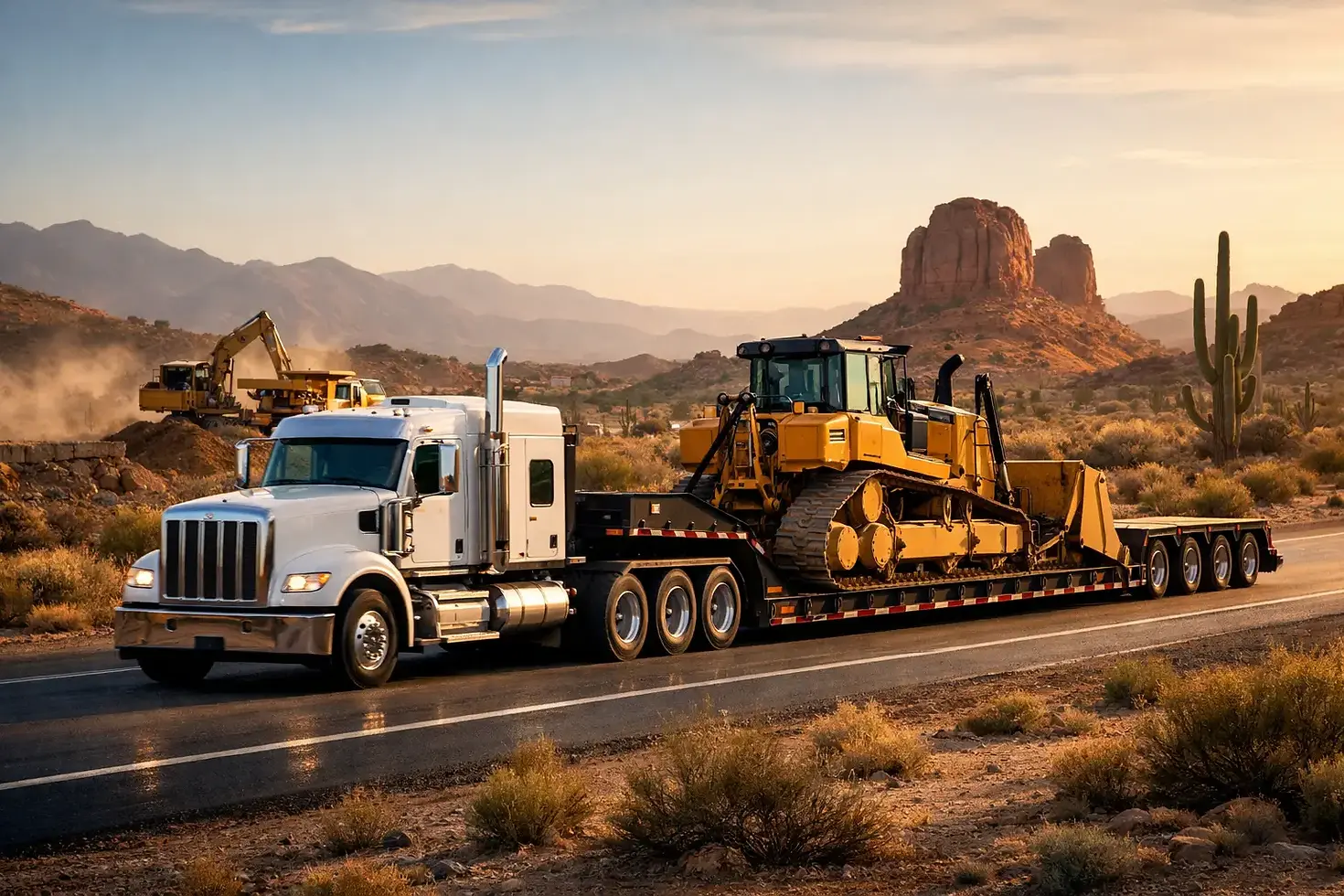
Earthmoving Equipment Transport Arizona Planning
- Flat Out Services
- 15 hours ago
- 6 min read

A 50,000-pound excavator can look like a straightforward move until the transport plan reaches the first bridge restriction, narrow mine access road, or jobsite with no room to turn a tractor-trailer around. Earthmoving equipment transport Arizona is not just a matter of finding an available lowboy. It is a coordinated decision involving machine dimensions, axle weights, permit limits, route conditions, loading method, and the receiving site's readiness.
For contractors and equipment managers, the cost of a poorly planned move is rarely limited to freight. A machine that arrives late can hold up crews, rentals, concrete schedules, paving operations, or a mine maintenance window. The best plan starts with accurate information before the truck is dispatched.
Start With the Machine, Not the Trailer
One mistake contractors make is quoting a machine by operating weight alone. Operating weight matters, but it does not tell a heavy haul operator whether the equipment can legally and practically move on a particular trailer.
An excavator may have a manageable transport weight but become too tall with the boom positioned incorrectly. A dozer may fit the deck length but create a width issue once blade wings are left installed. A wheel loader can be relatively easy to load, yet its axle placement and tire contact area may affect how weight is distributed on the trailer. Scrapers, in particular, require close attention to overall length, height, and articulation.
Before trailer selection, the carrier needs the actual make and model, serial number when available, shipping weight, transport dimensions, attachments, and any parts that will travel separately. Photos are useful, especially for older equipment that has aftermarket guards, counterweights, custom attachments, or modifications that do not match published specifications.
The key question is not simply, "Can it fit?" The question is, "Can it be loaded, permitted, routed, and delivered legally without creating avoidable risk or delay?"
Earthmoving Equipment Transport Arizona Requires Trailer Matching
Lowboys, Landoll tilt decks, RGNs, and multi-axle configurations all have their place. Selecting one is a practical judgment call, not a matter of sending the biggest trailer available.
A standard lowboy is often the efficient choice for common excavators, dozers, and loaders that can be kept within reasonable height and weight limits. Its lower deck helps control overall height, which matters on Arizona routes where overhead restrictions, power lines, and older structures can quickly narrow routing options.
An RGN, or removable gooseneck trailer, is generally the better answer for heavier tracked equipment that needs to be driven onto the deck from the front. It gives a low loading angle and avoids forcing an excavator or dozer up steep ramps. That matters when ground clearance is limited, track pads are worn, or the machine needs to load without questionable ramp transitions. The tradeoff is more setup time and a more specialized configuration, but that is often a reasonable trade for a heavy machine or a difficult loading site.
A Landoll tilt deck can be the practical choice for equipment that can roll or drive on safely and does not require the lower deck height of a lowboy. It is especially useful for certain smaller machines, attachments, or equipment moves where access and fast loading matter. It is not automatically the cheapest answer if the loaded height creates an oversize problem.
For heavier loads, axle count is not optional paperwork. A multi-axle or 9-axle combination spreads weight across more points, helping the load meet bridge formula and axle-weight requirements. More axles can also mean a longer overall configuration, different turning behavior, and more route limitations. The goal is not to add axles for appearance. It is to build a legal, stable configuration that works on the actual route.
Height Is Often the First Constraint
Arizona contractors sometimes focus on width because a blade or bucket is visibly oversize. Height can be the more restrictive issue. A tall excavator on the wrong trailer may require a different route, utility coordination, or a permit process that changes the entire schedule.
Experienced operators reduce height where possible before loading. That can mean removing a bucket, lowering the boom correctly, folding mirrors, taking off a stack extension, or shipping an attachment separately. Breaking out a component adds handling and coordination, so it is not always the right call. But it may be less expensive than building a route around an avoidable height issue.
Permits and Routing Are One Plan
Permitting is not a formality that happens after a truck is booked. Permit dimensions and weights must match the loaded configuration, and the route must support those numbers. A permit that works for an 11-foot-wide dozer does not automatically work after a contractor adds blade extensions or decides to load a second attachment alongside it.
This is especially relevant on moves between Phoenix, Kingman, Northern Arizona, Las Vegas, and Southern California. Interstate corridors handle a great deal of heavy equipment traffic, but the usable route is still shaped by construction zones, bridge restrictions, ramp geometry, lane closures, weather, and local access roads. The final miles into a quarry, solar project, subdivision, or mine site often cause more trouble than the interstate portion.
A route that looks shorter on a map may be the wrong route for a loaded RGN. Tight turns, steep access grades, soft shoulders, low utility crossings, and restricted bridge structures can eliminate it. On Northern Arizona moves, weather can alter the plan quickly. Monsoon activity, snow conditions, and wind exposure are operational issues, not background details.
Escort requirements also affect timing. Depending on the load's dimensions and the states or jurisdictions involved, pilot cars may be required. Some movements have travel-hour restrictions, curfews, or limitations around metropolitan areas. If a jobsite expects the machine at 7:00 a.m. but the permitted load cannot travel during the preceding overnight period, that delivery expectation needs to be addressed before dispatch.
At Flat Out Services, route planning is tied directly to the trailer and permit configuration. That approach avoids a common failure point: treating the route as someone else's problem after the load is already on the deck.
Prepare the Equipment for Loading and Securement
A machine can be mechanically sound and still be unprepared for transport. Equipment preparation protects the machine, the trailer, and the schedule.
Tracks, tires, brakes, steering, hydraulic functions, and battery condition should be checked before the truck arrives. If a machine cannot move under its own power, the loading method changes. A non-running excavator may need a winch, outside loading assistance, or a different trailer setup. That is manageable when known in advance. It becomes a problem when it is discovered at the gate.
Loose items need attention. Buckets, forks, rippers, counterweight components, grease guns, job boxes, and detached parts should be identified before loading. Some can travel securely with the machine; others should be loaded separately or transported on another unit. The answer depends on weight distribution, securement points, available deck space, and permit dimensions.
Securement is more than throwing chains over the tracks. The carrier must use proper tie-down points, adequate working load limits, and a configuration that restrains forward, rearward, and lateral movement. Attachments and articulated components may need additional restraint. A machine that looks stable on a trailer can still shift under braking or through uneven jobsite access if it has not been secured correctly.
Make the Jobsite Part of the Dispatch Plan
The receiving site needs to be ready before the truck reaches it. This is where a good transportation plan often separates itself from a frustrating one.
Confirm who will receive the driver, where the equipment will be unloaded, and whether the access route is clear of parked vehicles, stockpiles, overhead lines, trenching, and active crews. A loaded lowboy cannot simply pull into every construction entrance and figure it out later. The site needs enough room for approach, turning, unloading, and safe departure.
Ground conditions matter as well. A soft shoulder or recently watered pad can be enough to stop a loaded tractor-trailer. On active jobsites, a short site walk or detailed photos can prevent an expensive delay. For remote mining and industrial locations, confirm gate procedures, radio channels, escort requirements, and any site-specific safety rules before the truck arrives.
Timing should account for the machine's role in the work. If an excavator is needed to open a trench line first thing in the morning, delivery should not be scheduled so tightly that one traffic delay leaves the crew waiting. The lowest freight quote is not necessarily the lowest project cost when it creates no recovery time.
A dependable move comes from making the hard decisions early: measure the machine as it will ship, select the trailer around legal dimensions and loading conditions, permit the actual configuration, and verify the final mile before the truck rolls. That preparation gives the equipment its best chance of arriving ready to work instead of becoming the next issue on the superintendent's morning call.

Comments