


Arizona Copper Mine Equipment Hauling Done Right

A mine can have a replacement loader, drill, or dozer ready to go and still lose valuable operating time because the transport plan started too late. Arizona copper mine equipment hauling is not simply a matter of finding a truck with enough pulling power. It is a coordinated move involving machine dimensions, axle weights, permit limits, mine-site access, route restrictions, and a loading window that may have to work around active production.
For contractors and mine equipment managers, the right question is not, "Can this machine be hauled?" Nearly every machine can. The question is how to move it legally, safely, and without turning a short equipment relocation into a multi-day delay at the gate, on the highway, or at the unload site.
Arizona Copper Mine Equipment Hauling Starts With the Machine
The make and model matter, but a spec sheet alone does not tell the full hauling story. A Caterpillar 980 wheel loader, a D8 dozer, a 390 excavator, and a large haul-truck component can all fall into different transport categories even when their listed operating weights appear close.
The dimensions that drive the plan are actual loaded width, height, overall length, weight distribution, and ground clearance. Attachments change those numbers quickly. A bucket, ripper, boom, counterweight, blade, or track-width configuration can determine whether the load fits a standard lowboy, needs an extendable setup, or requires a wider multi-axle configuration and a more restrictive permit.
One mistake contractors make is providing the base-machine weight and assuming the carrier will handle the rest. That can create trouble when the machine arrives with a bucket installed, extra guarding, rock protection, a full fuel tank, or accessories not reflected in the original information. Accurate photos from all four sides, transport dimensions, machine serial number, and attachment details give the hauling team what it needs to build the correct plan before the truck is dispatched.
Equipment condition also matters. A machine that starts, steers, brakes, and can be driven onto a trailer is usually faster and less expensive to load than a non-running unit. That does not mean a disabled machine cannot move. It means the hauling plan may need a winch-equipped Landoll tilt deck, loading assistance, cribbing, or a controlled pull onto the deck. Those requirements should be addressed before the truck reaches the mine, not after.
Trailer Choice Is an Operational Decision
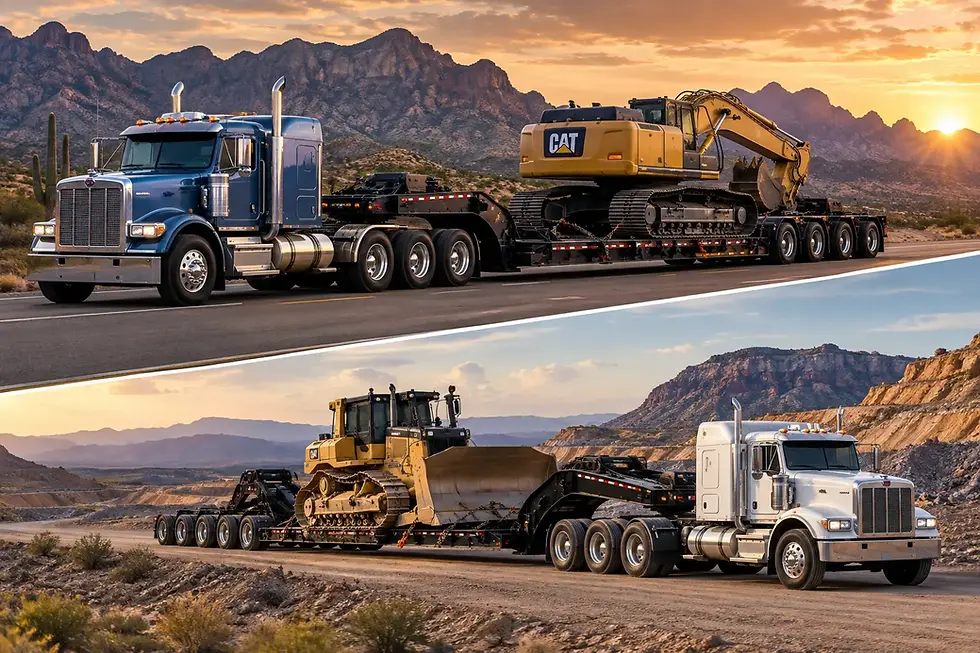
A lowboy is often the right answer for excavators, dozers, loaders, and mine support equipment because its lower deck helps manage transport height. But calling for a lowboy without knowing the machine's dimensions is not enough. Deck height, well length, neck style, trailer rating, axle spacing, and loading angle all affect the move.
A standard lowboy may be the efficient choice for a smaller dozer or excavator that stays within common permit dimensions. An RGN, or removable gooseneck trailer, is often better for heavier tracked machines because the machine can be driven onto the trailer from the front rather than climbed over ramps. That reduces loading angle and is particularly useful for low-clearance machines, equipment with limited ramp ability, or jobs where site conditions make backing onto a trailer difficult.
For unusually heavy mining equipment, a multi-axle setup is not excess capacity. It is how the load is distributed to meet bridge and roadway requirements. A 9-axle combination may allow a hauler to legally spread weight that a lighter configuration cannot carry under the same conditions. More axles can mean a higher transport cost and additional planning, but it may be the only practical way to move the machine without disassembly or an unfavorable route.
There are trade-offs. Breaking down a large excavator by removing the counterweight, boom, or stick may reduce permit complexity and height, but it adds labor, coordination, lifting requirements, and reassembly time. On a tight shutdown schedule, hauling the machine assembled with the right axle configuration may be less disruptive than turning the move into a field disassembly project. The best option depends on the route, site access, available labor, and how quickly the machine must return to work.
Permits and Routes Cannot Be an Afterthought
Arizona mining regions often involve a combination of interstate travel, state routes, local roads, narrow access roads, mine-property rules, and public crossings. Interstate 10, Interstate 17, Interstate 40, US-93, and connecting routes around Phoenix, Kingman, Tucson, and Northern Arizona all have different practical considerations once a load becomes oversize or overweight.
A permit is not a blanket approval to travel any road at any time. It is route-specific and may include travel-hour restrictions, escort requirements, lighting requirements, curfews, or instructions tied to a particular bridge, interchange, or municipality. Permit dimensions are one part of the decision. The carrier also has to verify whether the actual route works for the truck and trailer combination.
That means checking turning radiuses at mine entrances, grades on access roads, soft shoulders, overhead utilities, construction zones, lane closures, and room to position the trailer at both ends. A route that looks fine on a map can fail at the final half-mile if a loaded multi-axle trailer cannot make the gate turn or if the unload area has no stable, level space.
Customers sometimes assume the shortest route is automatically the best route. It often is not. A slightly longer route with better interchange geometry, fewer low-clearance conflicts, and safer pull-off options can be the more reliable choice. On an active mine schedule, predictability is worth more than saving a few highway miles.
Mine-Site Logistics Decide Whether the Move Stays on Schedule
Most highway planning is wasted if the mine site is not ready. Heavy haul crews need a confirmed loading area, a competent site contact, clear travel instructions, and enough room to stage the truck and trailer. Mine traffic, shift changes, blasting windows, water trucks, haul trucks, and restricted zones can all affect when a transport crew can enter and load.
The loading surface needs attention as well. A lowboy or RGN carrying a heavy tracked machine needs stable ground under the trailer and ramps. Loose material, steep cross-slope, and uneven pads can create a loading problem even when the machine itself is fully operational. Where possible, the load and unload point should be chosen for level approach, firm ground, and enough clearance to turn out after the machine is secured.
Equipment preparation should be completed before the truck arrives. Loose items need to be secured or removed. Buckets, booms, blades, and ripper positions should be agreed on in advance. Fuel levels may need consideration for weight-sensitive moves. Operators should be available when the machine must be driven on or off, and the site should provide any required escort or safety orientation without treating arrival time as the start of planning.
Communication matters most when conditions change. If the machine becomes inoperable, the mine changes the load location, or site access is delayed, the hauler needs to know immediately. A direct, asset-based carrier such as Flat Out Services can make faster equipment and routing decisions than a chain of brokers trying to relay field information between multiple parties.
Build the Schedule Around Risk, Not Best-Case Timing
Copper mine moves are frequently tied to maintenance outages, replacement schedules, rental returns, or a contractor's mobilization date. That creates pressure to book transport at the last minute. The problem is that oversize permits, escort availability, specialized trailer positioning, and route conditions do not always cooperate with a same-day request.
A practical schedule allows time for dimensions to be confirmed, permits to be issued, the correct trailer to be assigned, and the route to be reviewed. It also accounts for the possibility that a machine is not ready at the promised time. Dispatching a heavy haul truck too early can be costly, but dispatching it with incomplete information is usually worse.
For repeat mine-to-yard or mine-to-project moves, it pays to document the successful setup. Record the machine configuration, trailer used, loading location, gate instructions, route, escort needs, and unloading method. The next move can then be planned from field-tested information rather than assumptions.
The goal is not to make Arizona copper mine equipment hauling look routine. The goal is to make the routine parts predictable, so the unusual problems can be handled before they become downtime.


Comments